Amplitude

“Les Sylphides”, “Le Corsaire” Duo, “Bolero”,
“The Prodigal Son”
The Washington Ballet’s Russian Masters Program
Eisenhower Theater
The John F. Kennedy Center for the Performing Arts
Washington, DC
October 8, 2017 at 8 PM
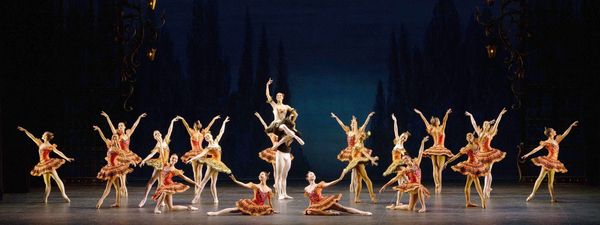
This so-called Russian view of humankind was amazing. All the bodies on stage belonged to what seemed real people and even imaginary beings pulsed with red blood in their veins, yet – as in life - individual temperaments differed distinctly. According to the program’s credited choreographers - Michel Fokine, Marius Petipa and Joseph Mazilier, Alexei Ratmansky and George Balanchine – our world is full of adventure, and surprise awaits those who open their eyes. When “Les Sylphides” was announced as representing Fokine for this program, my reaction was, “What, again?”. Although this Russian, who migrated to Western Europe and then to the USA, made many fine works during his lifetime (1880 –1942), current company directors seem intent on reducing him to being a “one ballet” choreographer. However, when the curtain went up on the 20 dancers in a dispersed cluster in front of Gothic ruins, and movement began to propel bodies sumptuously into new groupings and into still other formations at a pace that kept shifting subtlely, I was happy to see ”Les Sylphides” once more. All but one of the cast’s 20 are women – sylphs, or spirits that ride the air currents. Fokine gives three of them a mood of her own. The waltz girl (Nicole Graniero), the mazurka dancer (Euwon Lee) and the prelude soloist each straddles the gusts of air (Chopin’s music, orchestrated by Benjamin Britten) with a distinct sense of timing. For the corps of sylphs there are changes of pace that, in this staging by Susan Jones, occur smoothly, almost voluptuously. The flow of arms against the precision of the footwork creates a constant, subtle counterpoint. Another persistent contrast is that of the sylphs in their gauzy white skirts bending and stretching against the painted arches of the backdrop (set design by another Russian, Alexandre Benois). There’s just one man on stage, a predicament sort of role - that of a poet who witnesses the dancing of the sylphs and prominently partners one of them (Lee). Gian CarloPerez’s poet did as he was bid with the sylphs - his interactions were exemplary, but in his solo passages he seemed a bit pushy.
The dance duets called “Le Corsaire” today can be displays of technical show-off, of erotic attraction, of commanding classical style and, on rare occasions, something of all three approaches. Likely there’s little left that Joseph Mazilier (1801-1868), choreographer of the long 1856 ballet, would recognize and just a tad more that might seem familiar to Marius Petipa (1818-1910), who revised the piece in 1899 and added Riccardo Drigo music for the big display number. Mazilier and Petipa were both French but worked in Russia, even though Mazilier was there just briefly (1851-2 in St. Petersburg) whereas Petipa settled in the czarist capital. At the Sunday evening performance for The Washington Ballet, Brooklyn Mack did the male Corsaire role with dash. He could have come from a pirate ship, as called for in the Lord Byron verse tale that Mazilier had used as the ballet’s dramatic base. Not only did Mack accomplish spectacular leg work in the solo varitions, but he used his upper body with a powerful pliancy. Launching himself into formidable maneuvers, Mack’s face seems to be visualizing what his body is about to do. When he’s done, there is the briefest sense of “That’s it. What next?”.
If only his ballerina’s behavior had been as tell tale. Ayano Kimura’s technique is secure. There are moments when she commands her body, as in balances that are to be held absolutely still. But there is no excitement. When turning well, she merely smiles. Does she look at Mack significantly? He does at her. Kimura ought to be coached to project beyond the footlights. The pas de deux’s stagers were the company’s artistic director Julie Kent and acting executive director Victor Barbee.
The music for “Bolero”, by Maurice Ravel, repeats a pair of winsomely insistent melodic phrases ever louder, building them into a crashing crescendo. The first choreographer to tackle the score was Bronislava Nijinska (1891 – 1972), who was Polish Russian. Nijinska conceived her 1928 version as Spanish character dance – stamping, tapping and, thematically, based on the sex drive and death wish. The Washington Ballet opted for a somewhat more balletic, vaguely sportive, 2001 version by an ex-Russian - Alexei Ratmansky (born 1968). Used are six dancers whom the choreographer numbers like team members. Three are white clad females (#s 1,2,4) and the others are black clad males (#s 3,5,6). Busy passages and ones not busy alternate. So do standing straight, bent and lying down positions. There is some stretching and some lifting. Groups with different numbers and genders succeed each other, as do a few solos. The “last” dancer, #6 (Andile Ndlovu), seems particularly intense yet all six people – and people they seem indeed – appear to have come together to game play, to exercise and for companionship. The piece was staged for Washington by Tatiana Ratmansky. The ending, though, to Ravel’s crescendo, doesn’t climax. In retrospect, what remains of this reading of the Ravel composition is busyness with brief rest stops and life as gimmickry.
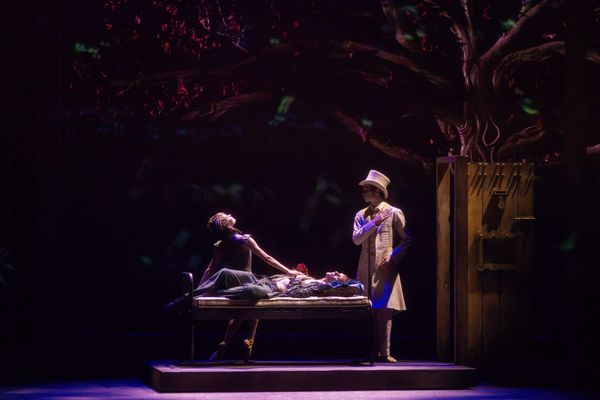
There’s trickery, lots of it, in “Prodigal Son” as George Balanchine (1904 –1983) visualized Boris Kochno’s recounting of the Biblical story to Sergei Prokofiev’s music. The illusions click, refreshingly as an item of scenery transforms (a fence turns into a gambling table, a love bed, a martyr’s pillar, a ship that sails away and again a fence). Clasps, as intricate as any embrace from India, resolve balletically. Acrobatics and mime combine expressively. How different is this 1929 piece of Ausdruckststanz from Balanchine’s earlier, sportively Olympian “Apollo”, and yet both ballets attain poignancy economically. Richard Tanner staged “Prodigal Son” for The Washington Ballet. By accident, I saw two casts. Sunday evening, October 8, the story unfolded like a flower. Jonathan Jordan, in the title role, built his wayward son gradually from the inside out. Kateryna Derechyna ‘s Siren uncoiled sensually. Saturday afternoon (October 7), Andile Ndlovu danced the Prodigal sharply and acted the part ferociously, but not always simultaneously. Sona Kharatian’s Siren needed more flow. Not in this staging nor in any other I know, have Georges Rouault’s designs for the painted drops been reproduced optimally.
The four “Russian” works gave The Washington Ballet welcome opportunities to dance, to act and to exhibit style.
copyright © 2017 by George Jackson