American Stories
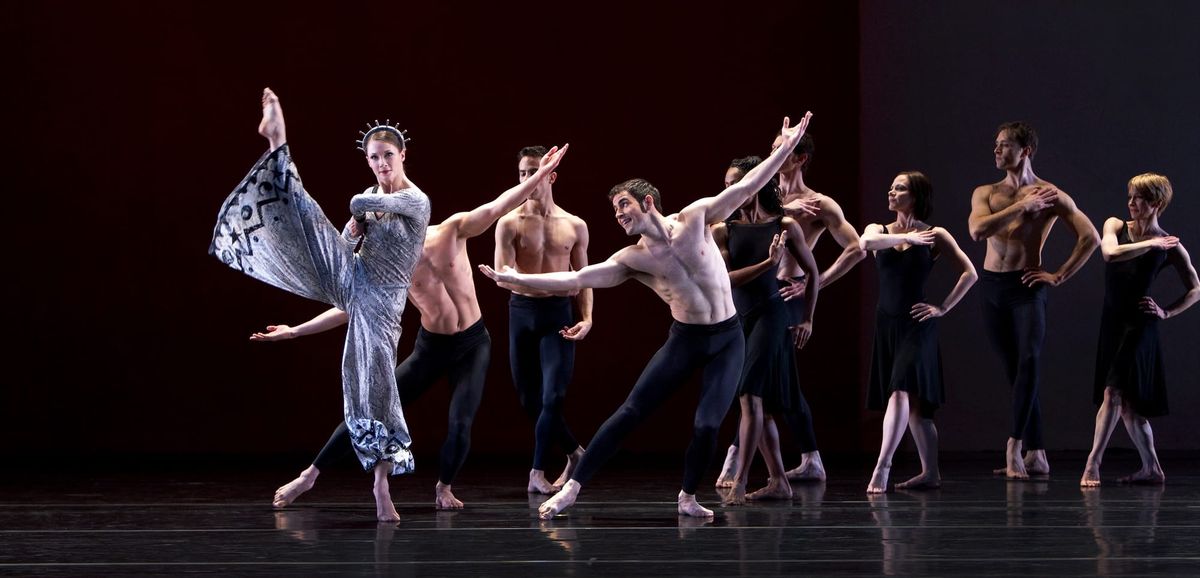
"Danbury Mix", "Ports of Call", "Black Tuesday"
Paul Taylor American Modern Dance
David H. Koch Theater
Lincoln Center
New York, New York
March 18, 2017, evening
Paul Taylor's takes on heroic and absurd America were on view Saturday night, as each work dealt with aspects of American life. "Danbury Mix", choreographed in 1988 for the New York City Ballet's American Music Festival, combines (or mixes) three excerpts from pieces by Charles Ives (of Danbury, Connecticut, the program explains). The sardonic view of America, with an alternatively seductive and manic Miss Liberty, variously sheltering groups of black-clad dancers, enticing them to march mindlessly, and finally laughing at their efforts, may be a wry comment on Balanchine's bright, strutting "Stars and Stripes". Taylor's piece even ends, like Balanchine's, with the American flag, though instead of a triumphant red, white, and blue dominating the stage, Taylor has a miniature group of black and white flags ranged in the background.
Though the dancers often moved with their hands behind their backs or in erratic, robotic groupings, Taylor does allow an occasional individual to break free, if only for a moment, and even if the struggle is fruitless, there is a certain heroism in the attempt. Laura Halzack was a particularly voluptuous Miss Liberty, much less angular than Karla Wolfangle, the first one to wear the crown, and the contrast between Halzack's mindless, high-strutting prance and her frantic little gestures and contortions was a remarkable contrast, as if she were veering between illusion and reality.
Illusion seems to be one aspect of Taylor's "Ports of Call", new this year. It is set to musical portraits by Jacques Ibert, meant to evoke Italy, Tunisia, and Spain. Taylor ignored the musical cues and visited Africa, Hawaii, and Alaska, with another Ibert work for a trip to the Midwest. This meant that the Eskimos had to dance to castanets, but perhaps, given the somewhat strained whimsy of the piece, this may have been part of the joke.
Africa was the most cohesive section, as Michelle Fleet and James Samson enjoyed a stylized courtship against a green, leafy backdrop. Other men invited their paradise and two groups had a slow motion fight which left Samson lifeless. Fleet had a powerful little dance combining anger and sorrow. Unfortunately, the other locations had no real emotional content.
Hawaii, set against a travel poster sky, looked like a sketch, as a group of grass-skirted women hulaed seductively, to be replaced by bright-shirted men who stomped vigorously. The end. It may have been a send-up of tropical musicals, but even the most mindless of these usually had a lead couple telling some sort of a story.
Alaska looked even more sketchy, as a group of girls shivered next to a painted igloo, joined by two men in big earmuffs who rubbed noses. Two polar bears joined them and horsed around. The Midwest section, too has an air of cliches gone wrong, as the vignette focused on a hillbilly wedding (the bride was literally barefoot and pregnant) and her father, who eyed the bridesmaids, wore overalls, a tattered straw hat, and loved chewing tobacco. The dancers certainly gave it their best, dancing with clarity, spirit, and grace, but the work isn't pointed enough to be satire or bright enough to be funny.
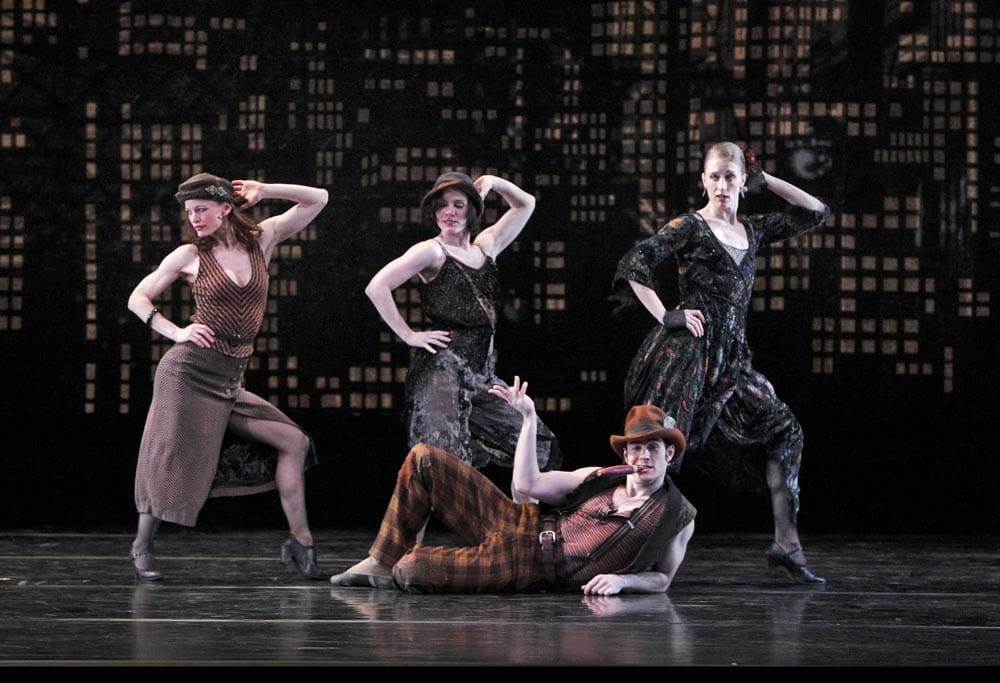
"Black Tuesday", though it has its comic moments, is a dark but sympathetic look at the America of the Depression, with breadlines, unemployment, and despair, partially hidden under a veneer of Tin Pal Alley optimism. Taylor choreographed it in 2001 and like his "Company B" used recordings of contemporary songs to set the mood -- at the time live music was too expensive for the company and the scratchy, tinny sound of the recordings was a brilliant work around.
The dancers were uniformly terrific, fluid, musical, and strong. Jamie Rae Walker in "I Went Hunting" was lighter and less triumphant than Lisa Viola, the original hunter, but her interpretation had a powerful tinge of desperation, as if she were a child sent out to do a grownup's job. Heather McGinley wandered through the "Boulevard of Broken Dreams" with a fierceness which made her humiliation by the gang of men even more disturbing. But Taylor doesn't make those men into cardboard villains -- "this is what poverty and despair can do", he seems to say. And Michael Trusnovec as the decent World War I veteran trying to survive seems to sum up all that is best about America's common man.
Copyright © 2017 by Mary Cargill



