Alone Together
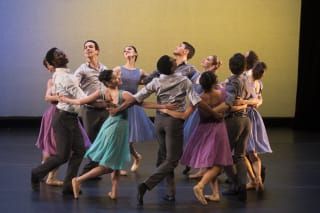
"Menagerie", "Myriad", "The Outset"
The Washington Ballet
Harman Hall
Washington, DC
March 18, 2018 at 1:30 PM
The surprise of this ambitious bill of three brand new ballets was the similarity of the dramatic theme which tantalized the 3 different, rather new choreographers. Clifton Brown, Gemma Bond and Marcelo Gomes addressed the relationship of the individual to that person's group. I suspect the similarity wasn't due to collusion but astonished the dance makers and also Julie Kent, director of The Washington Ballet, who had commissioned the premieres. Music for two of the ballets - Brown's and Gomes's - was, commendably, performed live. Brown's treatment of the group and its constituents was lighthearted and casual, Bond's seemed anxious and earnest, and Gomes's minutely detailed.
Brown’s title "Menagerie" suggests animals, and the pair of men who open this piece and who appear in it often, do sometimes trot about like donkeys. I probably missed other allusions to critters, but the cast's four women and six men have fun disporting themselves to Rossini music for cello (Suzanne Orban) and double bass (Marta Bradley). Brown manages balletic movement with musical competence and has a facility for quirky action. Towards the end of the piece, the dancing needs more of a difference.
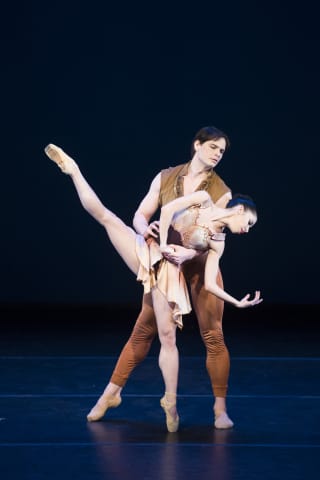
Gomes names every one of the dozen characters in “The Outset”, even though some of them function as corps de ballet. The story’s most complete personalities are Martin (Tamas Krizsa) and Penny (Eunwon Lee). They are a romantic pair. He, though, wants to leave the group for unexplored horizons whereas she wants him to stay. The telling of their disagreement takes time, too much so, and has an abrupt ending. Yet the overall course of the piece is an improvement over Gomes's previous ballets. Krizsa, late in his career, gets a role that calls for drama and bravura. Lee has impressive line but not an expressive face. The music, one of Dvorak's "American" string quartets (#12 in F Major, played by violinists Sally Mclain and Mayumi Pawel, violist Jennifer Ries and cellist Suzanne Orban) meets the story's requirements sometimes.
The precise plot being shown in “Myriad” by Bond and her dramaturge Jeremy E. Steinke puzzled me. There were six women and just one man. The women differed somewhat from each other but seemed related to Fokine’s sylphs and Balanchine’s serenaded sisterhood. Some were dressed in gauzy blue and some in gauzy lilac. The man wore a white tunic cut like a wanderer’s -- as if he were Odysseus but not Apollo. This costuming (designed by Bond) likely has a narrative function as does the horizontal paneling across the back of stage which is changeable: sometimes light zones dominate and sometimes dark. The man (Brooklyn Mack), though he dances with some of the women, is at the peak of his virtuosity when he is by himself. He also ends alone, sitting on the ground and hugging his knees. The women’s sextet seems to persist. Bond shaped balletic combinations and continuity adroitly to Henry Purcell songs and sonata selections.
Most new ballets last a couple of seasons and then vanish forever. My guess is that “Menagerie” would be the easiest of these three premieres to fit into a classical company’s repertory. Its choreographer, Clifton Brown, comes from more of a modern dance background (Alvin Ailey) but has worked some with dances for opera productions. Plans that Julie Kent has for April may be even more ambitious than three premieres: The Washington Ballet will be stagings three hits from the past. Revivals are more difficult to bring off than novelties.
copyright © 2018 by George Jackson



