A Trio — Well Chosen, Well Performed
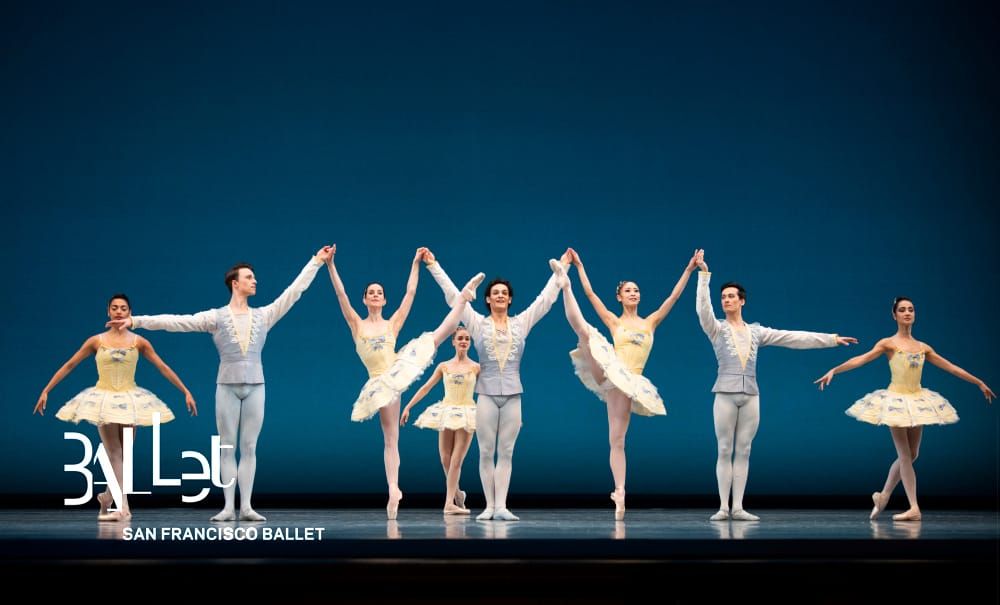
"Divertimento No 15" "Appassionata" "Hurry Up, We're Dreaming"
San Francisco Ballet
War Memorial Opera House
San Francisco, CA
February 12, 2019
Superb, intriguing, inviting is a good as tag I can come up with for San Francisco Ballet’s second 2019 Season program. Attending with a friend who grew up on New York City Ballet in its seventies, it was amusing to see at how stunned he was with the quality of the SFB dancers. The program, indeed, was very much worth beating the rain to the Opera House. Opening with the best of all, Balanchine’s “Divertimento No 15”, it was followed by the local premiere of Benjamin Millepied’s oddly chosen “Appassionata” to a fine dramatic performance by Mungunchimeg Buriad. The evening closed with a crowd pleaser from last spring’s Unbound Festival, “Hurry Up We’re Dreaming” by no-longer newcomer Justin Peck.
“Divertimento’s” choreography reflects the playful ease of Mozart’s score even though it’s about as geometrically strict and tight a design that Balanchine has ever worked with. The speed and precision in dancing in which everything is exposed — the short stiff tutus made sure of that — is technically fierce, yet the dancers looked playful and at ease. It makes so much sense that they periodically courtesy to each other. Moving them in myriad patterns Balanchine plays with uneven numbers that, of course, ultimately even out; five women, three men and an ensemble of eight. Yet each one makes sense as they enfold out of each other. That spatial design is nothing but brilliant. The women’s staccato point work sounds like affirmations; unisons look as if preordained until, all of a sudden in one of them, women alternate a raised knee’s direction. Three pas de deux in sequence become meditations on this core element of classical ballet. The work is mathematically but never mechanical. The soloists seem inspired by each other; among them Sasha de Sola lovingly focused yet at home in the fiendish speed of her en place footwork; Mathilde Froustey was guided by her exquisite épaulement.
Millepied’s “Appassionata” for three couples (De Sola/Benjamin Freemantle, Dores André/ Ulrik Birkkjaer, Elizabeth Powell/Jamie Garcia Castilla) did not convince me that Beethoven can or should be choreographed. I sensed a misalliance between the music’s huge range and drama and the rather modest concept about the three couples. Walking in individually through three huge portals, they pair up according their color-coordinated costumes —blue, red and purple— and engage each other in politely exploratory fashion but remain somewhat disengaged. They return in the second movement, in airier costumes, the women with open hair, having discarded their point shoes for slippers.
These pas deux are much more personalized. The exquisitely evanescent one for André/Birkkjaer impressed with its fragility, always on the verge of dissolving with André pursuing a yielding but also sometimes bemused Birkkjaer. This one ended in a kiss, a real kiss. Powell, delicately articulate and Garcia Castilla, now a fully matured artist, connect contentiously with Powell exploding as if to assert herself. De Sola’s is warm and sunny, partnered with by Freemantle who seems to grow any time he steps on stage these days. For the finale every one disappeared individually, the way they had stepped first through those portals. Was “Appassionata” a statement about the fragility of relationships? Or the old canard that flowing hair rather than buns and slippers rather than point shoes individualize women?
Unless my memory fails me, the set for Peck’s “Hurry Up We’re Dreaming” received new lighting. It appeared, at least, less underground, less what I had thought of as a subway station platform. The work is more congenial, but exudes the same urban energy of people gathering in a casual pile or a circle that immediately unrolled into a serpentine or everyone ending flat on their back. The walking patterns, both chaotic and orderly-as if on walkway —still look very fresh. The mood was one of full-engagement, however, momentary it might be.
From this environment arose three distinct duets: Powell’s gentle loner in a short encounter with Luke Ingham, tentative yet probably memorable for both. An explosive sailing Gabriela Gonzales with Luke Ingham and Andre, the queen of lifts, jumps and speed walking, just barely tamed by Joseph Walsh.
copyright © 2019 by Rita Felciano



