A Strong, and Interesting, Ending to NYCB's Winter Season
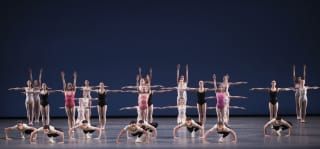
“Divertimento from ‘Le Baiser de la Fée,’” “Agon,” “Duo Concertant, “Symphony in three Movements”
New York City Ballet
David H. Koch Theater
New York
March 4, 2018
New York City Ballet’s final performance of the winter season consisted almost exclusively of Balan- chine/ Stravinsky ballets, often called “black-and-white” for their use of practice clothing for costumes. The one exception, while still a Balanchine/ Stravinsky work, was very different, but not simply because of its costuming. The “Divertimento from ‘Le Baiser de la Fée,’” seen with “Agon,”“Duo Concertant,” and “Symphony in three Movements” seemed to be from another planet.
“Le Baiser de la Fée” was commissioned by Ida Rubenstein and choreographed by Bronislava Nijinska in 1928. It disappeared from the repertory in the 1930s. Frederick Ashton created a version for the Sadler’s Wells Ballet in 1935 and Balanchine made another version for the American Ballet in 1937 (revived in 1950). When New York City Ballet’s Stravinsky Festival was being planned, Balanchine, feeling there were inherent problems with the story line of the full-length work, choreographed a one-act, plotless “Divertimento from ‘Le Baiser de la Fée,’” adding a final duet and a new ending in 1974.The Balanchine work centers on a couple, accompanied by a ten-member corps of women. Everyone is dressed in costumes that suggest a ballet version of nineteenth century peasant attire, the women in short dirndl skirts, the man in a white shirt and vest. The ballet starts off happily enough with the corps welcoming the couple, who then dance a duet and solos. As it appeared during the Stravinsky Festival, the ballet ended on a celebratory note. But once Balanchine added a second duet and a new ending, the ballet was cast in a far more mysterious light. Now, instead of the happy ending, the couple dance a second, strange duet in which she clings to the man, as he seems to retreat. At the end they are pulled apart by invisible forces, abetted by the corps, and exit at opposite sides of the stage, walking backward in deep backbends as they reach towards each other. We sense something terrible has happened to these young lovers, but we have no idea what it is.
In fact, the ballet contains ominous signs from the beginning. The opening music has discordant undertones that reappear through the work. Then there is the male solo, which is highly unusual. Filled with sharp changes of direction, its mood is conflicted and tense. The solo gradually intensifies as the steps, which begin simply, morph into a dizzying array of turns and jumps. At several moments, the dancer throws his head back, as if in pain, at others he crouches toward the floor. This dance contrasts markedly with the mood of the ballerina’s solo, which is bright and sprightly, and of the first duet, which is affectionate and light-hearted.
Balanchine did not refer to the original plot of “Le Baiser de la Fée” in his 1972 ballet, but it is clear he had it in mind, at least by the time he added the new material. In the full-length ballet, the hero receives a fatal kiss at birth from the Ice Maiden or fairy, which impels him to dedicate his life to art, giving up all earthly love. The girl in Balanchine’s ballet is the hero’s fiancée, who will be torn from him by the fairy’s command. The ballet makes far more sense when the story is known, but it could also be argued that it loses its sense of ambiguity and possibility. No longer does the audience have the chance to provide its own narrative, or to simply wonder at the man’s strange solo and the couple’s chilling parting.
Tiler Peck and Anthony Huxley in the roles of the lovers, could hardly have been better. Peck has danced the ballet a number of times and gave the first duet and her solo a sunny innocence. Her dancing was light, precise, and, as always, musically sensitive. As the mood changed, she was at first uncomprehending then increasingly desperate, as her lover seemed to fade before her eyes. Huxley was making his first appearances as the young man on Saturday and Sunday. He is the most refined male dancer at NYCB. For years he was given primarily solo roles, which called for that refinement, with little drama. Then he showed himself an excellent actor in Peter Martins’ “La Sylphide;” he was given a promotion to principal, and now we are seeing him in far more varied roles. He imbued the hero with exactly the sense of building conflict it demanded, without ever exaggerating the emotion. It was a subtle and moving performance.
The other ballets on the program also had new casting in important roles. “Agon” featured Teresa Reichlen and, for the first time, Chase Finlay. The two are well matched, both tall and fair haired. In the central duet Reichlen, with her long legs and cool manner, commanded attention. Finlay, though, is a seasoned principal dancer and he held his own alongside her, looking strong and elegant. Another interesting newcomer to the ballet was corps member Peter Walker, who danced the lead in the first pas de trois. He looked as if he was savoring every minute of the ballet’s athleticism, and he performed the sarabande solo, with its little bows to the baroque court, with panache.
Megan Fairchild and Russell Janzen aren’t new to “Duo Concertant.” Fairchild has danced it many times and has made it her own. She is playful, yet romantic, and in the final moments of the ballet, when the dancer is isolated in a spotlight and a sense of loss is felt, she was quietly eloquent. Janzen, who was so affecting a few weeks ago as Paris in Peter Martins’ “Romeo + Juliet,” here seemed less confident, even slightly awkward. He wasn’t helped by the 1950s practice costume of black tights and white t-shirt, which made him look thinner and less substantial than he is.
The evening ended with the monumental “Symphony in Three Movements,” with its cast of sixteen principals and soloists plus sixteen corps members. It drives forward like a gigantic machine whirling along at high speed. The three central couples were led by Sterling Hyltin and Adrian Danchig-Waring. Danchig-Waring was new to the role, but danced it as if he had been doing it for years. He and Hyltin were high-powered and bracing in their duet. Lauren King and Troy Schumacher as one of the other principal couples were also new, and like the cast as a whole, danced as if charged with electricity. Savannah Lowery and Sean Suozzi were the third couple. Lowery is among the company’s most joyous dancers, and this high octane work served her particularly well. Altogether, the ballet was a fitting end to the performance, concluding the season on a high note.
copyright © 2018 by Gay Morris



