A Robbins Repertory
"Glass Pieces", "Fancy Free", "The Four Seasons"
New York City Ballet
Opera House
The John F. Kennedy Center for the Performing Arts
Washington, DC
March 30, 2018
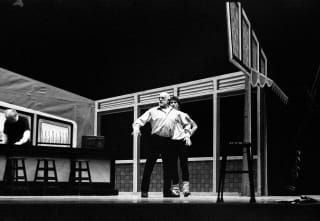
Jerome Robbins' classic "Fancy Free" is a character ballet. The three women in it wear heels, not toe shoes. Do any of its men snap into 5th position other than for comic effect? Yet this early (1944) work by the choreographer snares the audience's attention and satisfies expectations from beginning to middle through to the end. The program’s opening work, "Glass Pieces" (1983), can astonish and its closer, "The Four Seasons" (1979), does much to entertain. Yet neither of these later, clever pieces by Robbins (1918-1998) leaves viewers with the feeling of perfection - that every step and stance is critical, even a character's most casual response or suppressed itch for show-off.
The story of "Fancy Free" is about three sailors on shore leave in New York during World War 2. Of course, we are also told about the gals they encounter. Not to be forgotten is a bartender who isn't given much action but has a definite law-and-order presence. Three dancers rather new to the Washington audience were cast as the sailors: Roman Mejia as the straightforward, upright, military guy; Harrison Coll as the one with a touch of being a dreamer, a poet perhaps; and Sebastian Villarini-Velez as the savvy sailor, a bit boastful and with a Latin swagger. The gals are also distinct: Mary Elizabeth Sell is the tough one with the big red purse; Sterling Hyltin (this cast's only principal dancer) as the friendly, pliant passer-by who is most given to dancing; and Miriam Miller as the fleeting vision of femininity.
Body language and dance habits of the 1940s, when "Fancy Free" was made, differed from today's. Bravura and show-off were less emphatic, they were laid-back more than they tend to be now. This cast's women caught that difference with a consistency the men didn't quite match. The bartender, Giovanni Villalobos, wasn't always lit brightly enough when his stability was needed. Still, Robbins' and composer Leonard Bernstein's plot and people had impact, from start to stop!
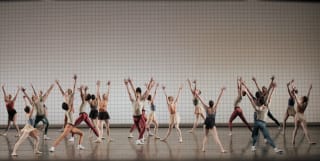
In “Glass Pieces”, Robbins addresses a question. Can the restless- ness, repetition, rhythmic urge and restrictiveness of so-called minimalist music be fitted out, at all, with ballet bodies and classical Western dance technique? The answers I think Robbins gave are: “somewhat”, “enough so” and “why not try?”. There are three parts to this piece of choreography to Philip Glass compositions. In the first, the section named "Rubric" after the music, many dancers walk - step very emphatically and do so rather fast - across the stage and keep walking. They stride. They are clad casually, sportively, colorfully. A few of them (half a dozen who are dressed more balletically, in velvety tights and tops) begin to jump amidst the striders and go on to do some other steps from the academic vocabulary. The backdrop to this semi-orderly, very urban, crowd scene is graph paper. I had the impression that the jumping dancers added the dimension of height to a flat scene. They were like air bubbles rising and spinning in a pan of water about to boil. Next, in the "Facades" section, a tall balletic couple (Maria Kowroski and Russell Janzen) dances adagio against an ever longer chain of the corps de ballet. Did the chain, which grew gradually, allude to famous 19th Century ballet formations such as The Shades in "La Bayadere"? In the concluding "Akhnaten", a corps of men and one of women were contrasted and combined in a marching manner meant to rouse.
My favorite among "The Four Seasons" was "Fall". Ashley Bouder and Joaquin De Luz as the pas de deux pair, and Daniel Ulbricht as a teasing satyr gave Washington jolts of virtuosity unlikely to be matched in the near future. Sara Mearns and Tyler Angle's "Spring" had a welcome pliancy. Ashley Larcey and Taylor Stanley raised the temperature for "Summer" suitably, and the trio of Devin Alberda, Harrison Cole and Indina Woodward huffed, puffed and shivered amusingly as "Winter". Robbins had assembled ballet music by opera composer Giuiseppi Verdi for this droll divertissement.
Andrews Sill conducted the Kennedy Center’s Opera House Orchestra on this occasion. Robbins made many sorts of works, and quite a few of them will be staged by NYC Ballet during its home seasons in this centennial year of the choreographer’s birth. I’d like to go and see the entire collection, even if it is “Fancy Free” that satisfies me the most.
copyright © 2018 by George Jackson



