A Hundred and Still Alive
"Opus 19/The Dreamer" "The Cage" "Other Dances" "Fancy Free"
San Francisco Ballet
March 2, 2018
Program V
War Memorial Opera House
San Francisco, CA
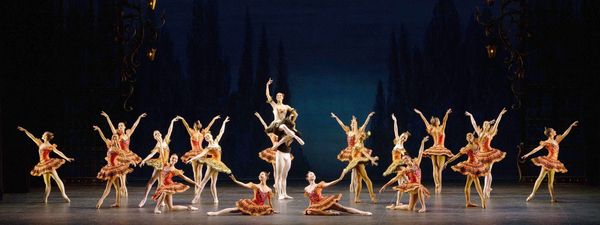
A full evening of one-choreographer works is a rarity, eagerly to be anticipated. At SFB it took the one choreographer’s centennial and an artistic director’s thank-you for having enabled him to get a spot on the list of the country’s great male dancers. The men, of course, are Jerome Robbins and Helgi Tomasson. So having a big dose of Robbins choreography was certainly going to be one of the current season’s highlights despite the upcoming "Unbound Festival” which will feature twelve world premieres in two programs. Though superbly danced and carefully balanced, the Robbins tribute left a pinch of dissatisfaction in at least in this viewer. Yet given the law of averages, two and a half of four successes is not negligible. But first the problematic one.
“The Cage” offered the biggest surprise. I remember the chill and even the horror of its first encounter. But not this time, though the performance was superb, and it did not deserve the snickers that it elicited from some in the audience. Yet there is more than a touch of melodrama in this stomping, high kicking horde of insects. Their ghoulish wigs didn’t help; these amazons, out for revenge, looked like denizens of a horror movie or a very bad Broadway show. Their choreography was too monochromatic; it had power but lacked the sense of inevitability that the wilis had.
Yuan Yuan Tan’s Novice, however, took your breath away. At first knee knocked and wobbly, she pretty quickly used those super-elongated limbs to splendid effect. The staccato quality from the first self-examination to that last bow to her queen (Jennifer Stahl) suggested growth and resignation. The love duet, with its mirror images and hand-to-hand connections, had an appealing erotic crescendo. For a moment Tan and Luke Ingham looked like young lovers out of other Robbins’ ballets. Still, when the moment of Ingham’s demise came, I almost expected his head to roll into a platter to be presented to King Herod in a DeMille extravaganza.
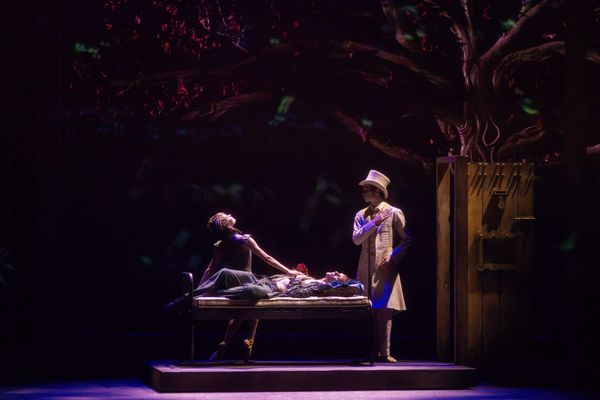
“Opus 19/The Dreamer” with Angelo Greco and Sophia Scheller making debuts in their roles, is a soft, romantic evocation of the ineffable. It echoes what you might find in German Romantic lyrics in which the poet walks at night in the woods. Robbins gave this searcher moments of repose straight out of Manet.The ballet started with a startling image: six chorus members kneeling upstage in a tight formation. They looked like a piece of furniture, yet they dissolved in answer to Greco’s opening moves. Throughout, the ensemble, both men and women, suggested the shadowy, fleeting fragments of dreams, present but not real. It’s here, in the always-reforming formations with their skips, walks and stalks, that Robbins pulled out the full range of his ability to choreograph ensembles. Towards the end Greco became part of a raucous circle dance from which he escaped; the romantics would had said that he had, just barely, saved his soul. The varied ensemble choreography keeps this dream alive.
Greco is a handsome, long-limbed dancer though at times still a little too rough to be a prince; his appealing sense of drama stands him well in many of his roles. His opening solo here showed fine épaulement with arms reaching and swooping as they embraced the stage in a manège-like circuit. Scheller’s pristine technique – floating bourrées and whipping chainés, heal/toe/flat-footed steps in quick change — is impressive. Best because it never becomes self-serving.
SFB’s Robbins tribute featured two highpoints. “Other Dances,” performed by guest artist Joaquin De Luz and Maria Kotchekova, highlights Chopin’s Mazurkas (elegantly played by Natal’ya Feygina). The piece is a gem. Light-hearted but not frivolous, the dancers integrated Russian traditions – both in the steps and the comportment – as if they had always been part of each other. (Maybe there is a PhD thesis in this somewhere).
Kotchekova, who sometimes can appear a little blasé, here danced as fresh as any young dancer who has as found an ideal partner. She couldn’t get the smile from her face. While DeLuz’s elevation, his travelling steps, and triple cabrioles impressed – and were those pas chats sauté with a gargouillade thrown in for good measure? – his port de bras, with that soft elegant extension of his hand, almost made you weep for joy.
“Fancy Free” brought up the evening. It’s a first rate work, particularly by a young choreographer. The characterization of these sailors (Esteban Hernandez, Benjamin Freemantle and Lonnie Weeks) is highly individualized. The work's trajectory is tight, the music splendid. The whole thing is jazzy, and it’s balletic. The yes/no women, Sasha de Sola and Madison Keeler, did their parts as New York working girls. Is “Fancy Free” dated? Of course. So what?
copyright © 2018 by Rita Felciano