A Holiday Treasure Reinvented
“The Nutcracker”
Ballet West
Opera House
The John F. Kennedy Center for the Performing Arts
Washington, D.C.
December 6, 2018
Ballet West’s splendidly refurbished “Nutcracker” is as warm and welcoming as a cup of holiday spiced tea on a cold winter evening. This company's version of the holiday classic is no stranger to Washington audiences (having visited in 2012 and 2014), but this year’s production boasts a lofty $3 million overhaul that delightfully blends the old and the new: old-world charm framed with state-of-the-art sets, vintage choreography adorned with glimmering costumes, and a fairy-tale story complemented by imaginative special effects. Any worries that the lavish embellishments might overshadow the heart and soul of Ballet West’s production — Willam Christensen’s historic choreography from the first “Nutcracker” created in the United States in 1944 — are quickly put to rest by enchanting color palettes and tastefully jeweled costumes that envelop the dancing with elegance.
One might expect the revamp to bring the story to a more current time, but John Wayne Cook’s scenic designs and David Heuvel’s costumes do just the opposite, transporting Act I backwards in time, from Victorian era Germany to early 19th century — the era of E.T.A. Hoffman’s original German Christmas tale. Modern elements are introduced through Kevin Dreyer’s lighting and Mike Tutaj’s projection designs, such as the lighting tricks that illuminate an artfully painted scrim with vivid imagery during Tchaikovsky’s suspenseful overture, before the curtain rises to reveal Dr. Drosselmeyer fine-tuning the Nutcracker doll in his workshop. A picturesque vision of snowy, old-world Germany in the dusk of evening, together with carolers and an antique street vendor, aid in the vivid storytelling that’s the hallmark of Christensen’s first Act. On Thursday evening the young Mckenzie Hymes, an appealing Clara, and Corbin Holloway, a particularly animated Fritz, carried the party scene with convincing energy and technical aplomb surprising for their age. Sayaka Ohtaki’s mechanical ballerina doll showed her pristine footwork and balances while convincing us that her limbs were most certainly not human (Huevel’s creative costuming added to the illusion).
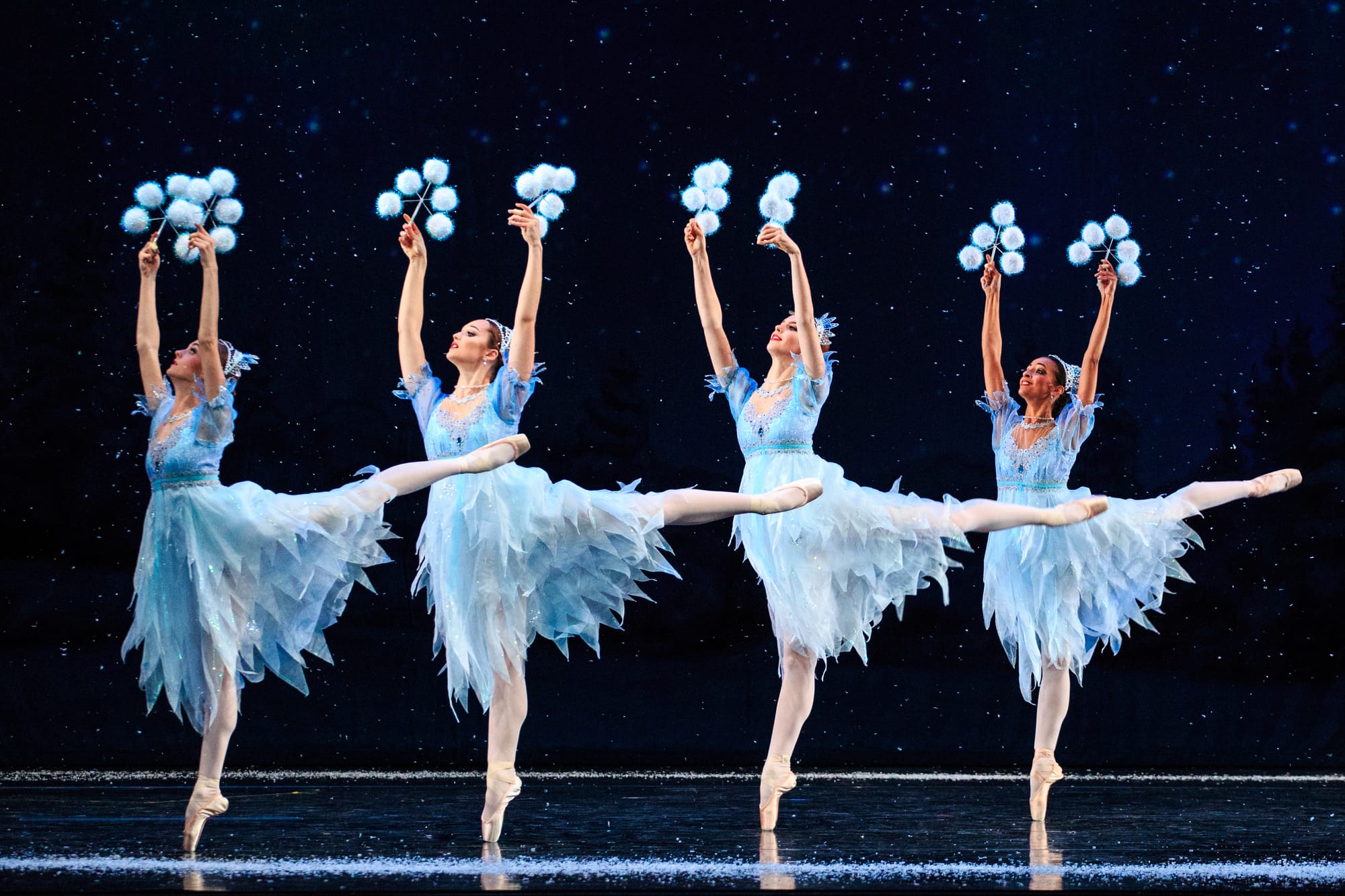
Christensen’s transformation scene (when the Christmas tree grows to reveal a larger-than-life Nutcracker doll) is one of the most exciting moments of this “Nutcracker,” with Cook’s sets and Dreyer’s and Tutaj’s special effects amplifying the magic. Beau Pearson’s commanding Dr. Drosselmeyer orchestrated the drama with expansive manipulation of his cape, illuminating the swells in Tchaikovsky’s score before the live Nutcracker was revealed in a startling burst of real flames. Lighting effects caused the Christmas tree to appear to grow so large and thick that it engulfed the entire stage, revealing a miniature battle scene beneath its branches. Toy soldiers clad in hues of blue and green marched in unison as a wind-up mouse darted across the stage. Tyler Gum’s Mouse King’s antics brought plenty of comic relief to the drama. Emily Adams and Adrian Fry as Snow Queen and her Cavalier rounded out Act I with a lovely, lyrical snow pas de deux (I only wished thick fog hadn’t hidden her feet from view), she displaying fine long lines and a sparkling presence, even if the partnering could have been more centered. The snowflake corps sailed through the somewhat linear patterns of the waltz with ease, draped in stunningly delicate tunics that shone with glittering crystals.
Cook’s ravishing scenic designs for Act II transport the land of the Sugar Plum Fairy to an extravagant, gold-adorned world resembling an Indonesian paradise, complete with palm trees, palaces, monkey servants, and a buffoon dressed as a beehive with baby bees dashing out from under her skirt (in homage to the Bee State, Ballet West’s home state of Utah). Clara dons a tutu and pointe shoes as the Sugar Plum Fairy (Beckanne Sisk) emerges with giant butterfly wings to reign over her kingdom with warmth and grace. The tasteful costuming and choreography for the divertissements show that it’s possible for these eclectic dances to read appropriately in the 21st century. Highlights on Thursday included Kaitlyn Addison’s sultry Arabian dance which made use of her strong technique and powerful stage presence, as well as Arolyn Williams’ precise footwork and inner glow as lead Mirliton. Christopher Sellars led the Russian men in a raucous showcase of their masculine athleticism, and Beau Pearson was a hilariously dramatic Mother Buffoon.
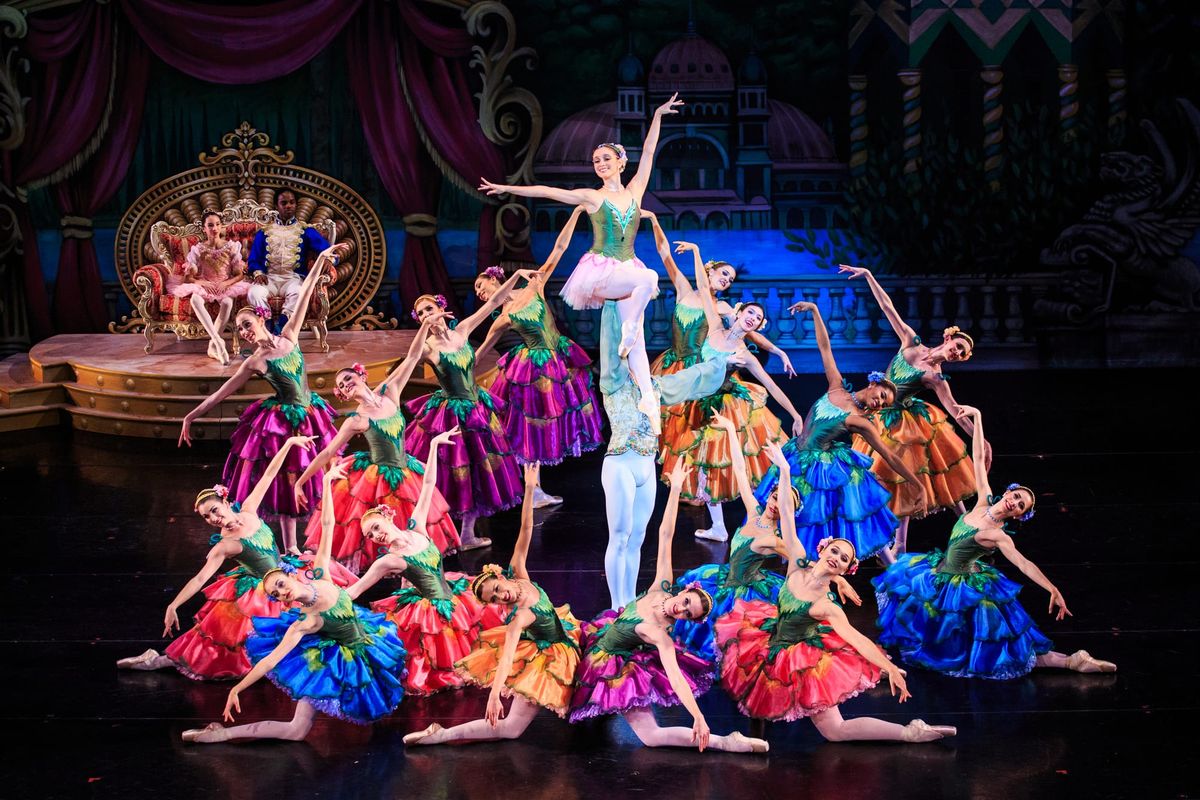
Huevel’s new costumes give Act II’s centerpiece — the Waltz of the Flowers — even more visual impact, with the dancers grouped in trios of different colored petals that move in and out of luscious formations. The corps danced cleanly and joyfully, led by Katherine Lawrence and Christopher Rudd who brought infectious charm to the waltz pas de deux as they moved through difficult lifts and turns with radiant assuredness. Lawrence danced with her usual serene composure that’s particularly appealing.
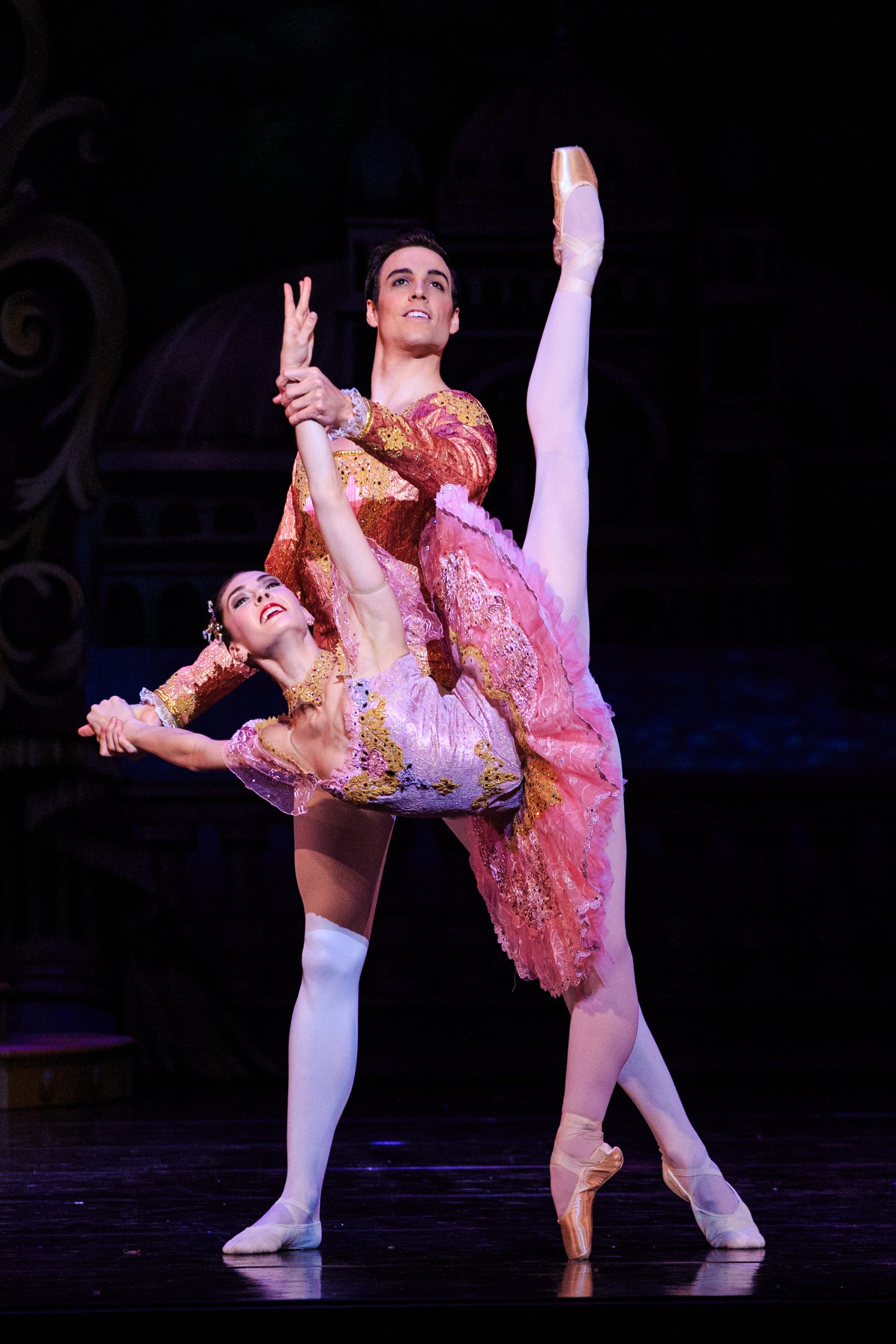
Beckanne Sisk and Chase O'Connell’s grand pas de deux was the cherry on top of an already delicious evening. The couple, who seems perfectly matched in physicality and demeanor, made the intricate high-flying lifts look effortless. Sisk’s all-natural classical line was at its best in the pas de deux, even if she looked a bit frenetic in her solo (one gets the sense she is still developing as an artist). O'Connell also benefits from an innate princely carriage and line, although he could use a bit more strength. After a glittering finale, the evening concluded on a high note when Clara and her Nutcracker Prince were whisked up into the heavens on a flying golden sleigh. The audience gasped in delight before rising to their feet with applause.
copyright © 2018 by Ashley McKean



