A Greek Trilogy Anew
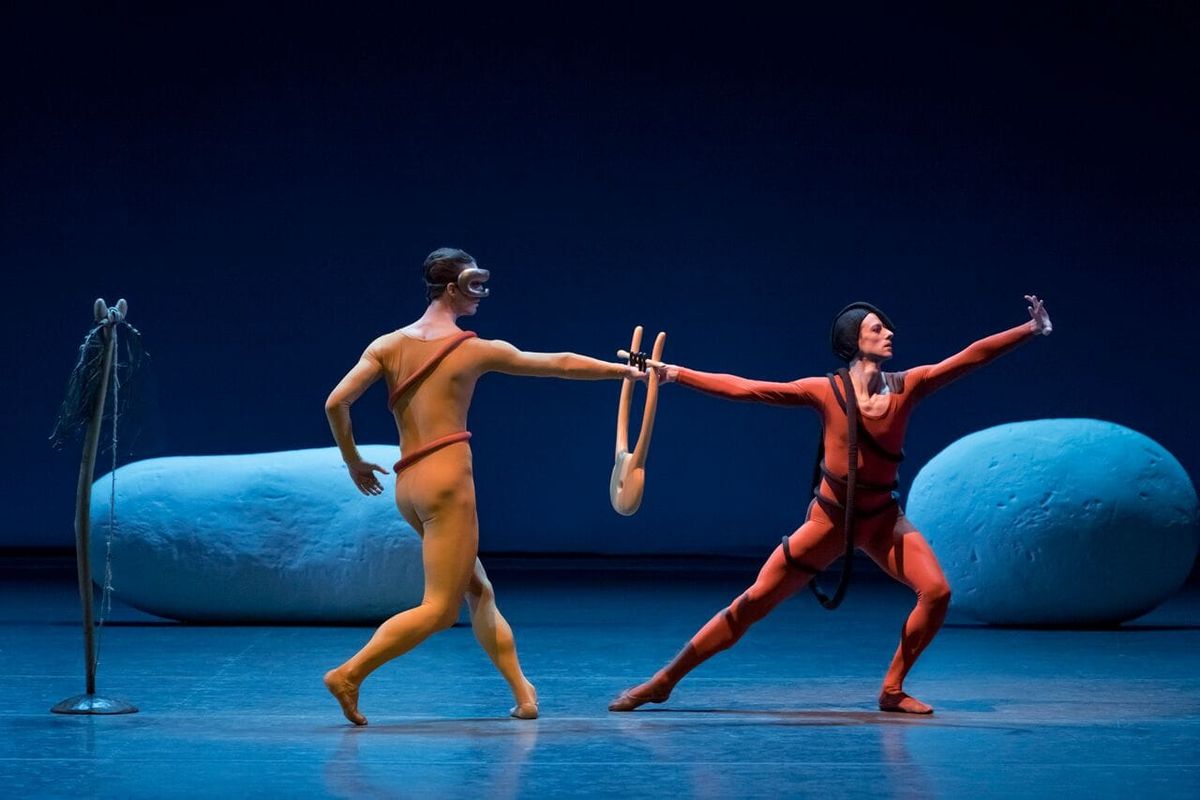
"Apollo", "Orpheus", "Agon"
New York City Ballet
David H. Koch Theater
Lincoln Center
New York, New York
January 26, 2019 evening
Apollo, in Balanchine's "Apollo" can be anyone from a "rascal"(the choreographer's exhortation to Edward Villella) to a breathtaking god, seemingly fully formed (Peter Martins, exchanging Valhalla for Mount Olympus as the ballet progressed), all valid. In his company debut, Gonzalo Garcia chose the middle ground and made it his own. The softness of his gestures, from the raised arm, partially unfurled as the curtain rose, rather than fully stretched, reflected the process of becoming in his world of velvet and moss, protected and privileged, with no sharp edges. This is an Apollo who has everything to learn (the explicit subject of the ballet) and nothing to prove.
Moderation, perhaps the reticence of rank, came through in this Apollo. While literally finding his feet, Garcia's upper body remained calm. When his arms reached out to test the space around him, his legs were less percussive. So, too, did nascent authority. All too often, Apollo hands the Muses their attributes with all the speed, interest and efficiency of a meter maid doling out parking tickets. Here, scroll, mask and lyre were delivered after Garcia's arm traced a wide arc, his eyes following it all the while. Time slowed to a crawl, giving everyone, Apollo, his muses, the audience, time to understand what was happening and its importance. Similarly, the call to Olympus took time to register on the music in three distinct phases, from hearing the summons, to identifying its source to understanding its meaning; as he did, we did. Plangent dancing spiced with theatrical instinct made the path from noble youth to divine maturity both easy to read and inevitable.
Garcia's muses were Sterling Hyltin as Terpsichore, Abi Stafford as Polyhymnia (a debut) and Lauren Lovette as Calliope. Hyltin's lightness, usually her calling card, undercut her authority here; if Terpsichore is the chosen one, we should see why. Her finest moment came during the pas de deux when, perched on Apollo's back (and neck), she taught Apollo to swim. This moment is often fraught for the audience as the dancers wobble. There was none of that here. Technical security begat serenity, and Hyltin really seemed to float, weightless, seemingly divorced from the ground.
Abi Stafford certainly has the technique for Polyhymnia's solo. Neither her turns nor the finger over her lips wavered. But everything seemed too small in scale for a muse entrusted with the education of a son of Zeus. As a performer, Lauren Lovette is both charming and endearing; her presence is a pleasure. But, like her sister muses, she lacked the force commensurate with her calling. It did not help that the orchestra seemed to slow down and lose steam at the end of Lovette's solo, leaving her without a musical floor to dance on.
Of the principals in "Orpheus" which followed, only Ask la Cour, the sole veteran in the cast, fully inhabited his character. But Orpheus alone cannot carry the ballet; everyone has to make it work or it won't. Teresa Reichlen, with her long limbs, is beautiful to look at and she wore the paleo, Cycladic, Martha Graham Greek costume rather than the costume wearing her. But she's too cool and aloof for the part. Orpheus wants Eurydice, but in Balanchine's telling, she wants him just as much. She contributes as much as he to their downfall. You wouldn't know it here. As the Dark Angel, Andrew Scordato was properly menacing on his entrance: it's hard not to be with a thick black rope bisecting the body on the vertical, and obstructing the face, leaving splayed hands the most visible body part. However, Scordato is thin and lithe, no physical match for la Cour's sculptural presence. The Leader of the Bacchantes, made on Tanaquil Le Clercq, is a "tall girl" role. But Claire Kretzschmar isn't a "tall girl", as her performance in the soloist role in "Rubies" has already proven. And she looked dumpy in Noguchi's costume; no female dancer at the New York City Ballet is dumpy.
"Agon" too had its share of debuts with Emilie Gerrity as the female soloist and Russell Janzen in the pas de deux. Gerrity has the chops for the solo. With time and more performances her own take on its wit and rhythms should come to the fore. Janzen and Miriam Miller were well paired in the pas de deux, moving with quiet certainty and on a large scale. Together these debuts will keep "Agon" in good health for years to come. Peter Walker, not so long ago a debutante himself, dances the man's solo as though it were in his DNA and has from the first. The beatnik 1950's hep slouching comes from within rather than being uncomfortably pasted on from without. Even more important, Walke'rs sense of the solo did not waver in its middle where the musical pulse is not as easily grasped. The through line held, the solo experienced as a whole rather than as three related but distinct parts. It's the kind of performance that keeps one coming back to see an evening full of debuts.
copyright © 2019 by Carol Pardo



