A Glimpse of the Future
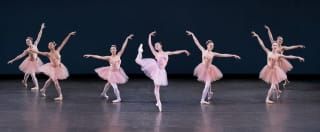
"La Source", "In Creases", "Circus Polka", "Western Symphony"
School of American Ballet
Peter Jay Sharp Theater
New York, NY
June 1, 2018 matinee
The afternoon began with a disconcerting jolt. The curtain rose on "La Source" revealing not the lead couple, but two members of the corps standing sentinel at the back corners of the stage. In deference to its student performers, "La Source" had been reconceived and recombined. Instead of two pas de deux interlarded with soloist and ensemble work, this version included the first of the duets, surrounded by the soloist and ensemble. The result was a coherent whole, but one which left anyone who knows the ballet wanting more.
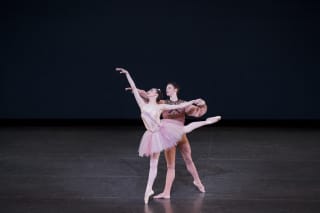
For all its sweetness and light, its Edwardian palette of pink and lavender, and its hummable Delibes score, alternately languorous and bouncy, "La Source" is a difficult and demanding ballet. It is an exploration of and homage to the French style in ballet, particularly in the women's roles (the original ballerina was Violette Verdy, the epitome of French style at the neoclassical New York City Ballet). But the ballet is also a showcase for a lead male dancer being groomed for great things (originally John Prinz) and a treatise on partnering as baptism by fire. The requisite speed, clarity, modesty and musicality of the Balanchine style were all in evidence. The wit and the scent of a subtle and insinuating French perfume were not. The ballet requires more experienced dancers to flower fully. Given the challenges of "La Source", it is not surprising that these young dancers looked most at ease in the ensembles and solos. Jules Mabie, lithe and sprightly still seems boyish, and happiest when airborne. In the soloist role, Naomi Corti was delicate and fleet but also commanding and closest to inhabiting the world of "La Source".
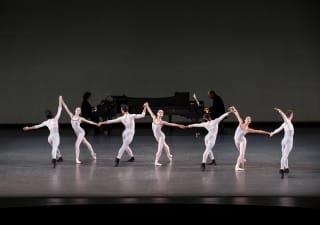
The dancers looked more at ease in Justin Peck's "In Creases", made by a young choreographer (age 24 when the ballet premiered in 2012) for eight of his peers. It is the first work Peck created for the New York City Ballet and the first to be performed at an SAB Workshop. The imagery is youthful: flowers blooming, receding and blooming anew. One dancer runs a little awkwardly through an obstacle course of this colleagues' outstretched legs--away from pursuit, toward a goal post? Shapes throughout "In Creases" are angular; limbs and lines taut. Peck's young people aren't cute and he's not sentimental about years gone by, though it is fascinated to watch this "In Creases" knowing what the choreographer has produced since.
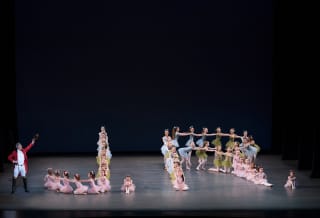
Jerome Robbins' "Circus Polka" is a pièce d'occasion with legs. Originally made for the 1972 Stravinsky Festival, it has reappeared over the years as the occasion demanded. Here, its presence honors Robbins' centennial year. It is also a gives forty-eight young girls (aged 9-13) stage experience and is a reminder of just how theatrically savvy Robbins was, all in four minutes. After all these years, the appearance of the first sixteen girls still elicits applause; the second recognition; and the third, the smallest group, the impulse to protect and a collective "Aw ...". How to top that? Form three concentric circles with the middle one turning in opposition to the others. With prancing steps and swaying pony tails, Robbins creates a merry-go-round come to life. Under the exacting but benign eye of ringmaster Arch Higgins, a faculty member at SAB, these student dancers ensured that "Circus Polka" will grace many occasions to come.
Balanchine's "Western Symphony," a perennial favorite at the Workshop, is a classical ballet hidden in a hoedown crashed by French cancan girls. It's a large scale work, colorful and fun, and sends the audience home smiling, particularly this one, full of parents and relations. And where else will you see Romantic Ballet, and ballet romance, sent up to the strains of "Red River Valley"? In the opening allegro, which can look like straightforward exposition, Lily Zerivitz and Davide Riccardo brought out the teasing flirtatiousness of the couple, giving it texture, intimacy and, in consequence, depth. In addition, Riccardo already knows how to use his gaze to show the audience what he sees. In the final rondo, KJ Takahashi, who can soar at any speed, the faster the better, did not just leave it at that but shaped the steps and made them musical. A final note for the corps of "Western Symphony". Their joy and energy are the envy of any company these dancers may hope to join in the future.
copyright © 2018 by Carol Pardo



