A Fine Night
"Valses Nobles et Sentimentales", "Tweedledum and Tweedledee", "The Walk to the Paradise Garden", "Friday's Child", "Sinfonietta/2nd Movement", "Façade"
The Sarasota Ballet
Joyce Theater
New York, NY
August 8, 2016
"A Knight of the British Ballet", the title of the Sarasota Ballet's week-long Joyce program, refers to Sir Frederick Ashton, Britain's great choreo- grapher. Iain Webb, Sarasota's director, had danced in a number of Ashton's works as a member of the Sadler's Wells Royal Ballet (now the Birmingham Royal Ballet) and when he came to Sarasota in 2007, he felt that Ashton's elegant, musical, and deceptively difficult works could challenge the company, and he has added them gradually to the repertoire. Almost by accident, the small company has become one of the leading champions of Ashton's choreography, as their glorious 2014 Ashton festival proved. They now have 23 of his works, both familiar and rare. The Joyce's all-Ashton program does not play it safe and, except for the closing "Façade", all of the ballets are comparative novelties, even to Ashton fans.
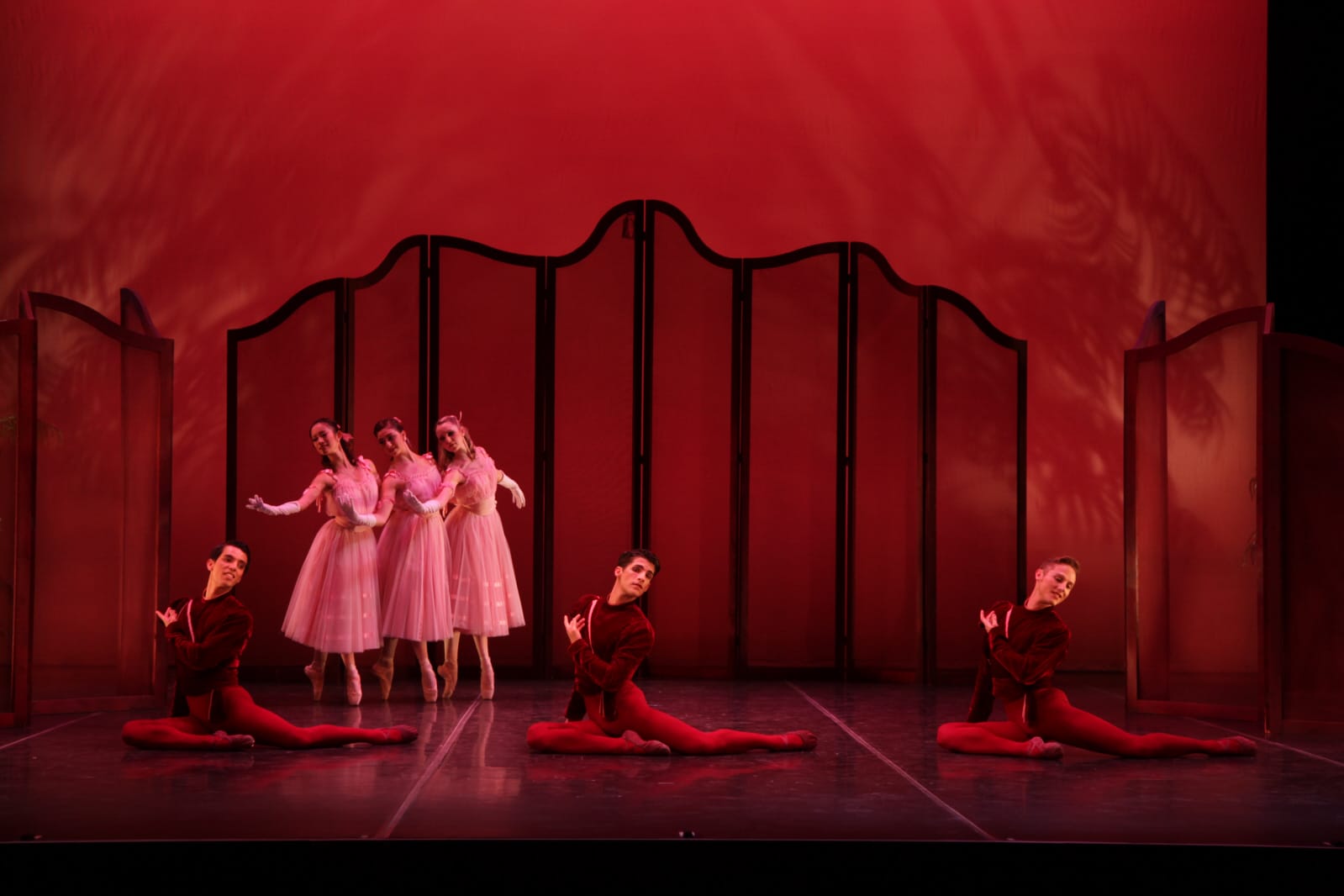
The evening opened with the New York premiere of the 1947 "Valses Nobles et Sentimentales", set to the Ravel score. (The space at the Joyce unfortunately requires taped music. The ballet was not frequently performed and Sarasota's version is based on a rehearsal film from 1987; its reconstruction, led by Assistant Director Margaret Barbieri (a noted Ashton stylist and Webb's wife) was a monumental effort. It is a ballet of mood, pink and romantic, with mysterious entrances and exits. Danielle Brown, a statuesque and dignified dancer whose elegant backbends dug into the music (it may have been opening night nerves, but she did have a fixed smile that contradicted her fluid dancing), flirted discretely with the men, while supported by the dignified Ricardo Graziano. There was a restlessness about the sweeping choreography as the dancers swirled about, moving in and out of view, often disappearing behind the translucent screen; this was no chocolate box view of romance. The curtain fell as the dancers were still moving – going somewhere. It was as if the dancers were swimming in a pool of perfume just before a storm.
The middle section was made up of four separate works, apparently designed to show off both the Sarasota dancers and Ashton's range. There were two short pieces Ashton had choreographed for galas; pièces d'occasion whose craftsmanship kept them alive "Tweedledum and Tweedledee" (Alex Harrison and Logan Learned, with Samantha Benoit as Alice in Wonderland) is a jaunty romp through Percy Grainger's rollicking music whose high spirits hide some tricky dancing (Alice has to stand on a stool in arabesque which being turned by the rambunctious twins.) The dancing was pure sunshine.
"The Walk to the Paradise Garden" was taken by Danielle Brown and Ricardo Graziano, to Delius' music from "A Village Romeo and Juliet". The doomed couple caught the surges of the music with some astounding and evocative lifts. I was particularly struck by an upside down pose, as Brown seemed to melt out of Graziano's arms onto the floor, a Soviet-style move which was an emotional rather than a gymnastic highlight.
The other two pieces were excepts from longer works which worked very well on their own. "Friday's Child" (or to be more accurate "Friday's Children" as both Ellen Overstreet and Edward Gonzales were loving and giving) is a jazzy, pop art pas de deux from the 1968 ballet "Jazz Calendar" which combined an elegant line with a sultry, smokey atmosphere that was just slightly tongue-in-cheek. Overstreet, looking magnificent in her form-fitting bi-colored leotard, danced with a confident freedom.
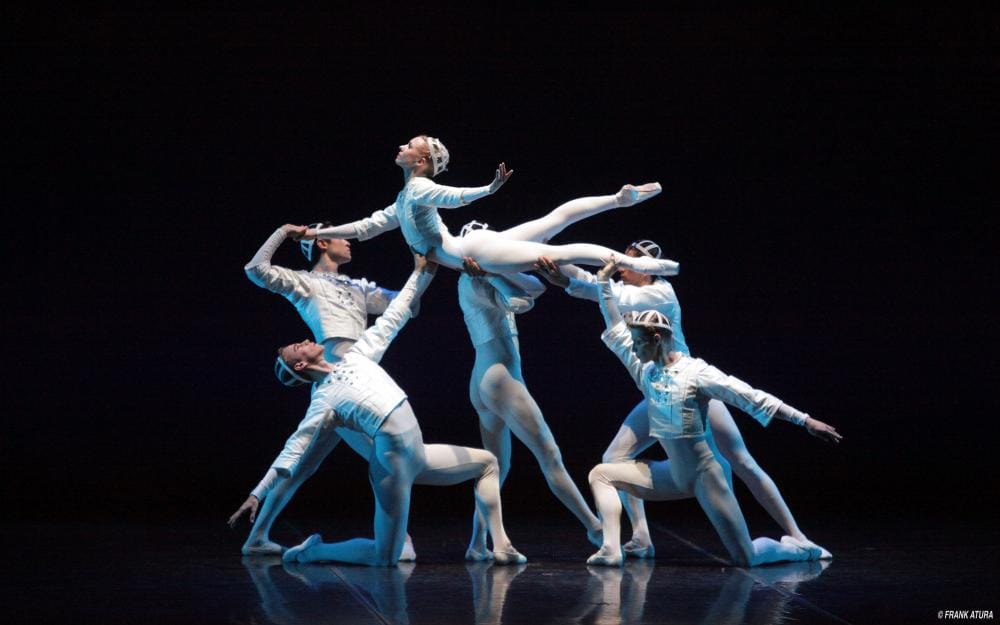
The second movement of Ashton's rarely seen 1967 "Sinfonietta" looked, to me, more distinctive on its own that it did when the complete ballet was shown in 2014. It is one of Ashton's modern ballet blancs, with one woman (Victoria Hulland) and five men, all dressed in the same white leotards and boxy white tops. There were clearly references to Balanchine (the sunburst post from "Apollo" made an appearance, this time performed by men) and any woman in white who doesn't touch the ground says "Unanswered Question" to New Yorkers. But Ashton had used the same conceit in his 1950 "Illuminations" made for NYCB, four years before she showed up in "Ivesiana"; the question is not "who copied who" but "does it look right", and the answer for both those great choreographers is yes.
Ashton's white woman is not the unattainable muse Balanchine's poet longed for, she is part of a moving sculpture. Hulland had a stoic, impassive grandeur as she seemed to float over the men. The constantly shifting shapes and unexpected moves (at one point Ashton had three couples, one co-ed and two male, doing the same supported arabesques) gave the piece a haunting, impersonal beauty, as if the audience had discovered a magical cavern with living stalagmites.
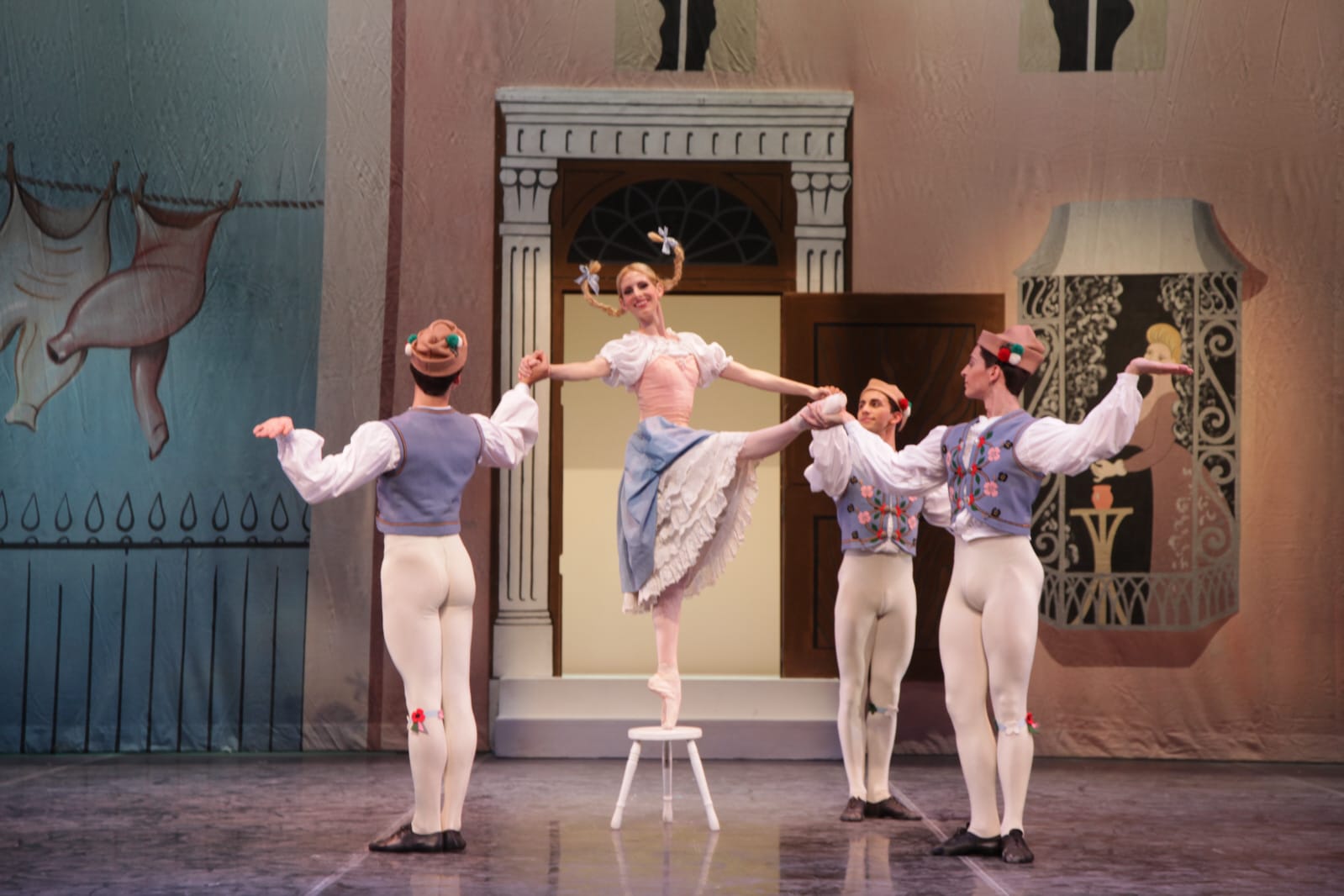
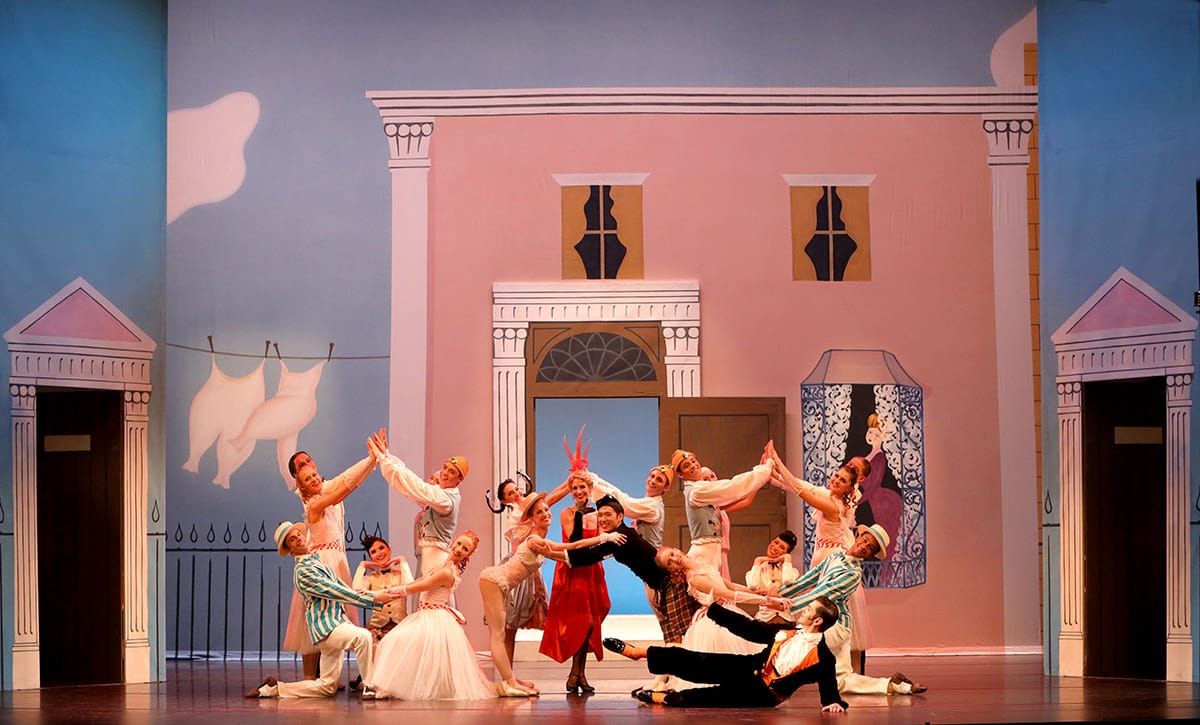
There is nothing impersonal about "Façade", Ashton's 1931 variety show of a ballet, gently satirizing versions of popular dances and those who dance them (such daffy girls and deadpan boys), set to William Walton's music. Sarasota has been dancing this since 2008 and looked at home with both its technical challenges and its humor. Hulland shed her marble demeanor from "Sinfonietta" to sizzle in the polka and Ryoko Sadoshima, Nicole Padilla and Alex Harrison looked like kilted firecrackers in the impossibly fast footwork of the Scotch Rhapsody. All of the dancers were excellent, but I must salute Kate Honea as the Swiss milkmaid, dancing, like Alice, on a stool, and still funny after 80 years; that cow it seems, never gets old.
The Popular Song, with Sam O'Brien and Patrick Ward as the deadpan soft-shoe couple, was also ageless; Ashton's wit seems so effortless but it is based on a solid craft and musicality that is unique. Ashton requires a rock-solid technique and the ability to make the dancing look natural and easy and Sarasota's dancers were vivid, committed and enormously appealing. In an ideal world, of course, the ballets would have live music, so crucial for Ashton's vibrant musicality, but with luck there will be another visit soon with more Ashton and an orchestra.
copyright © 2016 by Mary Cargill



