A Final Olé
"Theme and Variations", "Concerto Barocco", "A Suite of Dances", "Todo Buenos Aires"
New York City Ballet
David H. Koch Theater
Lincoln Center
New York, New York
October 14, 2018
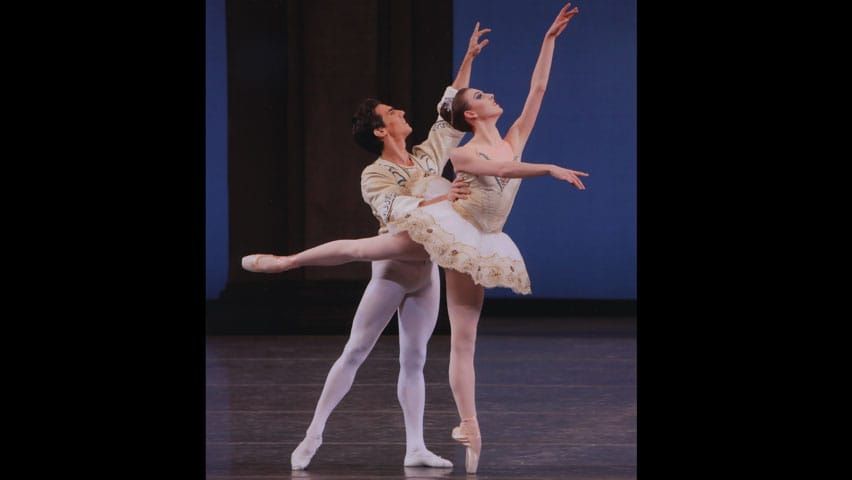
The final program of New York City Ballet's fall season celebrated Joaquin De Luz's retirement, though it was certainly a bitter sweet celebration as the ageless charmer proved he could still thrill an audience. Indeed, the opening work, Balanchine's "Theme and Variations", has one of the most challenging of male solos, a challenge that he more than met as he seemingly tossed off the series of double tours into pirouettes with verve. His dancing was both springy and pure. The role's reticent nobility is not that ebullient dancer's natural milieu and his smallish stature does not have an effortlessly elegant line but his sympathetic generosity and taste gave his dancing a rare richness. He shaped the role letting his dancing build – nothing was rushed or exaggerated and for all his technical prowess, he knew the difference between "The Sleeping Beauty" and "Rubies".
Tiler Peck was his lucky princess, luxuriating in his gallantry. She too shaped her dancing and this abridged version of "The Sleeping Beauty" hit all the emotional high points. Her brief adagio, Balanchine's brilliant distillation of all those vision scenes, had a plangent and mysterious melancholy which evaporated at the crash of a cymbal, turning into a glorious celebration.
The De Luzless "Concerto Barocco" gave him a rest before the final two ballets. Abi Stafford and Maria Kowroski were a somewhat mismatched pair and despite Stafford's free and playful attack, the ballet had a somewhat placid air. The pas de deux, especially, seemed unadventurous, as the series of arcs carved the same shapes with no feeling of exploration or excitement. But Balanchine's architecture, so perfectly matched to Bach's music, is indestructible.
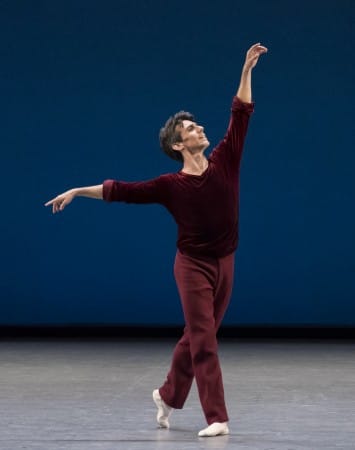
Jerome Robbins' "A Suite of Dances" is another, more informal take on Bach, a long, informal duet for a dancer (De Luz) and a cello (played on stage by Ann Kim). De Luz gave each of the four sections a distinctive quality, seeming to create a portrait of an artist. The first section has a casual, improv- isational feel, as he walked and skipped, trying a move out, discarding it, and trying another. The second section was more confident as his dancing was more outgoing and playful Robbins did have to indulge in somersaults, but De Luz mixed the whimsy with his genuine warmth. The third movement was more contemplative, as he paused to watch the cellist, looking around and almost caressing the air as if he wanted to hold on to the moment. (I expect I was not the only one who watched this through a blur.) The final movement was more incisive, as he ran, jumped and turned triumphantly, pulled by the music. De Luz made the work seem to be an exploration, a celebration, and a benediction, a portrait of a dedicated artist honoring the stage.
"Todo Buenos Aires" gave De Luz one more chance to show off his fireworks as the leader of a fairly glum band to tangoers posing to the glimmers of Astor Piazzolla as reorchestrated by Ron Wasserman. Wassermann's version removed the grime, smoke, and desperation from the original, leaving what seemed to be elevator music for a pre-fab hacienda, but De Luz was irresistible, generous, and captivating.
And then on to the curtain calls. The principals walked on with bouquets from the women and single flowers from the men, each sharing a private moment, then the rest of the company crowded the stage to applaud him. Then we saw a "This is Your Life" parade where people, including his mother and friends from his ABT days, got to say their goodbyes in a moving combination of public and private moments. And finally the audience got its chance to salute that generous and elegant stylist, a dancer who always respected and honored the ballets, the stage, and his audience.
Copyright © 2018 by Mary Cargill



