A Distinct Theatricality Mastered
“Glass Pieces”, “Fancy Free”, “The Four Seasons”
New York City Ballet
Opera House
The John F. Kennedy Center for the Performing Arts
Washington, DC
March 31, 2018 (matinee performance)
The New York City Ballet’s second 2018 program at the Kennedy Center this past Saturday paid homage to the legendary choreographer Jerome Robbins by showcasing three of his ballets which varied greatly in style, yet presented a consistent, unique performance quality. The charisma of the dancers, while partly due to their own talent and dexterity, was significantly amplified by the brilliant construction of the dances themselves. These works demonstrated the power that brilliant choreography can have in developing character and generating allure.
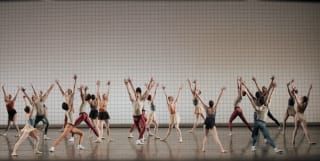
“Glass Pieces,” the first ballet to grace the stage, began suddenly. The stage lights brightened to reveal a grid backdrop, and within seconds an army of forty dancers and the repetitive undulations of Philip Glass’s score permeated the concert hall. This work is a visual masterpiece, as full-bodied and complex as the music it was set to, which, with a composition by Glass, is difficult to achieve. Its success is due in large part to the sheer number of dancers on stage. Robbins' usage of the corps de ballet is inspired: the transitions from one formation to another hypnotic, and the movement technically stunning and clear. The lighting design, by Ronald Bates, incorporates an intriguing manipulation of silhouette in the second part of the ballet, entitled “Facades.” The lighting serves to divide the stage between the corps and the pas de deux with Teresa Reichlen and Russell Janzen, and also encourages the dance to continue as a progression from one side of the stage to the other. As two dance entities, the corps and the duet provide differing interpretations of the music, emphasizing a greater complexity within the score, and include moments of intersection, which highlight contrasting movement vocabularies amongst the dancers that seem to compliment each other effortlessly, as opposed to contradict. The movement itself is full of postmodern influences, introducing body shapes and lines that are not usual in classical ballet. The unconventional motion parallels the futuristic themes insinuated by Glass’s melody. Where this ballet differed in comparison to the other two works in the program was in the lack of story. This additional element of performance was not required in the piece, since Robbins’s choreography manages to characterize individual dancers without labeling them, and sustains continued interest through the intricacies of his movement and a perpetually transforming arrangement.
“Fancy Free” followed the deluge of performers in “Glass Pieces,” with a classic story of three sailors (played by Roman Majia, Harrison Coll, and Sebastian Villarini-Velez) pursuing a light-hearted night of fun in New York City. Robbins’ more humorous side is exposed through the playful, gestural interaction among the sailors and the passers-by, all the while maintaining a fundamental rhythmic connection to Leonard Bernstein’s composition. This character ballet shows Robbins’ talent within the genre of musical theater. Initially, the characterization of the sailors seemed a bit forced: their actions appearing to be acted out instead of embodied. Nevertheless, throughout the evolution of the relationships onstage between the sailors and the girls, an essential honesty was attained, in large part due to the structure established by Robbins. From the flirty pas de deux — illustrating a growing attraction — to the following solos — serving to impress the women — Robbins focuses heavily on characterization. The dancers alone did not carry the burden of performance. Instead, the choreography partnered the performers by inventing and maintaining tenable characters. This cooperation between choreography and performer is a main factor as to why “Fancy Free” is considered such an iconic and beloved ballet.
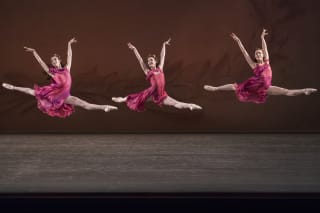
The afternoon performance closed with “The Four Seasons,” a piece which explicitly exemplifies Robbins’ ability to craft diverse movement that defines character, while broadcasting his propensity for the dramatic. Despite a few bobbles by soloists, the exemplary presentation of the company as a whole was remarkably precise with a multitude of animated personas. In “Winter,” the hurried gestures and scurrying bourrées were borderline cheesy, yet formed a setting full of frantic, hustling movement with an underlying comedy that was overall endearing to see. “Spring” brought a more careful and delicate duet performed by Sterling Hyltin and Anthony Huxley, which was explicitly flexible and flowing, and gave an impression of fragility. In the succeeding quartet, the men soared in their grand leaps and indulged in playful petite allegro. “Summer” injected a steamy, sensual quality, percolating from one shape to another, pulsing with diluted undertones. However, it seems clear from the work that Robbins’s favorite season was “Fall.” A dynamic, humorous fawn ushered in the profusion of dancers in the final portion. The change in atmosphere from sultry to victorious was immediate. A triumphant energy radiated from the company as the ballet came to a close.
This assorted compilation derived from Robbins’s repertoire highlighted his strengths in choreographing dramatic performance above all else, and was accompanied by The Kennedy Center Opera House Orchestra. NYCB’s interpretation of Robbins’ diverse theatricality defined his mastery, celebrated his distinguished career, and proffered his future legacy.
copyright © 2018 by Arielle Ostry



