A Community of Dancers
"Dances at a Gathering,” “Everywhere We Go”
New York City Ballet
David H. Koch Theater, Lincoln Center
New York, New York
October 8, 2019
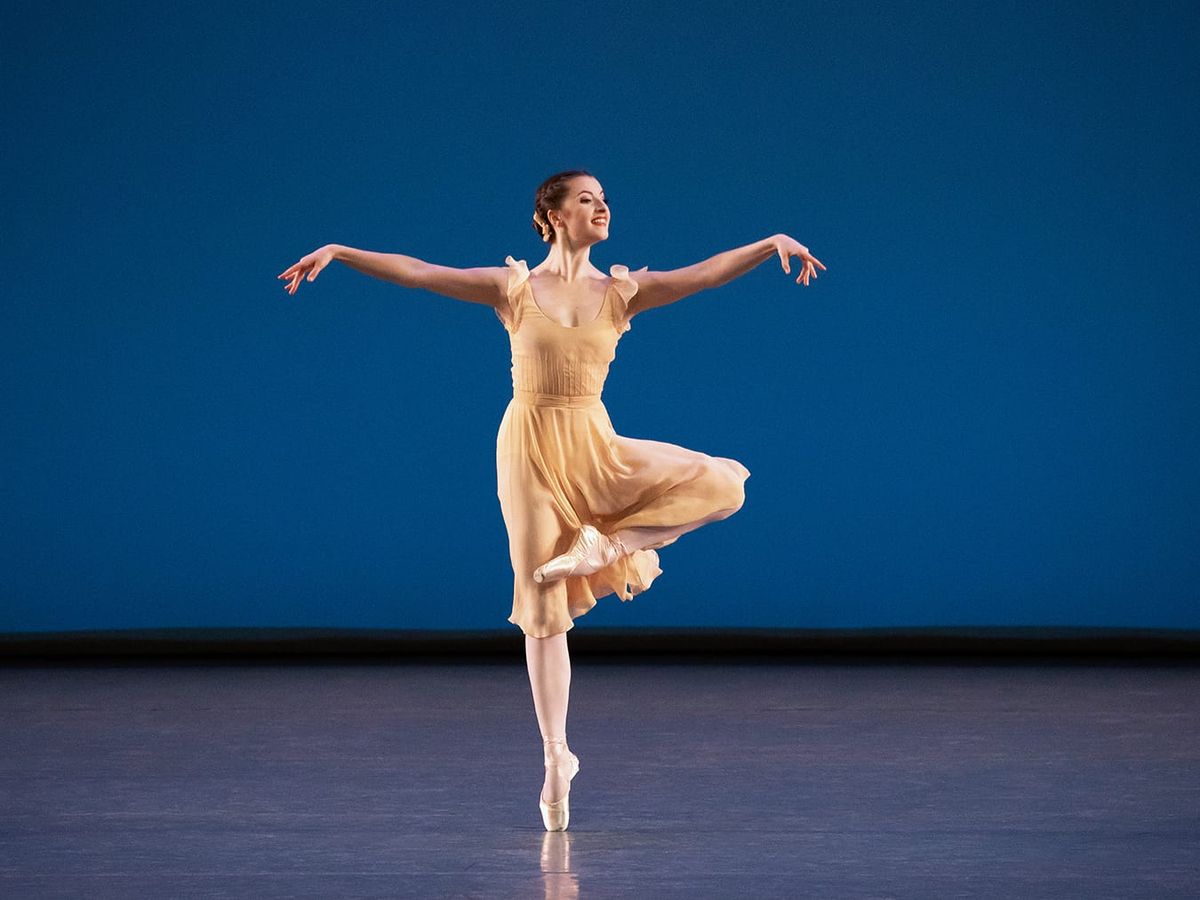
In 1969, when Jerome Robbins returned to New York City Ballet after a twelve-year hiatus, he created “Dances at a Gathering.” He had intended to make a pas de deux and ended with an hour-long series of dances, the ease of invention surprising even him. The ballet was an instant success and has remained so to this day. It was a pleasure to see it again on Tuesday and to be reminded of how pervasive the theme of community is in Robbins’s work, and how this ballet, which has no specific narrative, nevertheless reads like an homage to the communal nature of dance companies and of dance, itself.
Set to Chopin piano studies (played with warmth and elegance by Susan Walters) the dances unreel in ever changing groups and solos, the mood for the most part gentle to joyous. Robbins adds folk elements to the classical vocabulary, but it is hard to imagine the beautiful young people seen here spending their days tilling the fields. They seem far closer to Chekov’s upper-class dacha inhabitants. There is a nostalgia in the dances for a time when everyone lived close to the land, no matter what their social standing, and felt they belonged to a stable society of established traditions. Ballet companies, too, are communities with established traditions. And when one dancer, here Gonzalo Garcia, places his hand reverently on the ground, it is a sign, not only of the nineteenth century evoked by Chopin but of the dancers’ home, the stage.
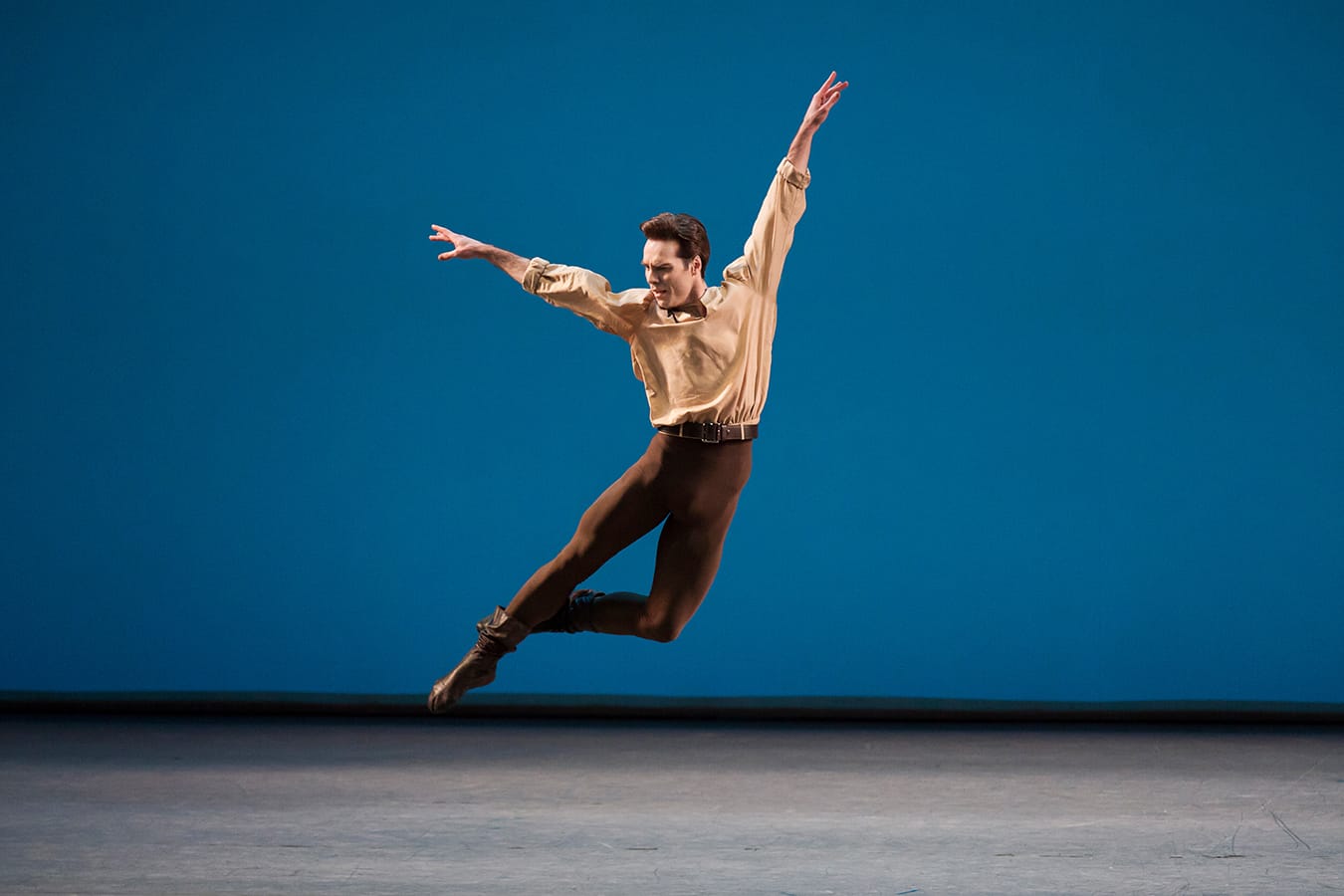
Casting for Tuesday’s performance featured a number of the company’s younger soloists, including Emilie Gerrity (in mauve), Brittany Pollack (in blue), and Indiana Woodward, (in apricot). Woodward, in particular, impressed with speed and lightness, but this crop of soloists, as a whole, is among the most interesting in recent memory, not only technically accomplished but each having a strong personality. Lauren Lovette, who is a principal, was also notable as the girl in apricot, a role that calls for speed and light heartedness in much of the dancing, but then shifts to a more serious mood of contemplation and yearning. The inimitable Sara Mearns appeared as the woman in green, who attempts to attract three men, without much success. She also has a solo, originally created for Violette Verdy, which suggests a mature woman who knows what she is about. Mearns imbued the dance with flirtatiousness but also with a sense of command.
There were more principal dancers among the men than the women. In addition to Garcia, they included Joseph Gordon (in green), and Russell Janzen (in purple), as well as soloist Sebastian Villarini-Velez (in brick), and newcomer Jovani Furlan (in blue). It was Furlan who made the most profound impact of the evening. He is a Brazilian dancer, a former principal with Miami City Ballet, who joined NYCB in August as a soloist. He is already being thrust into major roles (on Tuesday he was in “Everywhere We Go” as well as “Dances at a Gathering”) and it will be surprising if he isn’t promoted to principal before long. His dancing is clean and lucid, and he has something of Robert Fairchild’s dark good looks and extroverted personality. Fairchild left the company in 2017, and Furlan could well fill his place.
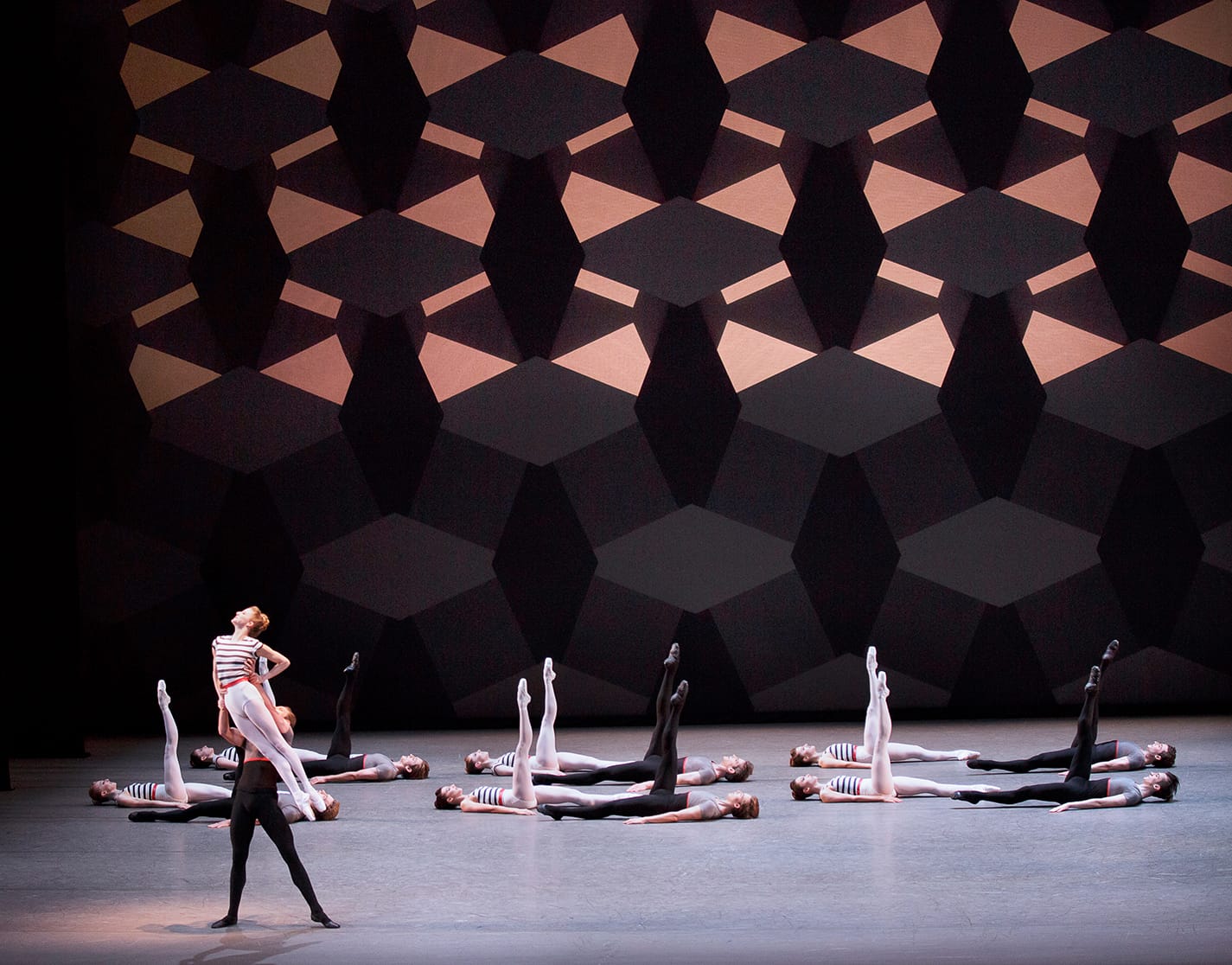
Justin Peck created “Everywhere We Go” in 2014, the year he was named the company’s resident choreo- grapher, while still in his twenties. It is a young choreo- grapher’s ballet, overflowing with inventive ideas and energy. There is no attempt to reduce movement to essentials here, or to capture deep emotion. The plethora of activity also reflects the cinematic drive of Sufjan Stevens’ score, which roars forth one moment, reduces itself to a tingling trickle the next, only to roar again like a giant machine. The cast is big, too, in keeping with the music: twenty-five dancers, including roles for seven principals, six soloists, and a corps of twelve.Many of the group dances feature semaphoric gestures and geometric formations reminiscent of Soviet gymnastic events of the 1920s, which celebrated the country’s industrialization. Kurt Jensen’s backdrop, which consists of a kaleidoscope of shifting black and white geometric shapes, adds to the impression. The costumes by former NYCB dancer, Janie Taylor, have the men dressed in shades of gray, the women in red, white, and blue that hint at nautical wear.
The ballet is a rush of big groups countered by smaller duets and solos that are then overtaken by and absorbed into the larger group. Like “Dances at a Gathering,” “Everywhere We Go” depicts a community, but one that is less contemplative and more, like youth itself, characterized by action. The ballet also includes a few moments of mystery, which are never resolved. At two points in the work, a man stands behind another covering the eyes of the man in front with his hand. At two other points, some of the dancers slowly start to collapse, and are caught by other dancers who lower them to the stage and then remain crouched beside them as if to make sure they are safe. After the first incident, all rise to dance again, but the curtain falls on the second sequence, with half the dancers lying on the stage while others watch over them.
Sterling Hyltin and Andrew Veyette danced leading roles, with Veyette looking in fine condition after several seasons where he seemed to struggle. Unity Phelan, another of the talented group of younger soloists, was paired with veteran Adrian Danchig-Waring, while Megan Fairchild danced a duet with Furlan. The latter was once again notable, giving Fairchild his full attention while dancing with concentration and commitment. She, however, seemed to be living in her own world, hardly acknowledging him a with a look.
The pairing of “Dances at a Gathering” with “Everywhere We Go” demonstrated a contrast between seasoned and youthful choreographers’ ideas of the communal. It was an intelligent use of NYCB’s unparalleled repertory to create new connections and insights that might not otherwise be apparent.
copyright © 2019 by Gay Morris



