A Brilliant Collaboration at Jacob’s Pillow
“The Day”
Jacob’s Pillow Dance Festival
Becket, MA
August 3, 2019
“THE DAY” was the brainchild of cellist Maya Beiser, but by the time it was finished it was a genuine gesamtkunstwerk involving nine creative people, including choreographer Lucinda Childs and dancer Wendy Whelan. The work was given its world premiere this past week at Jacob’s Pillow.
“THE DAY” was inspired by two pieces of music written for Beiser by composer David Lang: “world to come,” prompted by the tragedy of 9/11, and a prequel entitled “the day.” For the latter Lang drew on an internet search in which people from all over the world responded to the phrase, “I remember the day…” Beiser reversed the order of the compositions so that Lang’s “the day,” composed last, is performed first. In the most general way it is about light, while “world to come” is cast as darkness. Looking at both compositions together, one might think of life and death, memory and introspection, appearance and disappearance, the list of binaries goes on. Ultimately, though, this complex multi-genre work functions on a level of intense abstraction, a kind of pure mathematics of feeling.
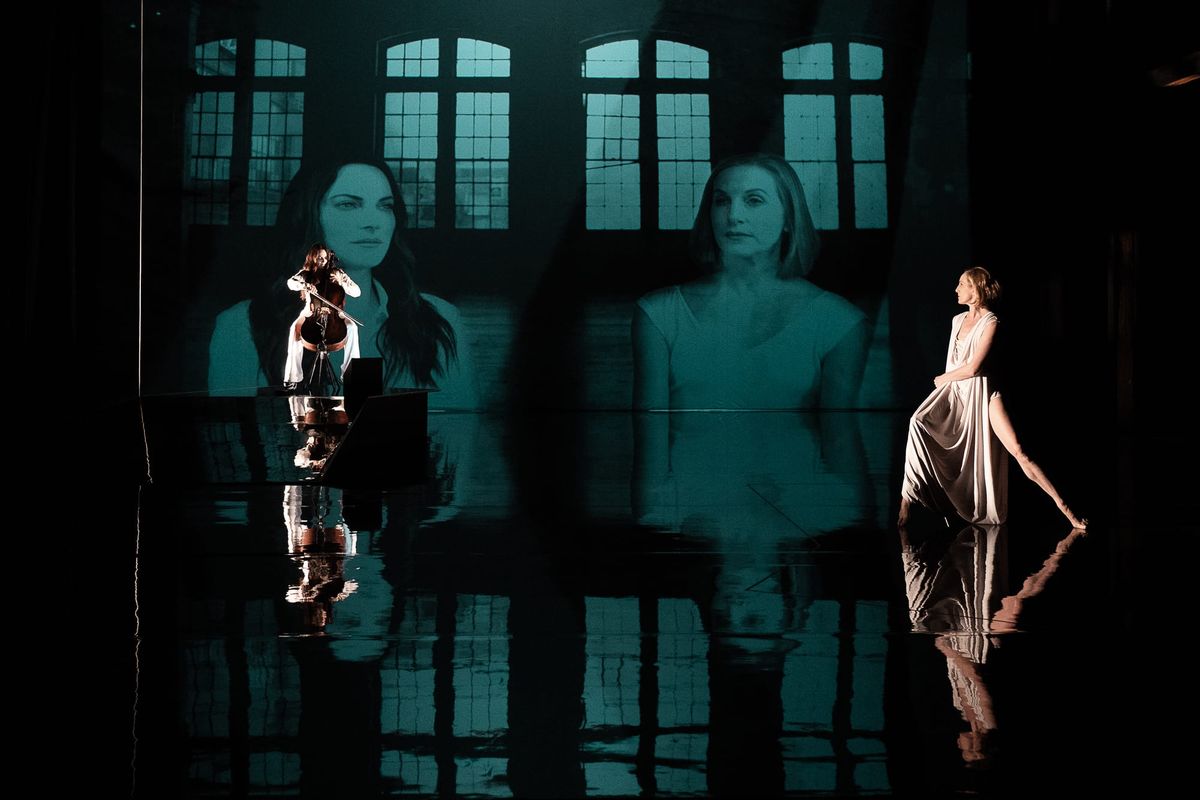
“THE DAY” opens with a black and white video backdrop showing Beiser and Whelan alternately speaking the first lines of Lang’s composition: “I remember the day,” followed by a series of phrases such as, “I achieved the perfect engineering drawing,” “I arrived at the prison, “ “I attended a wedding,” “I baited my hook,” “I became a true collector.” As the photos fade and the recorded voices continue, Beiser, seated on a low platform, begins to play, while Whelan, in another area of the performance space enclosed by lines drawn on the black reflecting floor, sits posed on a stool. Whelan slowly begins to move while stretching a cord in one direction then another, to create varied geometric configurations. Gradually she rises and moves out of her defined space in a continuous series of moves and poses, each time stretching the cord to make new shapes. As the section progresses and the voices continue, she exchanges the cord for a number of other props, including long metal wands, a flexible rope anchored offstage, and lengths of diaphanous fabric. The props, like the costumes worn by Beiser and Whelan in this section, are white.
Childs’ choreography is in no way virtuosic, but it doesn’t look simple as much as pristine. There are occasional overt references to the spoken text—for instance, when the words “I decided to run eighteen miles” are heard, Whelan briefly jogs along the periphery of the space — but those occasions are rare. For the most part, the movement is focused on Whelan’s manipulation of the props as she shifts from one movement phrase to another while also coordinating with the six second intervals of each verbal declaration and with the musical phrasing. However, when the music becomes impassioned, as it often does in Beiser’s intensely felt playing of Lang’s score, the movement remains even and uninflected, like the silent revolution of the planets.
It should be added that while the dancing and cello playing are going on, images continue to be projected on the video backdrop. These sometimes depict the interior of a large building, perhaps a railway station or other public space, in which blurred figures move about, or of a light filled room with large windows, suggesting an empty studio or ballroom.
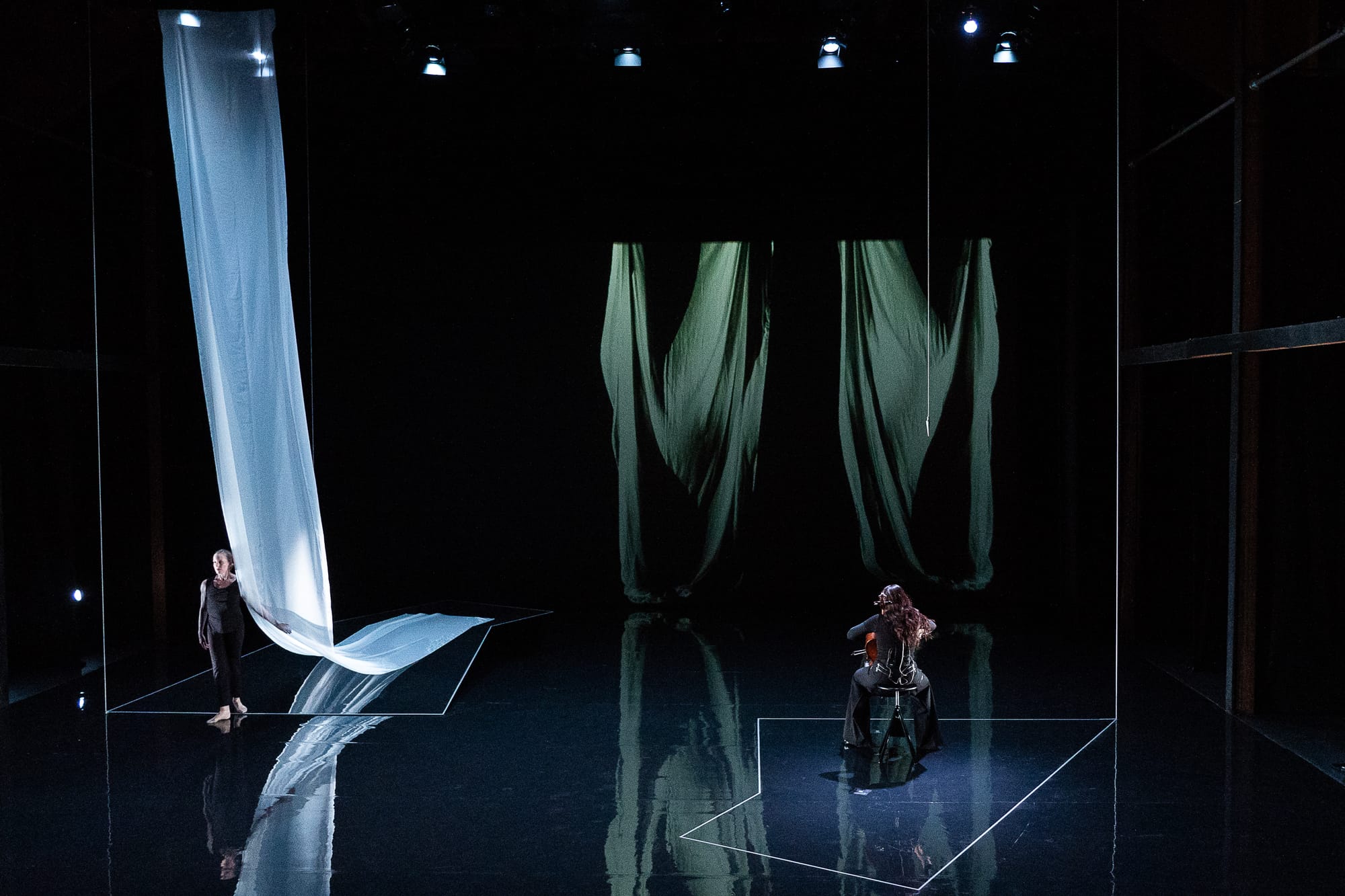
The second section of the work begins with a thunderous explosion on the video screen. All is dark here, the lighting picking out the two performers with spots. Beiser and Whelan are dressed in black, and they have switched sides of the performance space so that Whelan now dominates the inclined platform, Beiser the area defined by lines. There is no spoken text, but Beiser plays Lang’s “world to come” against a recorded sound score of wordless vocals and herself in a multitrack performance. Whelan’s dance is freer and more active than in the measured phrases of the first section. Still, there are poses, particularly a memorable one in which she stands at the top of the inclined platform and gazes outward, like a woman on a cliff above the sea, scanning the horizon for a returning ship. Through this section the video flashes its own dark scenes of the ocean at night, of smoke, of distant waves, and of rain. Here, the ropes and wands of the first half are replaced by a diaphanous drape hung above the stage, which eventually drops in a white billow to veil Whelan. Videos of similar drapes billowing downward are shown in the background. At the end of work Whelan wraps herself in the fabric and, lying lengthwise, rolls down the inclined platform, her unmoving, shrouded figure the last image we see.
As mentioned earlier, “THE DAY” is the result of a collaboration among a large group of artists. In addition to Beiser, Whelan, Childs and Lang, these include Sara Brown, scenic design; Dave Cook, sound design; Joshua Higgason, projection design; Natasha Katz, lighting design; and Karen Young, costume design. In performance, Whelan’s calm authority rivets the viewer’s attention, but it is impossible to imagine the work minus any of the artists’ contributions. Altogether the varied elements form a powerful totality. What is most remarkable is how that totality remains at once generalized, leaving interpretation open and expansive, while at the same time creating an emotional intensity that each viewer is likely to respond to in a deeply personal way. “THE DAY” is a brilliant work that will need a number of viewings to fully reveal its many facets. Fortunately there will be further opportunities to see it in October at the Joyce in New York and next April at the ICA in Boston.
copyright © 2019 by Gay Morris



