A Bouquet of Virtues
"Concerto Barocco," 'Garland Dance' from "The Sleeping Beauty", "New Sleep (pas de deux)", "Bourrée Fantasque"
School of American Ballet
Peter J. Sharp Theater
New York, NY
June 1, 2019 (matinee)
At this graduation performance by the students of the School of American Ballet, there was no single dancer who generated ongoing buzz (Paloma Herrera, 1991) or who made hearts stop (Monique Meunier, 1990). The virtues of this performance were not so much individual as collective: the ardor and scrupulousness of the students, the benefits of quality coaching (and a long rehearsal period) and – perhaps most surprising – the benefits of seeing all these works, particularly the three by Balanchine, on a small stage.
The afternoon opened with welcoming remarks and tributes to two members of the faculty who died during the past year, Andrei Kramarevsky and Peter Frame, delivered before the lineup of the Capstone students, that is, this year's graduates, fifteen girls and four boys of whom three were on stage. The paucity of male dancers ready to go out into the world was unexpected. A number of the girls were in the heroic mold, ready to take on Hippolyta in Balanchine's "Midsummer Night's Dream".
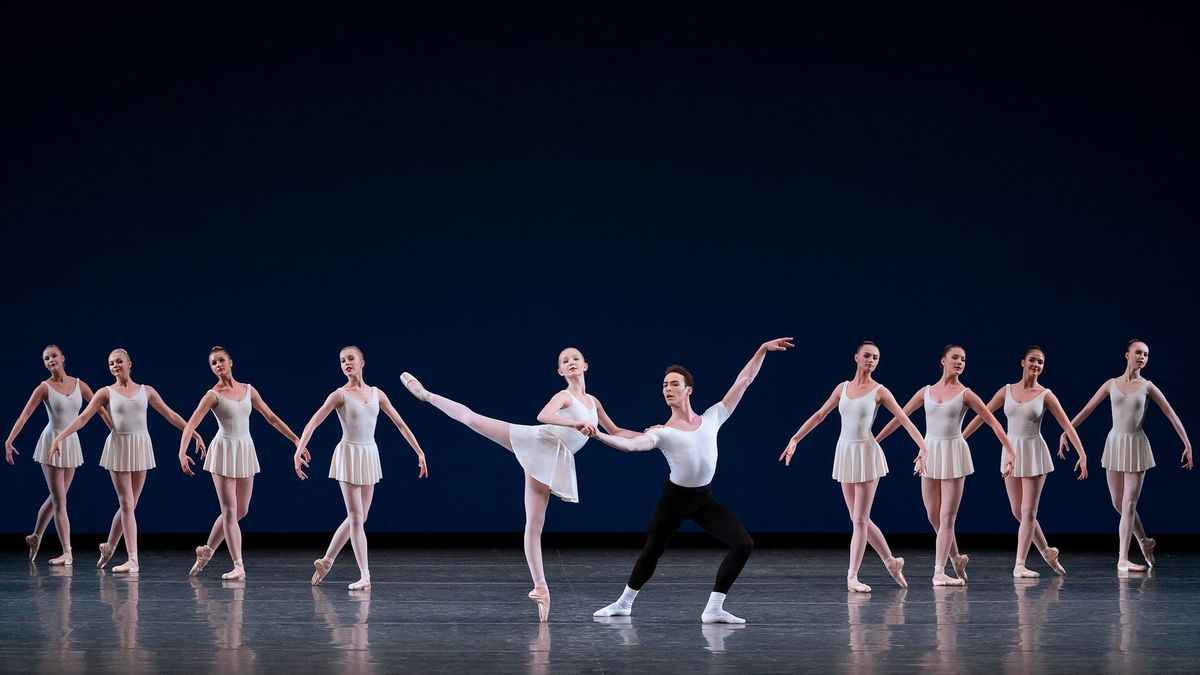
That sense of scale reasserted itself as the curtain rose on "Concerto Barocco" (staged by Suki Schorer) as the eight members of the corps seemed to tower over the two soloists, Rommie Tomasini and particularly the dandelion light Zoe Bliss Magnussen (who danced the pas de deux with Benjamin Lepson), blonde, thin, almost fey in contrast. It was stunning to realize that one takes a certain homogeneity, perhaps not actual but perceived, for granted in "Concerto Barocco". Everyone shared attention to detail (the slow descent of a leg stood out on the small stage) and to phrasing. There's a moment early in the adagio when the lead couple must disentangle themselves from each other, as if knotted together, and end facing away from each other, the women standing, the man on one knee. There's usually evidence of a struggle and a concomitant hiccup in timing. Here everything unwound as if greased, and ended in concert with the music. And the dancers' attack was softer than one is used to; legs weren't knives. The effect was pearlescent, rather than brilliant; Balanchine's and Bach's intentions showed through crystal clear.
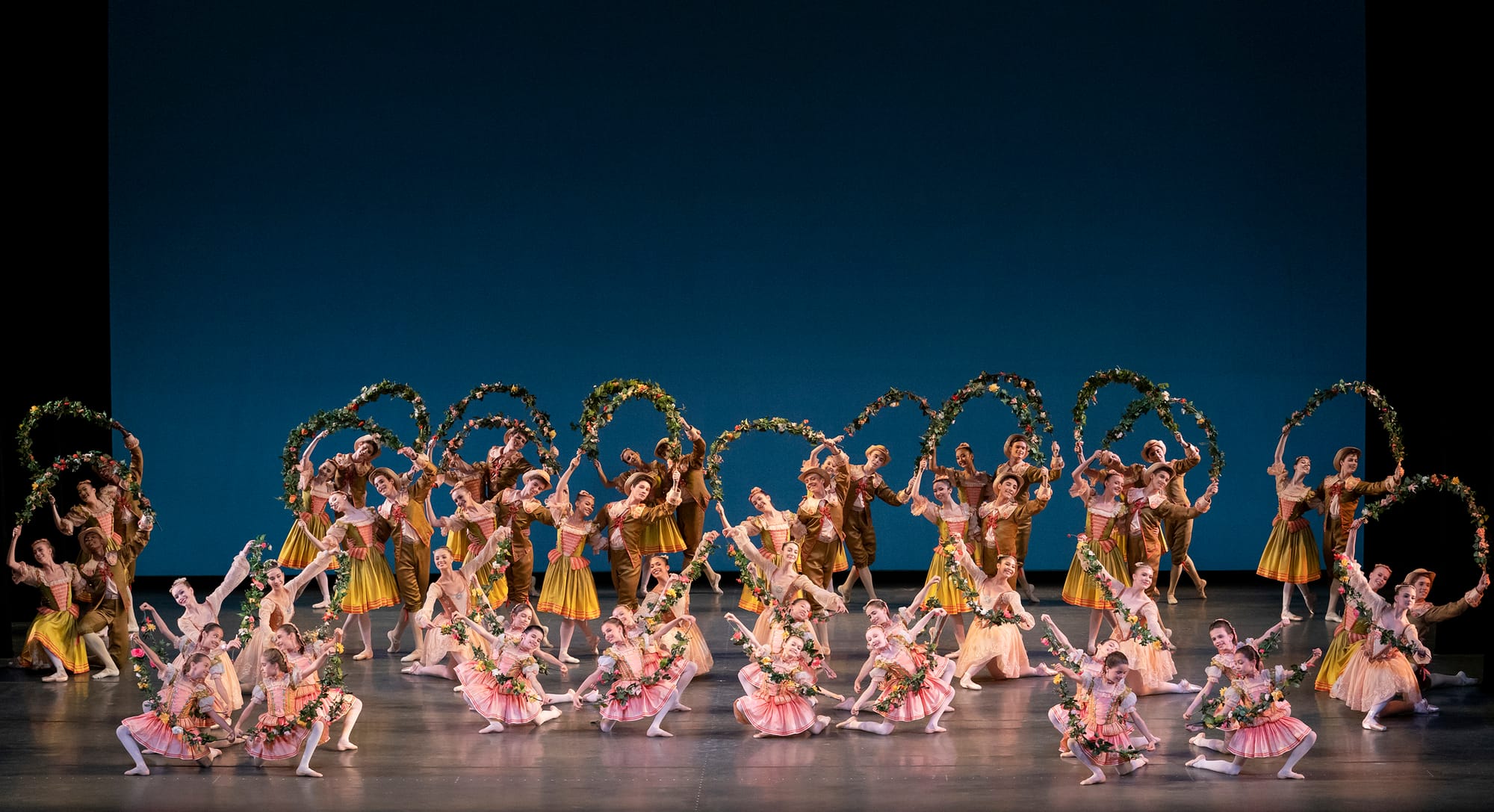
If, in "Barocco", the stage space was finite to be danced in, with the corps like a peristyle, rather than infinite and to be danced through, in Balanchine's 'Garland Dance' from "The Sleeping Beauty" it all but disappeared entirely, becoming an exuberantly blooming series of arbors, an avalanche of yellow, green and pink, rather like a late Monet in which form disappears into light and color, but here also, motion, leaving the viewer elated, awash in youth and spring, a perfect backdrop for Aurora.
Nothing could have been further from 'Garland Dance' that the somber black box of the pas de deux from William Forsythe's ballet made for the San Francisco Ballet in 1987. It begins with a fanfare for garbage can lids. Thereafter the music, by Thom Willems, goes its metallic way. Forsythe, at least in this duel, stays closer to the classical canon. No matter how far out, in space, in stretch in line, the emphasis was on the return to repose, to order, to classicism. Shelby Tzung had a beautiful rounded quality in motion which gave sculptural weight to the classical vocabulary and Ross Allen particularly elegant epaulement. That they looked well and worked seamlessly together reinforced the rational calm of classicism in general.
The performance ended with "Bourrée Fantasque", staged by Susan Pilarre, its three sections in turn antic, mysterious and primed to go off like a firecracker. The opening section has one built in problem: no one can ever reproduce the relationship between, or the kinetic wit of, the original cast: Jerome Robbins and Tanaquil LeClercq. Mary Kate Edwards and KJ Takahashi made their relationship closer to Pierrot and Pierrette. He yearned for a single kiss (eventually given) while she teased and withheld. Everyone made clear the shifts of weight which add flavor to the piece, from flat feet to pointe (there are even turns on flat feet), from upright to collapsing from the waist like a rag doll.
The following movement is a complete change of pace in which a man and woman meet, dance but cannot connect, and drift off, still in search of something they cannot find. It is another variation on a frequent Balanchine theme: the poet and the unattainable muse. All too often in "Bourrée Fantasque", its presence is discordant, as if dropped in from another planet. But as danced by Mia Domini and Colby Clark, as if in one breath and with all the hope in the world, it made perfect sense.
Only the final movement with forty-two people on stage (there were fifty-seven by the end of the 'Garland Dance') looked cramped on the small stage. But Balanchine's craft in sending 'em home happy still shown through with the dancers from each section leaping across the stage in formation like platoons of soldiers having a good time. "Bourrée Fantasque" turns seventy this year. Happy birthday.
copyright © 2019 by Carol Pardo



