Women in White
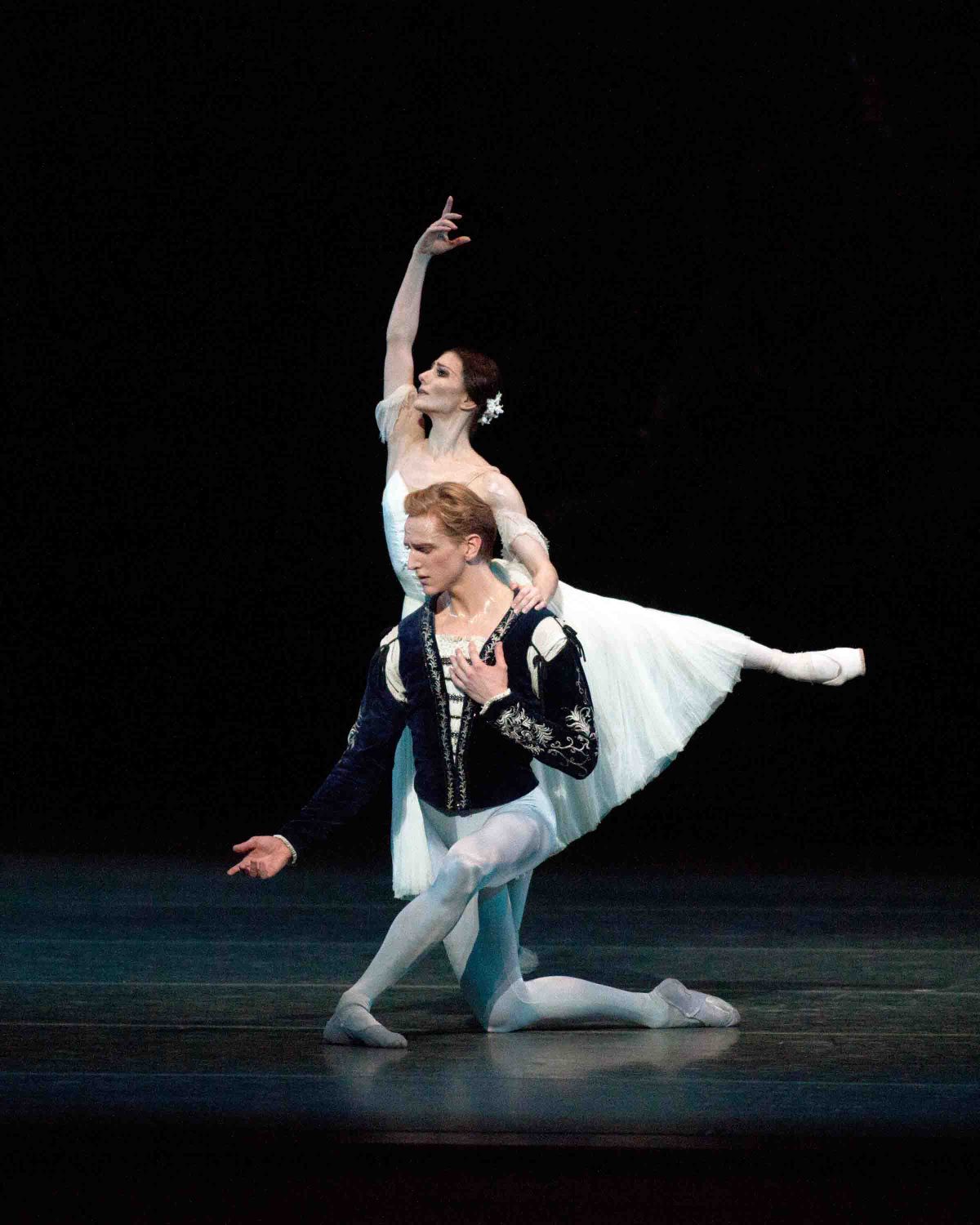
"Giselle"
American Ballet Theatre
Metropolitan Opera House
New York, NY
May 28, 2011
ABT's version of the most famous Romantic ballet is, fortunately, straightforward, clear, and by and large, dramatically strong. The basic structure has not been rethought, so the story of the poor peasant girl and her faithless swain remains as moving and powerful as ever. This season, ABT has imported a number of guests, and the Royal Ballet dancer Alina Cojocaru danced Giselle. She is a natural romantic heroine, small, frail, and completely committed. The logical mind did notice some quibbles; her costume in the second act didn't match her sister wilis' dresses, she avoided some of the jumps, her extensions sometimes got in the way of her dancing, and her first act solo differed from the one usually done, and seemed much less musical. But the overall impression was so much greater than these reservations, as Cojocaru's intense yet delicate performance triumphed over mere technical questions. Not that her technique was completely at issue--her delicate, floating jumps were beautiful.
Her Giselle was a delicate porcelain doll with a huge heart. She knew she was in love, and loved everyone in return; she didn't even want to hurt Hilarion (a very sympathetic Jared Matthews), and her interactions with her mother (Nancy Raffa, in a vivid performance) were profoundly moving. Cojocaru was focused on the other dancers, and made the drama seem fresh, so there was no over-rehearsed feeling, no sense of doing this particular gesture to this bit of music. Her mad scene was especially effective, as she just went limp and seemed to die inside. She moved as if the air were heavy, such a dramatic difference from her earlier light and feathery dancing.
Hallberg was in love with her from the start. His dancing is so pure and honest that Albrecht as cad would probably look false on him (though this can be a very effective approach), and he seemed to be caught almost unwillingly. He handled Cojocaru in the opening dances with an awed delicacy, as if he couldn't believe that such a creature existed. He wasn't a heedless Albrecht, or a deliberately cruel one, he was almost in a fog, acting as if he thought it might be a beautiful dream. Of course, it all comes apart, and with time, Hallberg will probably give the moment when he kissed Bathilde's hand more moral weight, but he made his grief for Giselle unbearably moving.
Cojocaru's second act was completely focused on Hallberg, making the act a dramatic arc, and not just a trip through a book of Romantic lithographs. Hallberg's dancing was simply breathtaking, especially his series of entrechants, which seemed to last about fifteen minutes. The ending was slightly different than the one usually seen in this production and rather than bathing Albrecht in a cascade of lilies (a flower shop in the middle of the forest is so convenient), Giselle just dropped a flower as she disappeared, bourreéing into the night, which Albrecht picked up and cradled, his one last connection with her, as he walked slowly away. It was a magnificent and powerful ending.
The supporting dancers were also very strong. Luciana Paris was a condescending and haughty Bathilde (though the fancy costumes of the Prince's party made it look as if they did most of hunting along the Rue de la Paix). Sarah Lane and Daniil Simkin danced the peasant pas de deux as if they were part of the community, and not just stopping by on the competition circuit. Stella Abrera substituted for Gillian Murphy as Myrta. Her opening bourreés were especially lovely, and she was an effective queen, but I missed the feeling that Myrta, too, has a story. The corps of wilis got the usual round of well-deserved applause, as did the lead couple in the rapturous curtain calls. The audience seemed to realize that this was a rare and special paring.
copyright © 2011 by Mary Cargill



