Winding Down
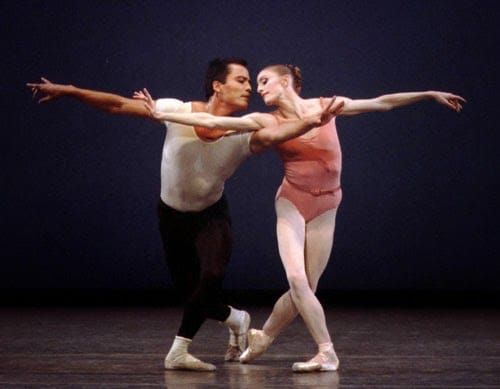
"Stravinsky Violin Concerto", "Cortège Hongrois", "Symphony in Three Movements
New York City Ballet
New York State Theater
New York, NY
Sunday, June 27, 2004
The final performance of the Balanchine celebration was, appropriately, an all-Balanchine program. But, equally in keeping with the injury-plagued season, the scheduled Tschaikovsky Suite No. 3 had to be scrapped because there was no one available to dance the male lead.
Stravinsky Violin Concerto, with its astringent and witty double pas de deux, featured Sofiane Sylve in the Karin von Aroldingen part. She danced it as though she had been waiting for it all her life, combining power with allure, and drama with wit—she uses her eyes so expressively. There was no feeling of acrobatics, even in the back bends, because she kept the movement going, without pausing to let the audience admire her. It was gymnastic without gimmickry.
Alexandra Ansanelli, in the Kay Mazzo role, unfortunately, took the opposite tack. She seemed to have decided that the part needed the flailing drama of a Juliet combined with the bossy nature of a Swanilda, and danced without any sense of vulnerability or mystery. The role is one of Balanchine’s meditations on the illusive woman, and needs an inner delicacy. Nikolaj Hübbe, as her partner, gave an extraordinarily controlled and powerful performance. The drama came from his gestures, from inside, with a reach and a push, not just from his face.
Cortège Hongrois is Balanchine channeling Petipa, sometimes, as in the woman’s solo, very directly. This solo was made for Pierina Legnani in her maturity, and needs grace, amplitude, and grandeur. Caroline Cavallo, the American-trained, Royal Danish Ballet dancer, was invited to dance the role; she is a dutiful, rather prim dancer, with little projection, and gave a dutiful, rather prim performance. Nilas Martins was her partner, and he is just not a white tights kind of guy.
Symphony in Three Movements closed the program. It didn’t have all the explosive energy needed—the dancers were probably exhausted, and there were a few slips and fumbles. Ashley Bouder, though, had energy to spare, and whipped through her part like a benign pink tornado. Jock Soto and Wendy Whelan danced the slinky, quirky pas de deux. The costume does not flatter her, but her control and authority give the dance a throw-away elegance that is hypnotic. The final massed pose, with all of the order of a Petipa ballet combined with the stark, modern shapes of the straightened arms was a fitting farewell to the Balanchine
copyright © 2004 by Mary Cargill



