Watermill
“Watermill”
BAM Fisher
Brooklyn Academy of Music
Brooklyn, New York
October 24, 2018
Jerome Robbins created “Watermill” for New York City Ballet in 1972. It was staged for what was then known as the State Theater, now the David H. Koch Theater, a proscenium theater of opera house proportions. Choreographer Luca Veggetti has re-imagined the work for the intimate BAM Fisher, and the ballet benefits greatly from it.
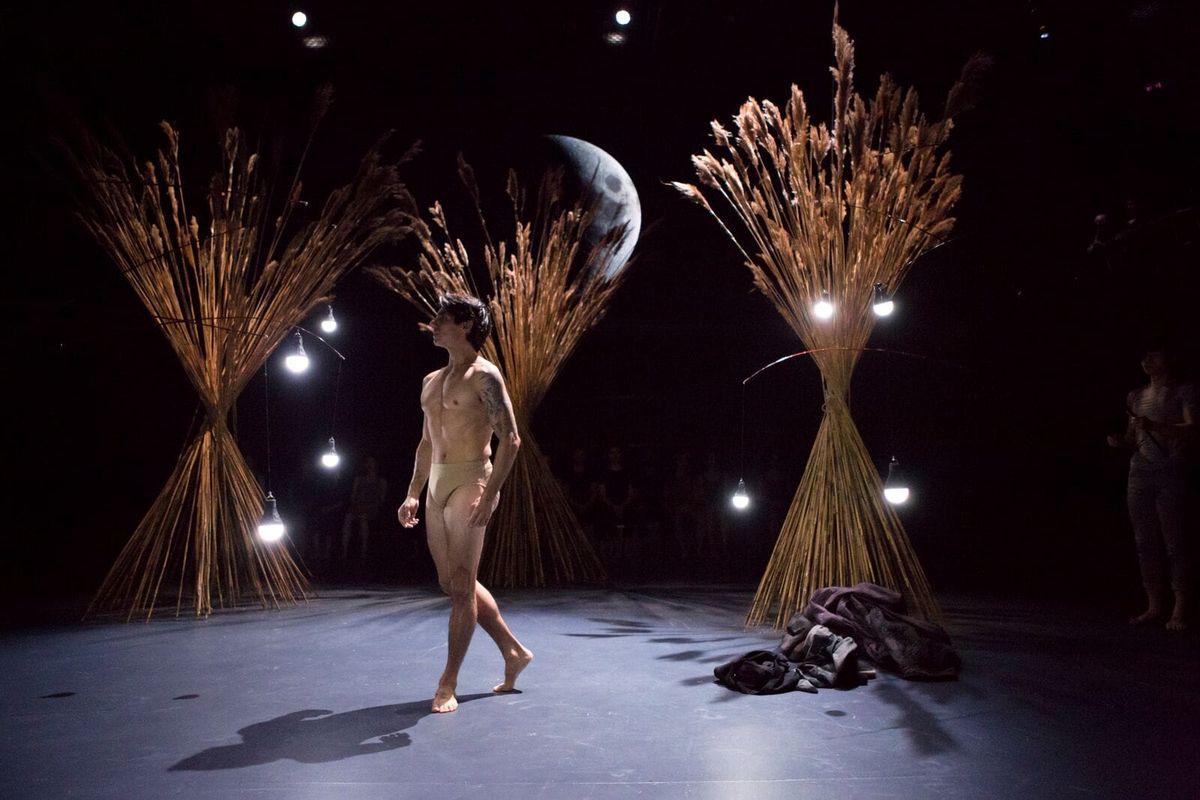
Veggetti has been respectful of Robbins’ vision for “Watermill;” his is not a reworking of the ballet, but primarily a spatial adjustment. The audience is situated on three sides of the performance area and the dancers, instead of entering and exiting, remain on stage throughout the work. All except the central character sit in a horizontal band at the back of the performance space, rising from their chairs when called upon to perform. The costuming is similar to the original, the dancers dressed primarily in practice clothes. The original choreography and Teiji Ito’s score, played live by five musicians in the balcony to the side of the performance area, seem to have been wholly preserved. I was expecting more change and was grateful for Veggetti’s subtle hand.
“Watermill” was an anomaly in Robbins’ oeuvre. Inspired by Japanese Noh theater, and perhaps by postmodern artists like Robert Wilson, much of it moves at a slow pace. However, that said, a good deal happens in the ballet’s one-hour length, and Robbins interspersed slowness with, at times, fast, even frenetic, movement. “Watermill” may be a meditation, but it is one aimed at holding a western audience’s attention.
The ballet centers on a man who looks back on, or dreams of, incidents that may have occurred at different stages of his life. In much of this action, the central character watches other dancers perform, as if he is observing himself in earlier events in his life. Or he dances alone, reinforcing the idea that the supporting figures exist in his memory or imagination.
As the ballet begins, the man enters wearing a long cloak. He slowly removes it and the rest of his clothing until he wears only flesh colored trunks. It is as if he is stripped of all outer illusions. Early on, he watches as a young man dances boldly; later there is an erotic duet, a man is attacked and beaten by a raffia clad figure and three henchmen while the main character writhes on the floor as if in a nightmare. There may be a harvest, snow falls. And at last a dark, bent figure in black appears as the man looks on attentively.
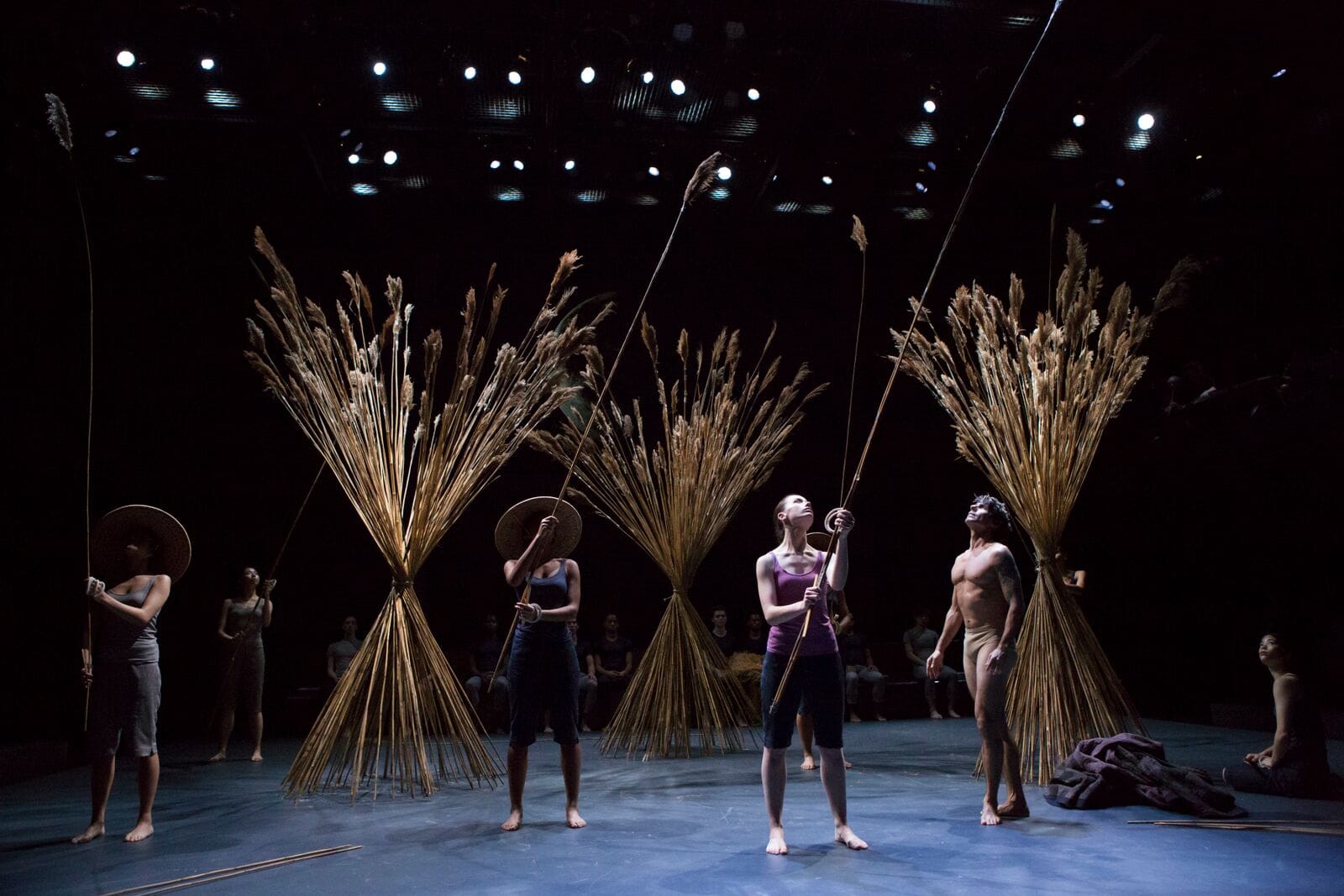
One of the most beautiful scenes features several women, who slowly wave long, feathery topped reeds, and then allow them to drift to the ground. The central man takes up two of the reeds and, with them, executes an equally slow dance of his own.
While the stage action is going on, we see in the background a black and white projection of a moon slowly lightening until it is full, and then entering into darkness until only a sliver of light is left. The ballet thus reinforces an idea of time through the seasons, the cycles of the moon, and a life. The work also includes a number of beautiful theatrical effects, including the dancers holding small lights (originally paper lanterns) on long flexible poles so that they dance in the semi-darkness, and another scene of flying kites in the shape of birds.
The original work featured the great NYCB dancer Edward Villella in the central role. Here it was another important NYCB dancer, Joaquin De Luz, who just retired from the company several weeks ago. He was a quiet but powerful presence in the ballet. I saw De Luz last year in a workshop performance at NY City Center that focused on stillness. He said at the time that the exercises in the workshop had opened his eyes to how to keep stillness alive on stage, something a western theater dancer is not normally trained to do. I thought of that in De Luz’s performance, which often demanded stillness, and which he commanded with poignant authority. The other eleven dancers were students from the Conservatory of Dance at Purchase College, SUNY, and they are obviously a talented group, already of professional caliber.
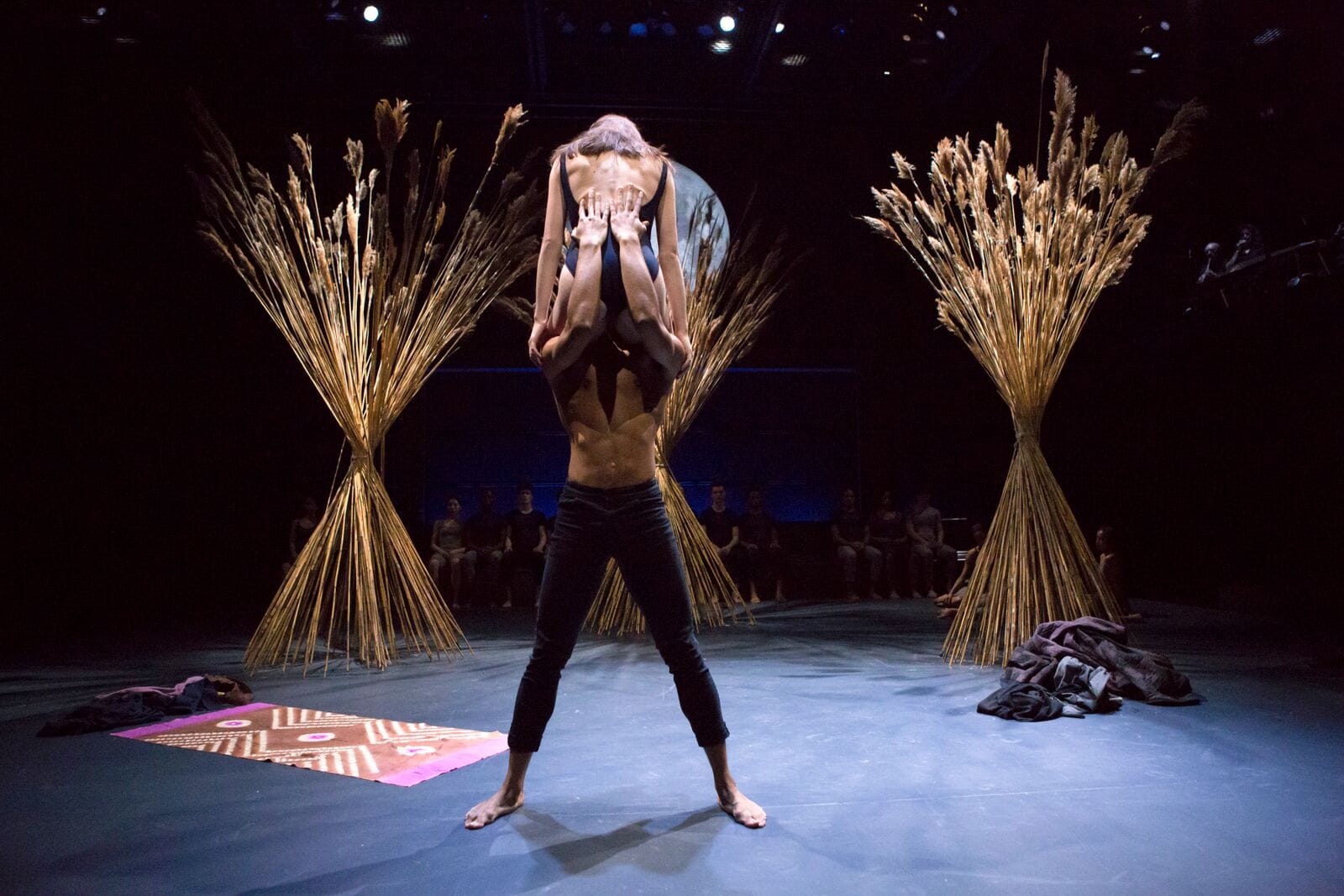
The work included one jarring note that had nothing to do with Veggetti’s staging. It was the duet. A woman, who may be at a beach, spreads out a towel on the ground, leisurely brushes her hair, and lies down as if sun bathing. A man appears and the woman rises on all fours with her back to him. She remains in this position for several minutes, as if waiting. He eventually straddles her and then repeatedly manipulates her body in ways that expose her in upside down side splits and other vulnerable positions, before pushing himself on top of her. Robbins was known for misogynist elements in some of his dances, and in today’s environment, and with an audience sitting close to the performance space, the duet was disturbing in the woman’s passivity and the man’s aggression.
As a whole, though, Veggetti transposed “Watermill” to an altogether new kind of space with a deft hand, which retained the work’s dramatic visual effects and dream-like atmosphere without disturbing its choreographic core.
copyright © 2018 by Gay Morris



