Undressed or Corseted
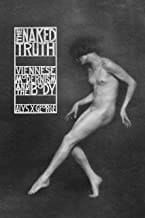
“Naked Truth – Viennese Modernism and the Body”
by Alys X. George
University of Chicago Press, 2020
Look carefully at the picture on the cover of this book. It shows a naked woman dancing. Her face is turned away so that only part of her profile appears. Her torso seems somewhat flattened, like that of an ancient Egyptian image. The arms and hands are held lightly away from the body’s center of gravity. The lines of the long legs are bent slightly at the knees. She gives the impression of moving forward, to our left. Oddly, this woman is not even Viennese, but the German dancer Claire Bauroff (1895-1984). Still, the author is trying to make a point: that the body in its totalities was focal in Vienna from ca. 1870 to 1938. Bodies included cadavers that were being dissected at Vienna’s famous medical school and lively ones dancing at the city’s ballrooms and cafes. Vienna’s professional ballet dancers elegantly arched their feet, the women wearing pointe shoes and, for classwork, transparent white socks over the toe shoes so that the teacher could readily spot and correct cramped stances. Under their costumes or practice garb, the ballet women wore corsets or girdles. Bauroff is barefoot on the book’s cover, yet my guess is that her delicate toes have had pointework training. The imprint of such instruments as corsets and toe shoes isn’t easily erased from the flesh.
Early in the book, the author focuses on exhibits, which were popular fare in Vienna. She sees them not as still displays but as live performances. Topics ranged from anthropological (a village of Ashanti tribes people was imported) to hygienic (women nursing babies and the effects of nutrition). These exhibits were huge and attracted crowds. Also called to our attention are the Viennese links between science and art: physician writers such as Arthur Schnitzler and Marie Pappenheim, that Sigmund Freud was a master essayist and that Egon Schiele did anatomic drawings. There was fascination with the pregnant female form. Grim reminders of a devastating war were the wounded veterans who became street hawkers in the “rump” republic of Austria that remained after the dissolution of the Habsburg Empire in 1918. The design and manufacture of anatomic prostheses became both a science and an art.
Discussed somewhat in detail by the author are a few of Vienna’s dancers – Grete Wiesenthal and her sisters, Gertrud Bodenwieser, Hilde Holger and also one of the visiting dancers, America’s Ruth St. Denis who spent time on the banks of the Danube. To boot, there is Max Thun-Hohenstein, a Viennese movement artist who was also a physiologist. I first heard about him from critic Walter Sorell. Thun-Hohenstein (1887-1935) taught humans to dance on all fours and trained four legged animals to move upright on two legs. The animals looked natural as bipeds and the people also seemed at ease doing four legged strides according to Sorell. In addition, Thun-Hohenstein advocated nudity for human males and females when they danced. It is in the book’s last big chapter (#4) that the author concentrates on pantomime, dance and early film. Not surprisingly we learn more about the scenarios of the pantomimes and the themes of the dances than about the choreographies, which usually have not survived.
Finding concern with “the body” so consistently in Vienna’s modernist past is a valuable insight. It is something which the author, Gladys X. George, can claim with pride. However, that modernist Vienna has been a lost piece of history, something forgotten until she came along, isn’t the case. A considerable literature has accumulated about modernist Vienna, even in English.
Prices for the book listed on the Internet range from $32.39 to $38.49.



