Two by Two
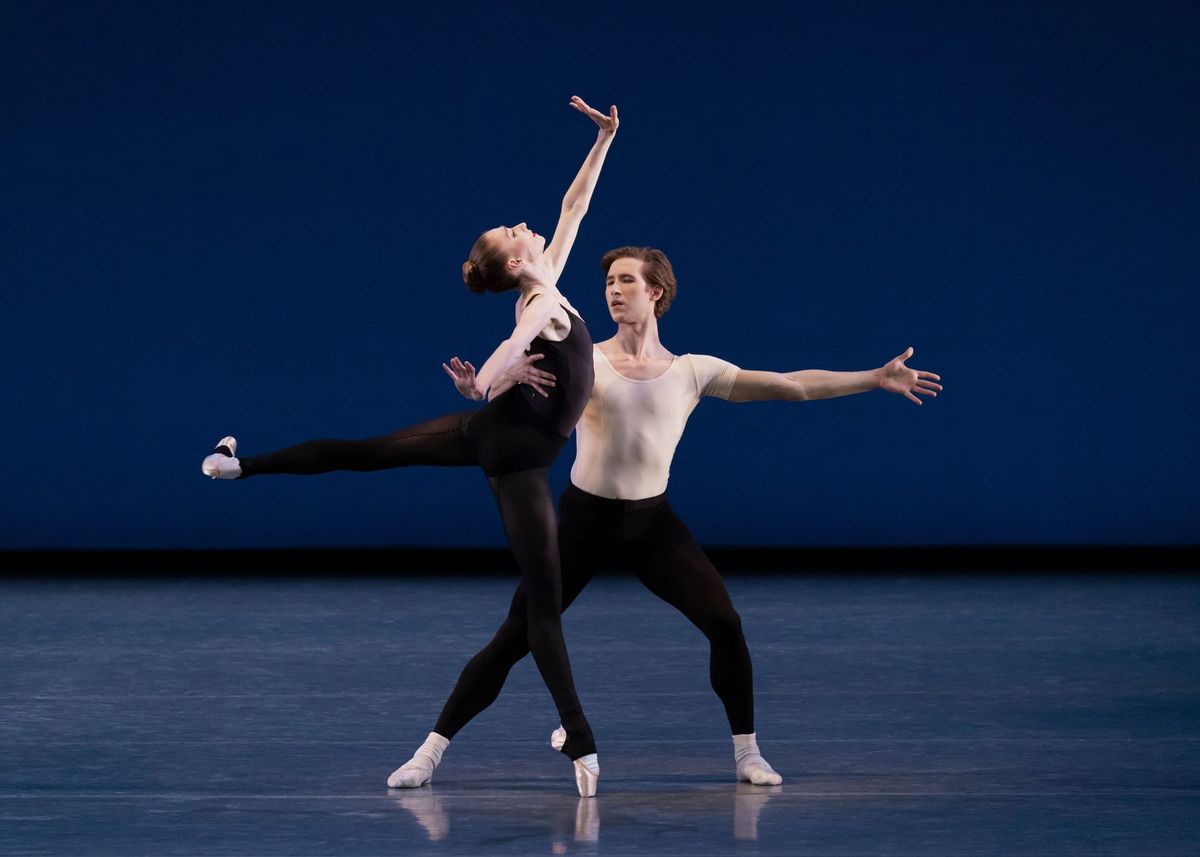
"Donizetti Variations", "Haieff Divertimento", "Valse-Fantaisie", "Stravinsky Violin Concerto"
New York City Ballet
David H. Koch Theater
Lincoln Center
New York, New York
January 17, 2023
New York City Ballet's Winter season opened with two pairs of Balanchine ballets, as the 19th century confections "Donizetti Variations" and "Valse-Fantaisie" alternated with the more austere and astringent 20th century works "Haieff Divertimento" and "Stravinsky Violin Concerto". The pairings, with their contrasting styles, showed so clearly how music propelled Balanchine's choreography. These ballets are all wedded to their scores, the movements intertwined with the music, and, with the barest whisper of a narrative, all have a distinctive emotion.
"Donizetti Variations" is set to the juicy, melodic, and irresistibly danceable ballet music from Donizetti's tragic opera "Don Sebastian", a work with multiple deaths culminating in the loss of Portugal's independence; the ballet music must have been a welcome relief for the opera's audience. The only hint of this in Balanchine's ballet is a brief flourish of Spanish dancing for the men, and the ballet, with its traditional peasant costumes (19th century ballet peasants often had very nice headdresses), echoes of folk-dancing, petit batterie, and the general sunny feel, seems like remnants from a lost Bournonville work.
The main couple, Megan Fairchild and Anthony Huxley (a debut), gave a gloriously sparking performance, weaving in and out of the small corps, pausing to toss off some elegant dancing. Fairchild made her flirtatious little jumps, bravura pas de chats, and fearless turns look easy and fun. Huxley's crisp beats, quick changes of direction, and fast, solid, and controlled turns were thrilling in the understated, non-stop Bournonville tradition, and they had a warm connection with each other and the audience. "Donizetti Variations" is an extravaganza of charm, and is a perfect opening ballet, guaranteed to enchant anyone who loves dancing for its own sake.
"Haieff Divertimento", choreographed in 1947, has rarely been seen. Balanchine dropped it from the repertoire in 1952, possibly because it borrowed so much from "The Four Temperaments" choreographed the year before. But if you are going to borrow, why not borrow from the best? It was revived in 1985 by the Kansas City Ballet with the help of Todd Bolender and Francisco Moncion who were part of the original cast. New York City Ballet danced it in 1993 as part of the Balanchine Celebration and soon vanished; Wendy Whelan was the lead woman, and it may be due to her that it returned in 2020.
Indiana Woodward, making her debut, and Harrison Ball, who danced it in 2020, were the main couple, supported by four couples. It opened formally, with the couple bowing to each other, and the dignified and intense Ball alone bowing to an invisible partner, the poet looking for his muse. Woodward entered and they danced and oddly cool pas de deux, with traveling lifts and pawing legs. Woodward gave the role hints and gleams of emotion, without excessive emoting; she was controlled yet warm, and her eventual departure, leaving Ball alone, had a mysterious inevitability.
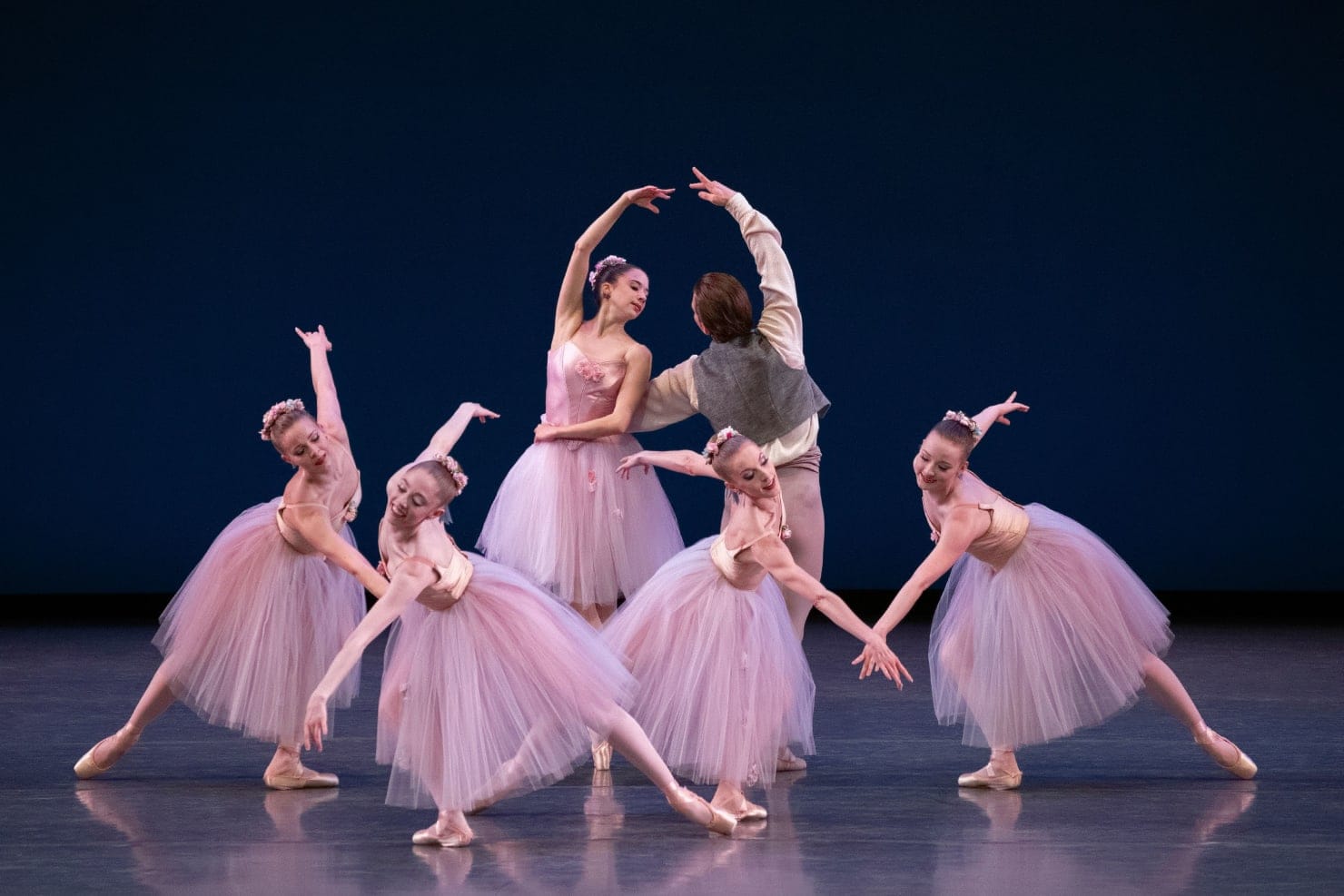
"Valse-Fantaisie", set to a wind-swept, spun sugar score, is a pink swirl of non-stop allegro dancing, led by Erica Pereira and Daniel Ulbricht supported by four energetic nymphs. Pereira's jumps and turns were lilting and airy but her rather sloppy arms and flat hands gave a rather two-dimensional air to her dancing--a bit of 19th century epaulement never hurts when dancing to Romantic melodies. Ulbricht is not a light dancer, and gave his role a welcome hint of weight setting off the lighter. He seemed not to defy gravity, but to conquer it with a plush power.
There is plenty of power in "Stravinsky Violin Concerto", especially in the first Aria, originally danced by the majestic and powerful Karin von Aroldingen. Mira Nadon, a dancer of delicate beauty, made her debut in the role. She did not have the knotty power or fierceness that Aroldingen gave the role, but she was in complete control, a molten form snaking through those odd, shifting shapes. Adrian Danchig-Waring as her partner moved with an almost desperate urgency, as if she were burning his fingers. The audience erupted at the end, refusing to stop until they returned for a second curtain call--her electric debut literally stopped the music.
Ashley Laracey and Joseph Gordon danced the quieter Aria II. The original cast had the tall Peter Martins partnering and protecting the much small Kay Mazzo; Laracey and Gordon don't have that contrast, but Laracey's fragile vulnerability and inner radiance gave the role an almost tragic dimension as Gordon tried so hard to support her as the piercing music of the violin seemed to promise some mysterious sorrow. The only sorrow I had was that this wonderfully varied program had to end.
copyright © 2023 by Mary Cargill



