To Tell a Story
"Jewels"
New York City Ballet
David H. Koch Theater
New York, NY
September 24, 2026
“Jewels” is famously described as a full-length abstract ballet, but that doesn’t mean it’s about nothing, and many of the dancers in this performance gave such detailed and nuanced attention to their performances that there were hints of narratives and emotional arcs that illuminated their dancing in fascinating ways. The was especially true in "Rubies", where Alexa Maxwell, in her debut with Joseph Gordon, and Naomi Corti as a new Tall Girl danced a “Rubies” to remember. “Emeralds”, too, had two new female debuts with Olivia MacKinnon in the Verdy role and Meghan Dutton-O’Hara in the walking pas de deux. But this “Emeralds” really belonged to the men, especially to Davide Riccardo partnering MacKinnon.
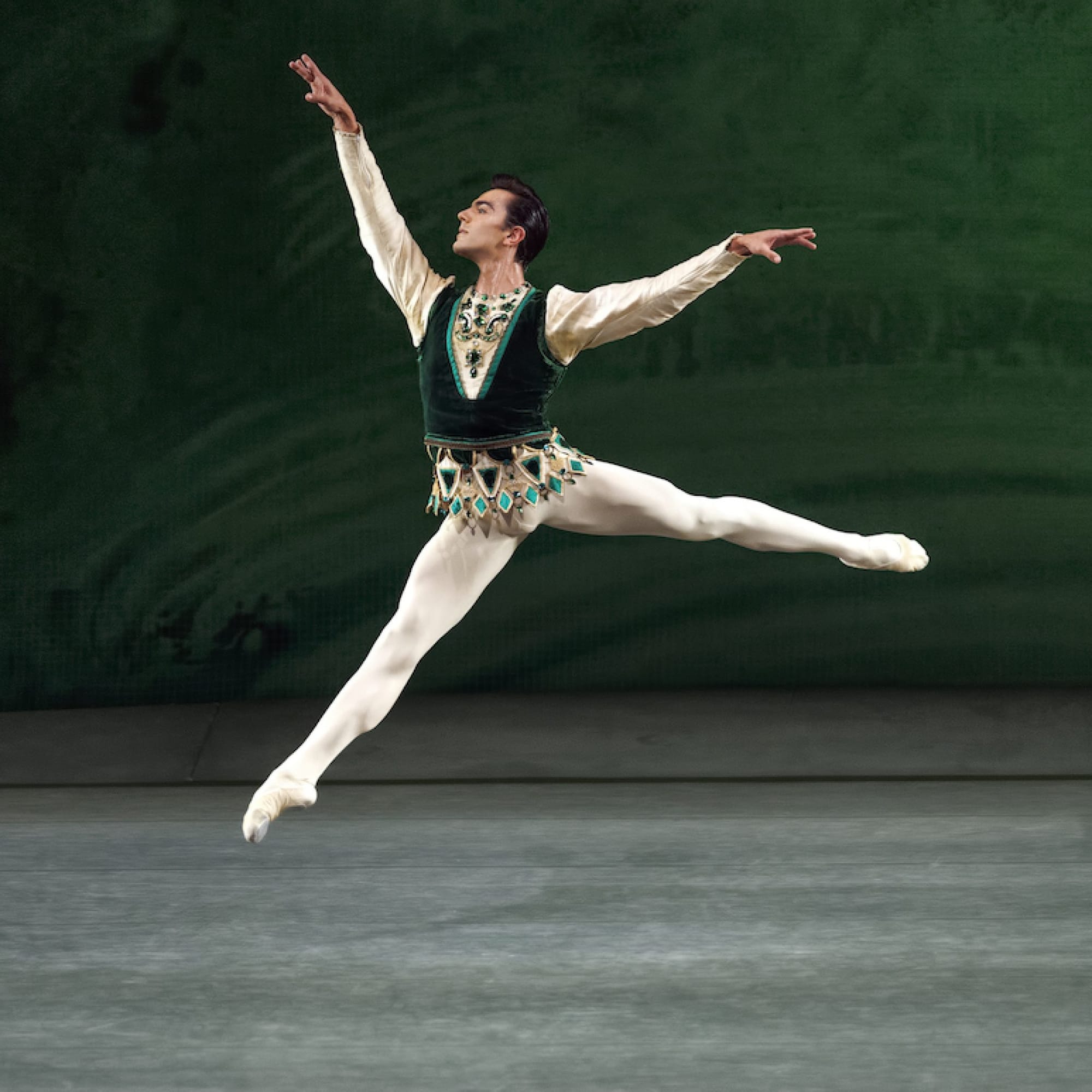
MacKinnon gave her role a light, airy feel, pretty but rather pastel. Her arms were lovely, especially in the solo, but her dancing seemed careful rather than spontaneous or personal; she seemed like a fragile sylph-like character in need of protection rather than the idealized embodiment of feminine perfection. And Riccardo was the perfect protector, focusing on her, offering his hand with a generous nobility, awed that he could see such a rare creature. His concentration never flagged and his dancing, even during bravura turns, was never flamboyant but seemed to be an extension of his thoughts and feelings. He could have been James, jumping for joy in the sylph’s forest, and the triumphant false ending seemed an ironic comment on his deluded hopes. The final resigned arm sweep was deep and potent, a farewell to his chance at happiness, embodying all those Romantic heroes in love with impossible dreams. He gave a rich and moving performance.
Dutton-O’Hara gave her opening solo a distinct personality; she was a bit more earthbound than some, tiptoeing on the ground rather than floating above it, but she had a fine interior quality, leaning into the music and letting her thoughts and feelings show. I loved the quiet deliberation she showed when bowing to her invisible partner. This partner of course showed up later in the serene walking pas de deux; Alec Knight, returning from an injury, was an exemplary squire, supporting her effortlessly.
Andres Zuniga, in his debut, was the more energetic squire, promenading with India Bradley (her debut) and Mary Thomas MacKinnon. His dancing was crisp and clear, with soft jumps and quiet landings, a fine debut. MacKinnon was especially lively, with a smooth, elegant upper body. Bradley, though, with her wiry limbs and rather sloppy hands, looked out of place. She has a fine energy, but tends to push her positions too hard, clearly working to get her leg up that extra, unnecessary inch.
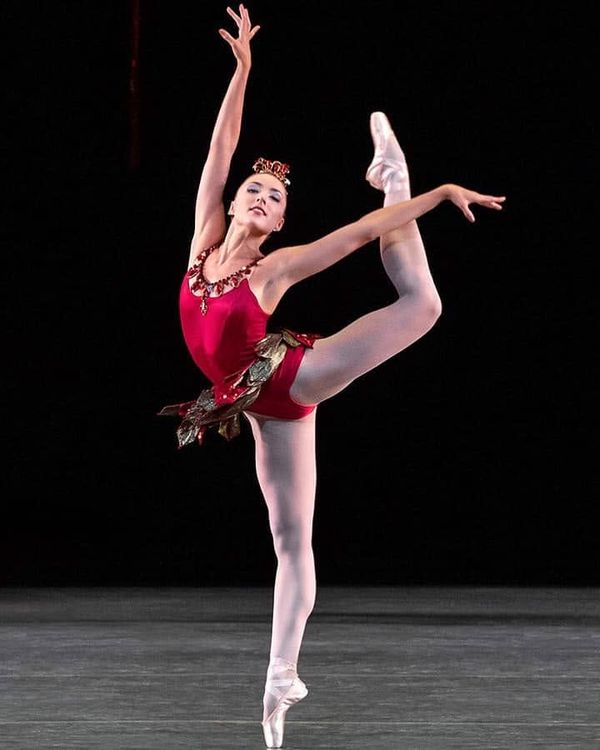
“Rubies” had a lot of energy, beginning with Corti’s confident shapes; she moved with a luxurious sensuality without any vulgarity, and seemed to revel in the four boys at her feet. Maxwell too had an almost innocent sensuality, swinging to the music. She seemed to be in charge, dancing with a casual flirtatious air, as if enjoying her freedom. Her dancing was clear, sharp, and completely captivating, submerged in Stravinsky’s rhythms. Maxwell has always been an interesting dancer, investing every role with her vibrant personality, but she, it turns out, is also a technical whiz, tossing off turns and jumps with a magnificent ease.
Gordon seemed smitten, almost echoing her moves, and was a bit hesitant to approach this flame-like creature until she gradually melted—the little arm movement as she delicately placed her pointed finger on his palm was, if not quite X-rated, very nearly so. After her surrender, he burst out with a rambunctious energy, leading his pack with bounding jumps. Gordon seemed to be glad to let his dignified classical reticence go and just have fun; it was a glorious performance with a distinct emotional arc. It was capped in the finale by Corti’s entrance, where she briefly acknowledged the couple and raised her arms as if to bless them, moving like a combination of a Vogue model and the Lilac Fairy. It pulled the work together, making her part of the lightly sketched story.
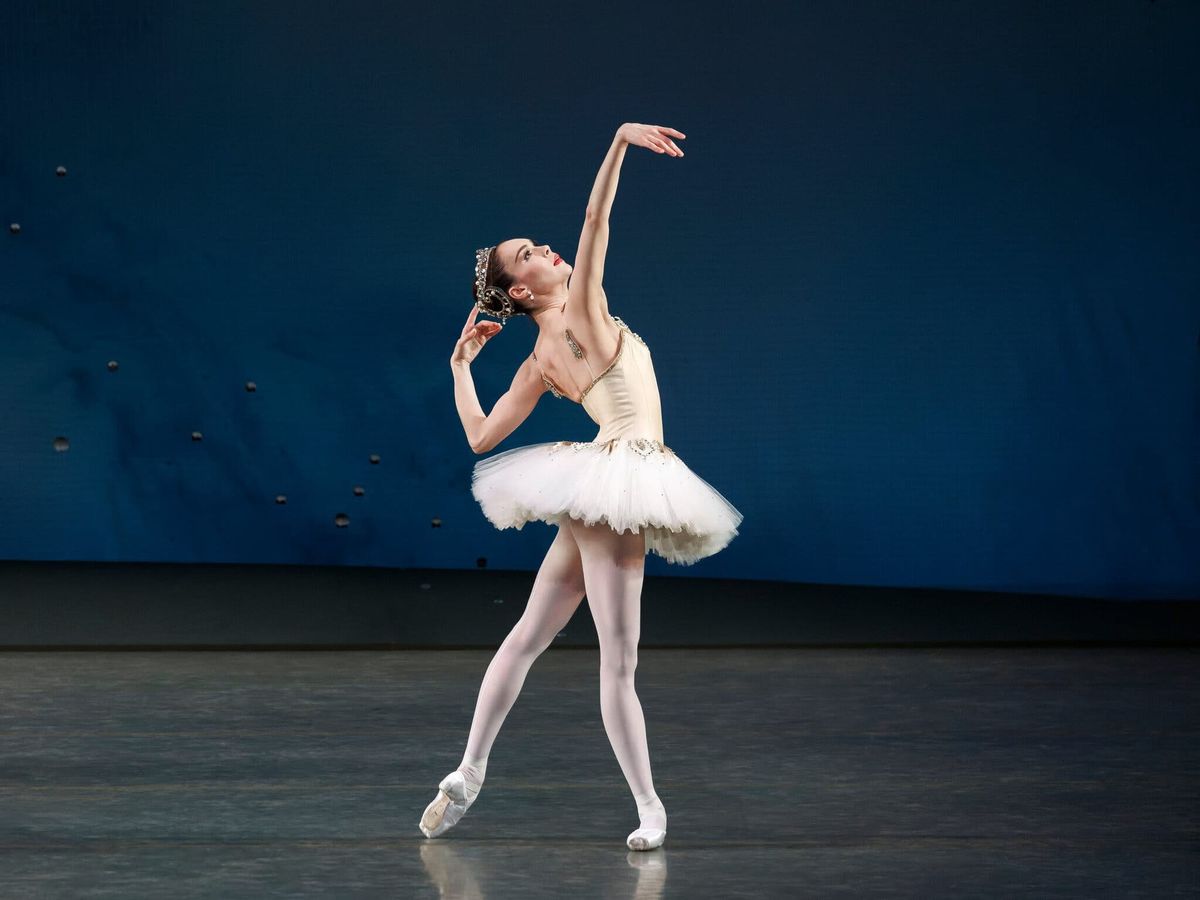
The pas de deux in “Diamonds” certainly has dramatic undertones, beautifully expressed by Mira Nadon and Chun Wai Chan. Nadon is a rare dancer, unearthly yet vital, technical yet spontaneous, beautiful yet approachable; there is little a critic can do but lean back in awe and gratitude. Her “Diamonds” is like a moonbeam reflected on water, a long, elegiac expanse of beauty. She did not make it overtly tragic and the small, subtle references to “Swan Lake” remained hints rather than statements but there was an undercurrent of melancholy that ran through her dancing; her arching arabesques seemed to reach far beyond the stage.
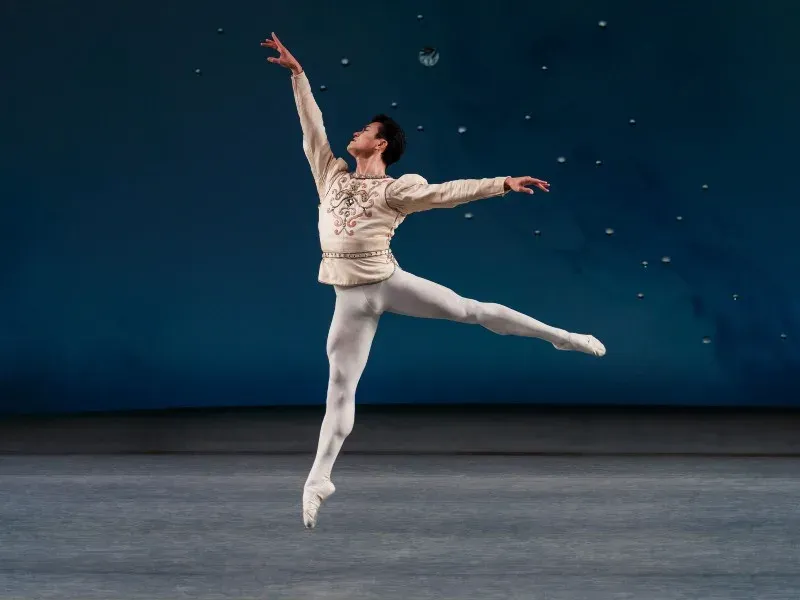
The bright scherzo, with her thrilling fouettés and quick jumps was certainly a change of mood, and she sparkled; she made it seem as if "Diamonds" had two short stories with the same characters set in different times. She gave them both an emotional logic, making chronology completely irrelevant. Chan was her elegant support. He has a warm and gracious stage presence that seems to embrace everyone, including the audience, and a soft, elegant spring in his jumps, not to mention some immaculate à la seconde turns. And he was definitely in on the story, reacting to Nadon’s emotions with an eager ease. Story telling has rarely been so moving.
© 2026 Mary Cargill