Three in One or One in Three?
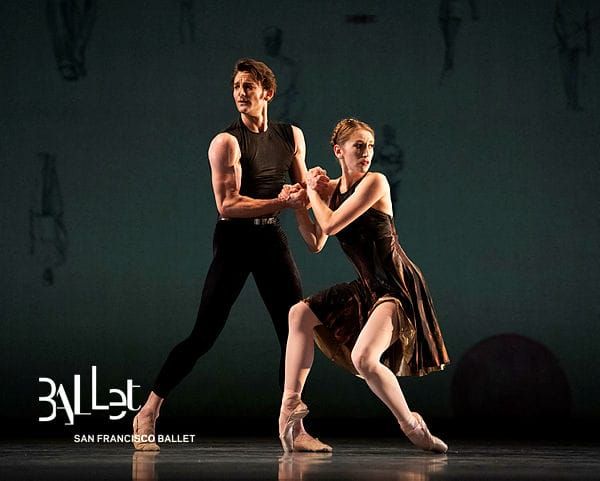
"Shostakovich Trilogy"
San Francisco Ballet
War Memorial Opera House
San Francisco, CA
May 7, 2019
Just about everybody I encountered at the reprise of Alexei Ratmansky’s “Shostakovich Trilogy,” premiered by ABT in 2013 and San Francisco Ballet in 2014, commented on how they “hate Shostakovich’s music, but love it when danced.” I am actually one of those who Ratmansky made hear the music because I could see it in the dancers’ bodies. More often than not well known music — think Arvo Part –- is really a impediment to the dance. But Ratmansky gave these scores such personal interpretations, and the ballet orchestra played them so masterfully, that I was not alone in listening to them through his refined sensibilities.
Ratmansky wants these three pieces to be seen as a unit. But a second viewing again suggested that each of them is so closely tied to its so very individual score that, I think, they could stand on their own. This viewing also highlighted the quality of SFB’s current roster of female dancers – all of them excellent and yet so different. Jennifer Stahl keeps surprising me with the depth of her interpretations; Sasha de Sola can look almost innocent despite her fierce technique; Mathilde Froustey can step almost voluptuously out of extreme reserve. And there was Yuan Yuan Tan, still SFB's prima, in a very small part – warm, giving, generous.
In the first movement of Symphony #9, the ebullience of the music recalled Stravinsky but the stenciled quality of the men’s sharp unison jumps, and needle sharp point work showed control imposed from the outside. No matter how varied the movements became, they looked frantic. You could almost anticipate that something dire was about to happen. And of course it did. The fragile lovers’ duet between Stahl, in Russian style braids, and Aaron Robison was full of tender embraces and anxious pulls away from each other. Curiously, it was Stahl who had to pull Robison into her early sense of doom. She was also the first to fall. I still wonder how Wei Wang’s splendid whipping turns and his death defying leap fit into the scenario. Was it hope or defiance?
In the Chamber Symphony, we enter a world of desperation. George Tsypin’s transparent silhouettes loomed over the ensemble. I recognized Lenin and Trotsky but could not identify what must have been other Soviet power players. With Ulrik Birkkjaer as a huge tragic figure, or as Everyman as I tended to see him, this second movement was about as highly dramatic as we are accustomed to see in ballet. It came pretty close to dance-theater. Yet despite his big gestural vocabulary and his embrace of space, Birkkjaer, bare-chested in a black suit, looked ever so vulnerable. His skin colored slippers against his black pants made him look bare-footed.
The women in our hero's life could not be more different. In the Everyman stories, they represent various stages. The sunny De Sola, a little flirtatious in escaping jetés, seemed slightly bemused by what to her appeared to be an older man. The desperately languid Pas de Deux between Froustey and Berkkjaer really needed the Corps' precisely spaced duets as a support but also to contain the pain of death. Amazingly, Tan almost tried to fuse herself to her partner. Engaging with the three women, Berkkjaer seemed full of wonder, and perhaps questions. The Corps, often in multi-level patterns, seemed to suggest a whole society.
Mungunchimeg Buriad, SFB’s Company Pianist and Soloist, gave Piano Concert No. 1, the earliest of these Shostakovich scores, a powerful performance, particularly towards the end, when with the help of trumpet player Adam Luftman, she tried to outrun the orchestra. The score was light-hearted, quite melodic, and a little piecemeal. There was a jazzy looseness to it. I thought I even recognized parts of a popular song. Maybe the music inspired Tsypin’s red fragments of political symbols that floated over the dancers. Did theie brokenness suggest an optimistic future? Yet Keso Dekker’s costumes — red in front, grey in back — suggested something else: at the very least a mixed picture.
Key to the choreography were two identical duets by petite Wona Park with Angelo Greco and the majestic Sofiane Sylph and Carlo di Lanno, the latter more in tune with each other. Performing separately and in tandem, they said what? Equality between the sexes? And did I really see the two women, facing upstage, lift the men for a split second?
copyright © Rita Felciano 2019



