Then and Now
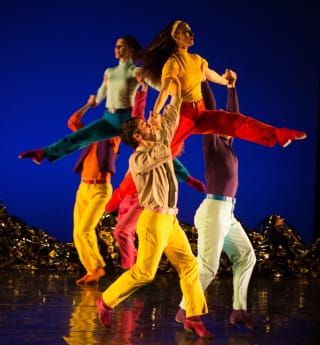
"Pepperland"
Mark Morris Dance Group
Zellerbach Hall
Berkeley, CA
September 28, 2018
Can Mark Morris disappoint? Yes and no. The recent “Pepperland” performance at UC Berkeley’s Zellerbach Hall showed his company at the top of its abilities. These magnificent dancers probably couldn’t present a sloppy show if they tried. A ballet company’s quality is in major parts determined by the quality of its corps. The Mark Morris Dance Group is a corps made up of Principals. Elizabeth Kurtzman’s delicious color-saturated, Oscar-worthy costumes were among the best I have seen. Johan Henckens’ intriguing stage set looked like collapsed cityscapes with all the lights still on. I was ready to be entertained.
Yet almost immediately Morris choreography also reminded me that the ebullient “Sergeant Pepper's Lonely Hearts Club Band” was issued in 1967. It was a horrible time with the civil rights struggle and the War in Vietnam tearing up the country. It was also the time of the draft when those unlucky not to have teachers who inflated their grades were called up.
While Morris surely had in mind the walking dances of his youth, “Pepperland’s” were strangely impersonal, blank-faced versions. These unisons uncomfortably recalled the military’s basic training discipline that is designed to break down individual identity and have the group become the all-dominant reality.
But Morris is a very good choreographer. He infused those impersonal chains, spacings and swinging arms with accents of skipping, semi-plié, and, particularly splendid, a series of bourrées. And Lauren Grant with the help of some friends, simply flew over all this bobbing. Yet despite their variety, the patterns’ communicative impetus waned pretty quickly; they became oppressive and, worse, they disengaged attention.
Despite these problems, "Pepperland" also shone in moments of sheer brilliance, often with wit and generosity. In the ‘Magna Carta’ section, a single gesture characterized the greats of this world, already memorialized on the album’s cover. A disintegrating kick line in ‘When I’m sixty-four’ sent exhausted and confused participants to the sidelines where they kept cheering the survivors. With only two left, Mica Bernas hiked her partner over her shoulders and wobbled out.
In ‘Within You Without You’ and Iverson’s approximation of a sitar, Dallas McMurray, a Buddha with sunglasses, reposed in a yoga position, oblivious to the ebullient ensemble around him. Equally oblivious was a frantically gesturing Noa Vinson in a spot behind him, apparently caught in the center of a maelstrom. Then with a few casual steps McMurray’s liberated both of them.
Yet "Pepperland" just never fully engaged. That’s when Balanchine came to the rescue. “If you don’t like what you see, listen to the music,” he famously said. Iverson may be best known as a jazz artist but here he had plucked small parts of songs and wove them into a seamless but always telling tapestry of original compositions. The seven musicians offered offered jazz from stage right, baroque from stage left with brass and percussion in between. Harpsichord and saxophone co-existed amiably. A Theremin took the place of a soprano to Clinton Curtis’s resonant baritone. I was pretty sure I heard some Bach as well as a New Orleans funeral band. “Pepperland” is carried by its music. In that respect it reminded me of “Revelations.”
copyright ©2018 by Rita Felciano



