The Scottish Musical
"Brigadoon"
New York City Center
New York, New York
November 16, 2017.
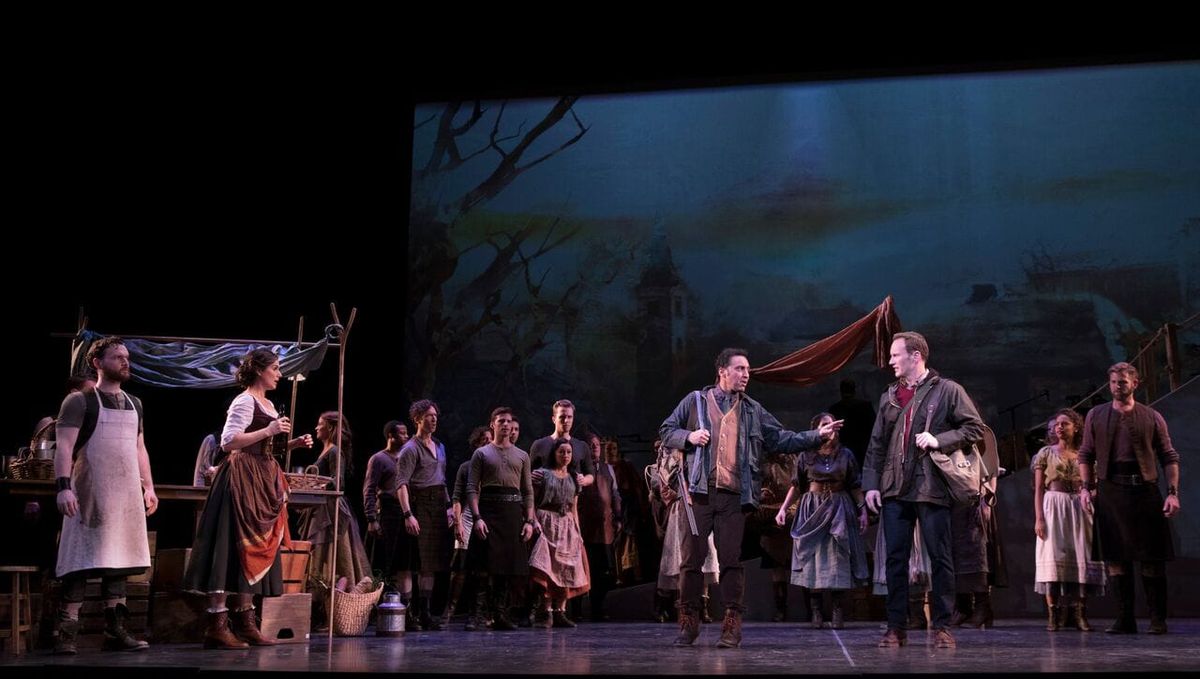
New York City Center's Encore Series has traditionally given revivals of musicals in stripped-down, partially staged, script-clutching performances, offering current stars a chance to perform those glorious songs without having to commit blocks of time to rehearsals. The series' gala production of Lerner and Loewe's "Brigadoon", directed and choreographed by Christopher Wheeldon, did have glorious songs, but it was fully (if economically) staged and the actors, complete with valiant attempts as Scottish accents, had memorized their lines, much to Romance's benefit. It is hard to make a kiss convincing which reading from a script.
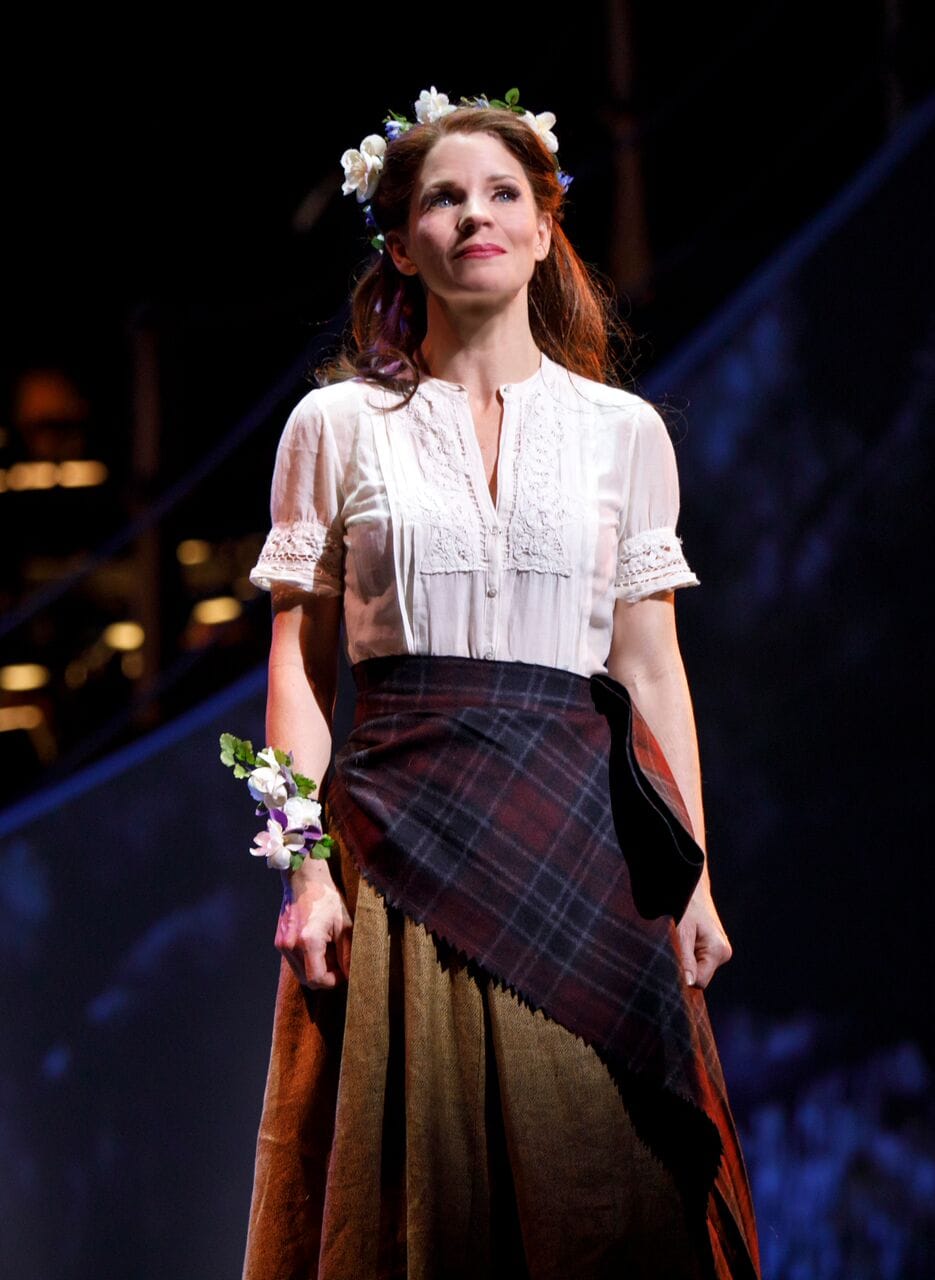
The story of a magical Scottish village whose residents could avoid all the tragedies of modern life certainly resonated with the war-weary audiences of 1947, especially when that Highland Shangri-La was so full of beautiful songs. The songs remain potent, especially when sung by Kelli O'Hara as Fiona MacLaren, the lassie who was waiting for her dearie. O'Hara's voice combined power with a richly moving purity and she made Fiona a believable and sympathetic icon of feminine determination, a loving woman who wasn't about to settle for just anyone. Her version of "Waitin' For My Dearie" with its contrast between the soaring confidence in the laddie wandering free and the quiet, tremulous sweetness of that final "Me" was unforgettably beautiful.
Patrick Wilson, as Tommy Albright, the jaded New Yorker who met her standards, also had a powerful, if somewhat generic voice. He was a bit overshadowed by the comic timing of his cynical, drunken sidekick Jeff, played by Aasif Mandvi.
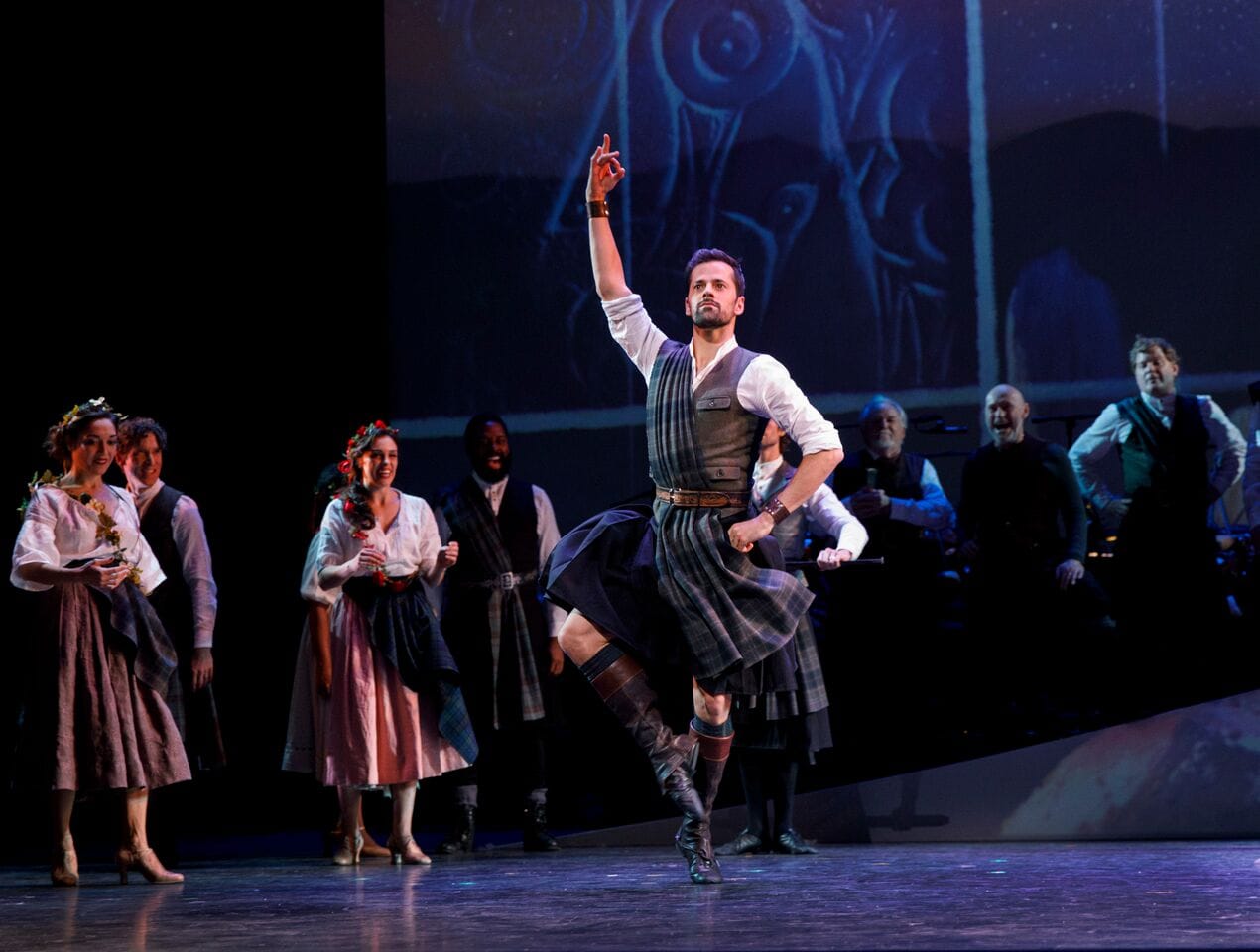
Robert Fairchild, a darker version of Jeff, without the jokes, played (or rather danced) Harry Beaton, the disappointed loner, doomed to that small village throughout eternity. Fairchild, sporting a scruffy beard and a Scottish burr, gave Beaton a sullen vulnerability, a James Dean in kilts. His dancing, especially in the semi-traditional sword dance, was passionate, weighty, and graceful.
These adjectives, unfortunately, did not apply to most of the other choreography, which was either generically balletic or Graham-lite, with lots of huddles and finicky, expressionistic arm movements. The self-conscious artifice of the choreography did not mesh with the sometimes gritty drabness of the costumes (designed by Emily Rebholz), which looked as if they had been marinated in peat. Any connection between the dance moves and a Scottish village seemed accidental.
The second act, too, was a bit problematic, as it lurched from tragedy to comedy and back again, beginning with Harry's death, moving to a comic wedding song, followed by a grim staging of his funeral, and then on the blissful romance of Tommy's love summoning Fiona as they disappear into the mist. Poor Harry went from tragic hero to forgotten postscript with disconcerting speed, and his memory was not helped by the overwrought choreography for Patricia Delgado as his chief mourner. This powerful dancer, formerly with Miami City Ballet, was saddled with dry heaves, invisible drums, and lots of wide-spread legs, so at odds with the fierce dignity and timeless keening of the accompanying bagpipe.
But, oh, those songs! Ross Lekites, who would go home with Bonnie Jean, sang a warm and loving "Come to Me, Bend to Me", which surely deserved an encore or two. Stephanie Block was a whirling dervish as Meg Brockie, the half-gypsy good time girl. Her two songs started with a frenzy and had no where to develop (perhaps due to the direction), though her timing and diction were impeccable. And Kelli O'Hara could make the most squalid hovel seem worth waiting for.
Copyright © 2017 by Mary Cargill



