The Heart of the Matter
"Crime and Punishment"
American Ballet Theatre
David H. Koch Theater
Lincoln Center
New York, New York
October 30, 2024
As Oscar Wilde wrote “all bad poetry is sincere”. The same can be said for all forms of art, as unfortunately Helen Pickett’s “Crime and Punishment”, ABT’s new ballet, shows. In a recent interview in the “New York Times” Pickett described her fascination with Dostoevsky’s famous novel and talked about her dedication in turning it into a ballet. She did describe the murderous Raskolnikov as “a family-loving, generous, self-sacrificing fighter against injustice”, though, so perhaps she used a different translation than the one I read. She certainly absorbed the plot details, which appear in 20 scenes plus a prologue and an epilogue, all in two hours, racing through the events at the speed of a classic comic book. This episodic approach tends to emphasize the more minor characters, leaving Raskolnikov haunting the edges of the action in constant agony. The basic themes of the book, Raskolnikov’s specious rationalization justifying his murder of the repulsive old pawnbroker (as a superior being, he has the right to commit any crime to further his ends) and the poor prostitute Sonya’s religious beliefs, exemplified in the parable of Lazarus, are almost completely obliterated.
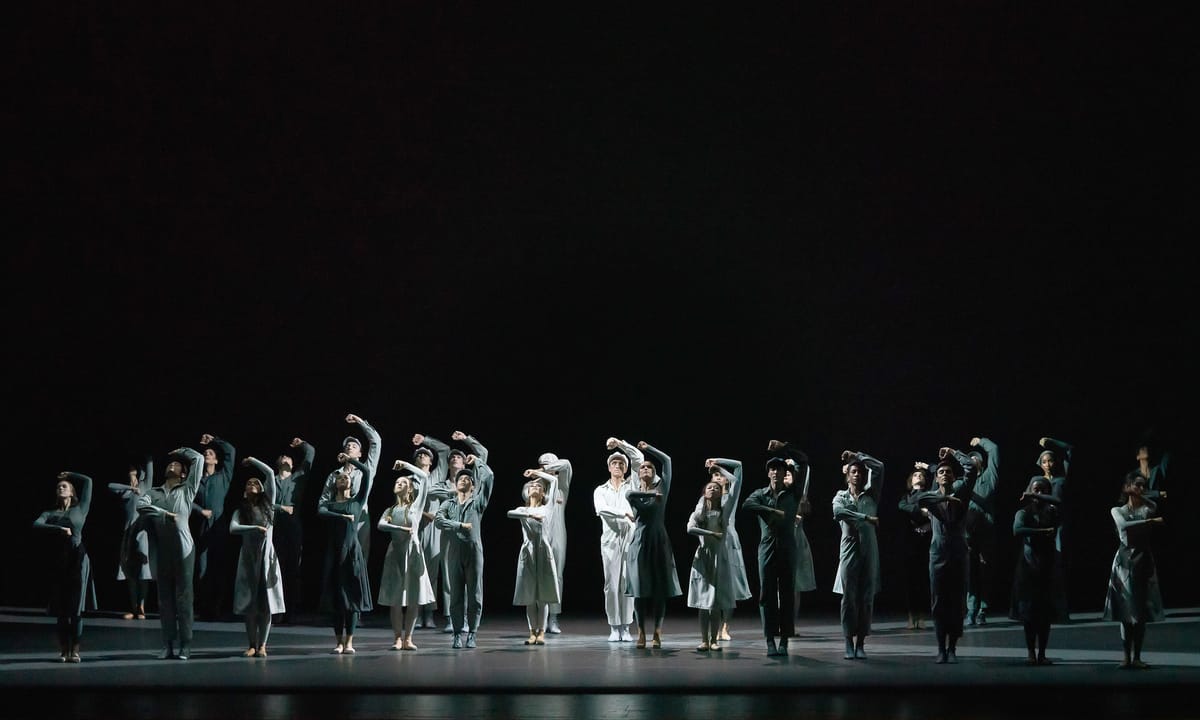
Designed by Soutra Gilmour, the ballet has a modern, timeless feel, with the many scene changes indicated by dancers moving a bed, a desk, and three large rectangular wheeled plywood boxes around against a dull grayish background. The large cast is also in dull gray or black, with a few exceptions, mainly Sonya, the sainted prostitute in yellow, Dunya, Raskolnikov’s lovely sister in blue, her pompous fiancé Luzhin, in purple,and Porfiry the police detective in brown. The music, composed for the ballet by Isobel Waller-Bridge, is effective in a movie-score way, with a lot of percussion for the frequent bursts of agony, soaring in the few pas de deux, and nice harp sounds when Sonya shows Raskolnikov a book, presumably a Bible.
The choreography alternates between energetic bursts, open-armed backbends, and static exposition, where the characters wave their arms around, miming, it seems, in a foreign language since the gestures, other than Dunya pointing to her ring finger and pushing her hands away clearing saying “I will not marry you”, are completely meaningless. The frequent silent film-like inter titles projected on the scrim do help to explain the action but “Raskolnikov wakes up in a sweat. There has been a murder.” is about as profound as it gets.
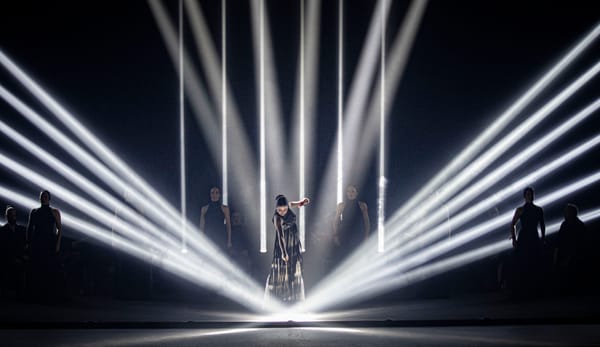
There are three viewings of the murder projected on the scrim via a video by Tal Yarden (Raskolnikov has several nightmares) and several other deaths. Marmeladov, Sonya’s drunken sot of a father, dies from a fall and his wife breaks down in grief (since he drank his pension away and let his daughter prostitute herself to support the family, this does seem excessive), finally dying herself of tuberculosis, signified by a recording of loud coughing. Then they are apparently forgotten as Sonya, who in time of stress turns to bourrées, comforts Raskolnikov. Svidrigailov, Dunya’s former employer, gets a dramatic suicide near the end of the ballet, as he climbs some stairs, stops in a brightly illuminated shaded door and shoots himself; this is striking but has no noticeable bearing on anyone else in the work and comes across as padding.
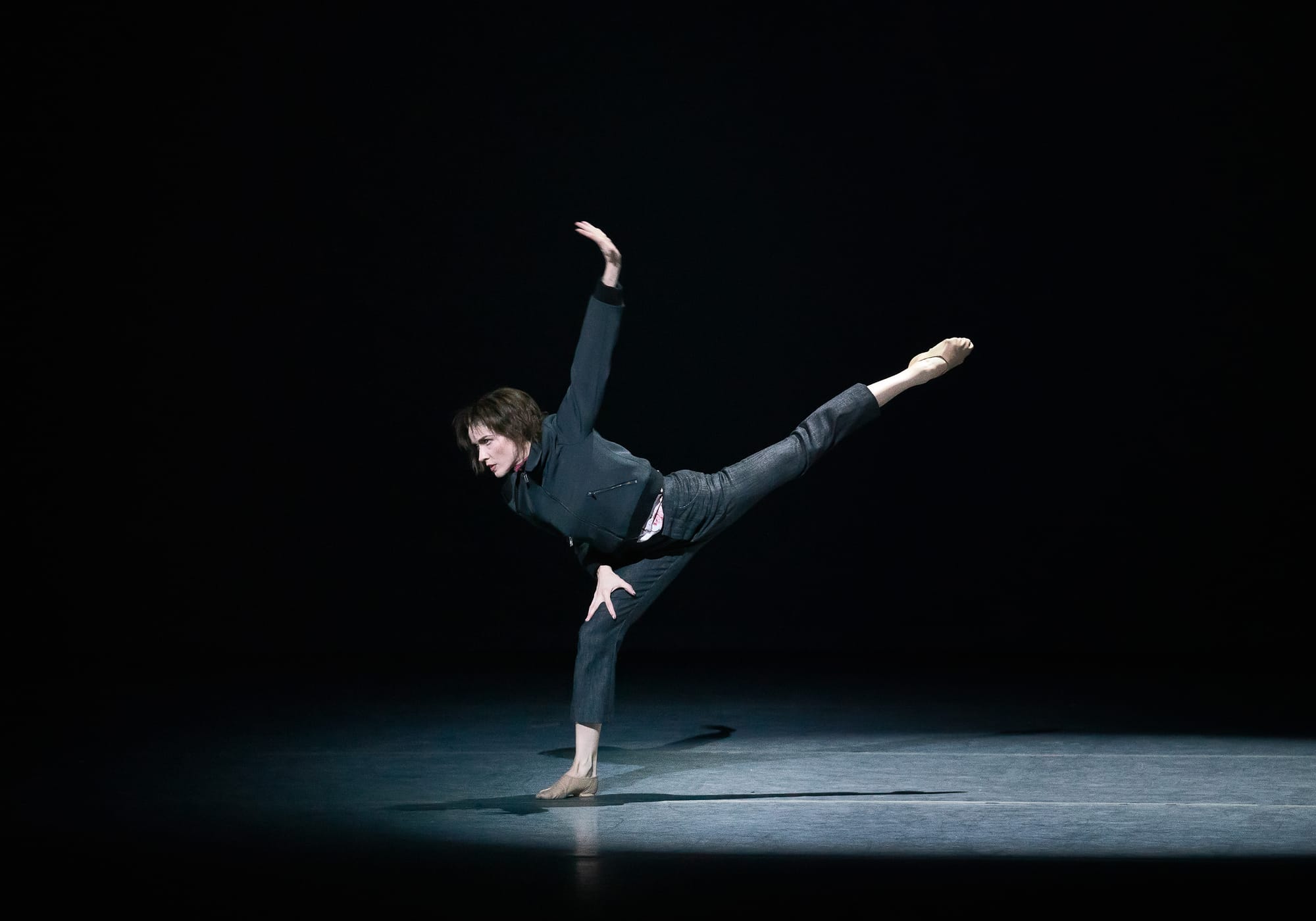
The dancers certainly gave dedicated and hardworking performances. Cassandra Trenary was an electric bundle of concentrated fury as Raskolnikov; the gender neutral casting seemed irrelevant as she spent most of the time waving her arms and contracting in a ball, and other than holding hands a few times with Soyna, there was no partnering required. Her small frame gave Raskolnikov a slightly adolescent air, and the final reconciliation scene in Siberia had a frail pathetic dignity. Otherwise there was little variety in the choreography and little depth; Raskolnikov explained his ideas of ubermensch superiority to the barroom mass by apparently conducting a military band. The complicated relationship between Dunya (Christine Shevchenko) and Luzhin (Joseph Markey) was never spelled out (the surtitles would have been useful here), and other than wearing purple and dancing with his legs crossed, Luzhin seemed like a pretty nice fellow, so when Raskolnikov attacked him, Trenary just looked like an unhinged pest.
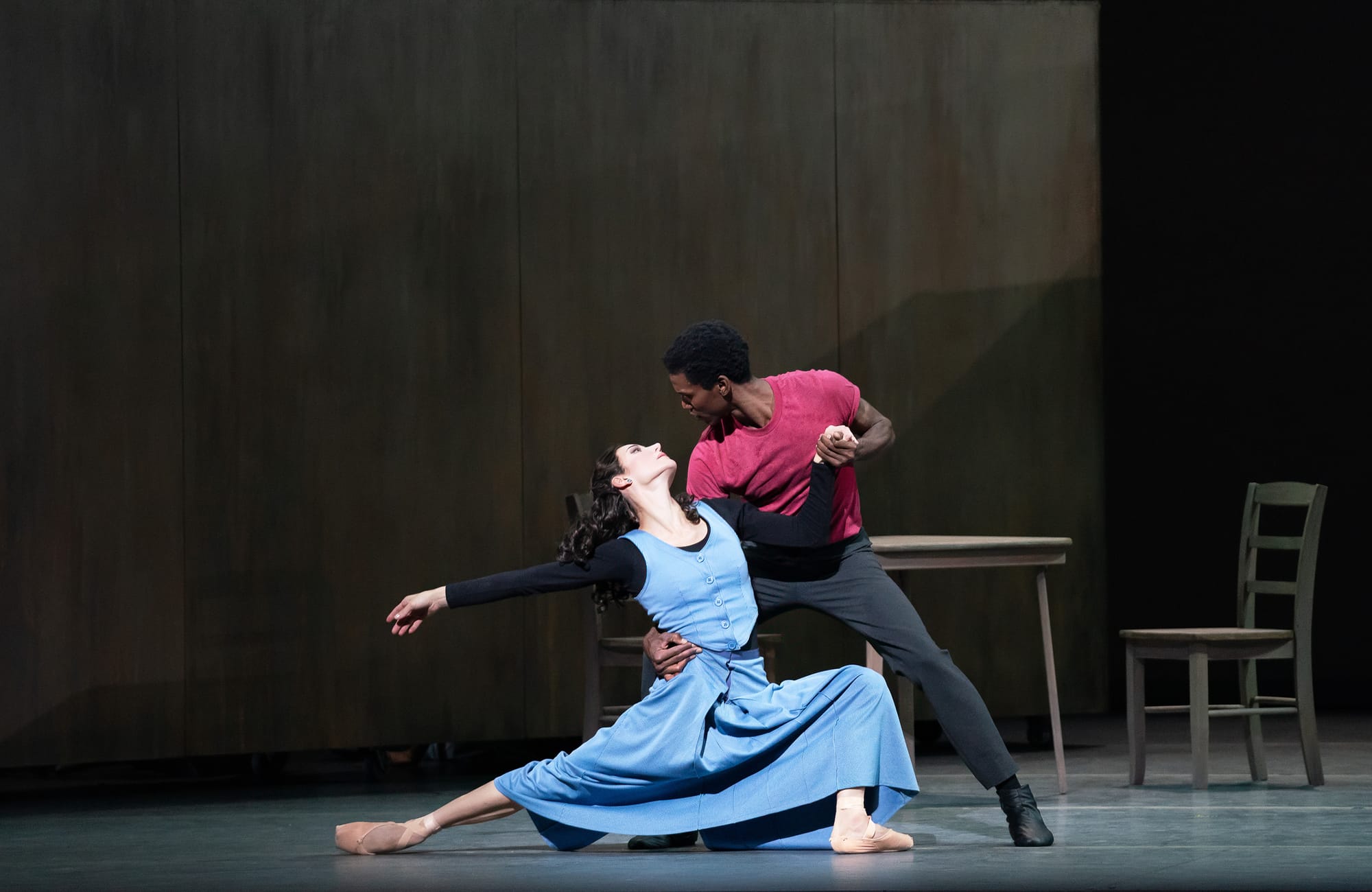
Shevchenko gave Dunya a lyrical flow, and she and Calvin Royal III, who danced Raskolnikov’s buddy Razumikhin with a warm and openhearted generosity, had the most sustained dancing of the evening. Shevchenko even managed to make it almost believable that, having just fought off a rape attempt by Luzhin, attempting to shoot him, and discovering that her brother was a murderer, she would fall into Royal’s arms for an exalted pas de deux with lots of triumphant ice dancing lifts.
The many other roles were also well danced. Sunmi Park, as Sonya, had a radiant simpleminded simplicity. James Whiteside as Svidrigailov was suitably smarmy, and Thomas Forster as Porfiry, the police detective, gave the role a dignity despite his ambiguous choreography. (In the book he decides to allow Raskolnikov to confess rather than arrest him right away, so that he won’t be hung—none of that made it into the ballet.) Pickett introduced a new character, the Ever Watcher (Melvin Lawovi), who appeared now and then before Raskolnikov with his hand raised, presumably a manifestation of his conscience, though Pickett had him confess to the murder by simulating wielding an axe, letting Raskolnikov off the hook. (Porfiry seemed not to notice and kept after Raskolnikov.) Lawovi gave him a mysterious, slightly ominous air, which was very impressive. But since Pickett has concentrated on external incidents rather than psychological motivations (flinging hands and generalized agonized expressions aside), it seems that anyone who has read the book will find the ballet irrelevant and those who haven’t will find it inscrutable.
© 2024 Mary Cargill