The Dancers Have It.
"Take Five" "The Man in Black" "Carmina Burana"
Smuin Contemporary Ballet
Cowell Theater
San Francisco, CA
September 27, 2019
Smuin Contemporary Ballet’s sixteen dancers opened the company’s 26th season with an infectious verve and the confidence to take on whatever might come down the line. (The fact that soon they will move into a home of their own just may have contributed to the upbeat mood). They also welcomed five new colleagues, some of whom already brought their own stamp to the show. They are Zachary Artice, Ricardo Dyer, Cassidy Isaacson, Joao Sampaio and Brennan Wall. So this was an evening to cheer for the performers even though you might only want to see one of three choreographies again. That would be James Kudelka’s 2003 “The Man in Black.” Former company member Rex Wheeler’s “Take Five” opened the program. Set to Dave Brubeck, the piece is an extension of an in-house choreography from 2018. Bringing up the evening was Michael Smuin’s 1997 Carmina Burana. I have yet to see satisfying choreography to that score. So the dancers had to carry it such as it is.
Wheeler set the Brubeck selections on five couples, mostly dressed in Kool-Aid red, for a piece that bubbled with charm and a sense of ease. After the opening clapping tutti, newcomer Isaacson confidently jetéd in to partner Peter Kurta in the classic ‘Take Five.’ Throughout the work lifts and throws abounded as did slithery slides, showy extensions, buoyant jetés and quicksilver partnering. Two dancers forming a mirror for others to admire themselves in became a recurring image. Some of “Take” looked like a tribute to the late Michael Smuin. Wheeler’s deft touch with his appreciative dancers was appealing but the material needed more variety. Maybe expanding the original work was not that good an idea. With the exception of “Camptown Races’, a trio performed by new company members Sampaio and Artice plus Kurta, the choreographer’s approach to Brubeck escaped me. In his first appearance Artice showed touches of technical and expressive potential.
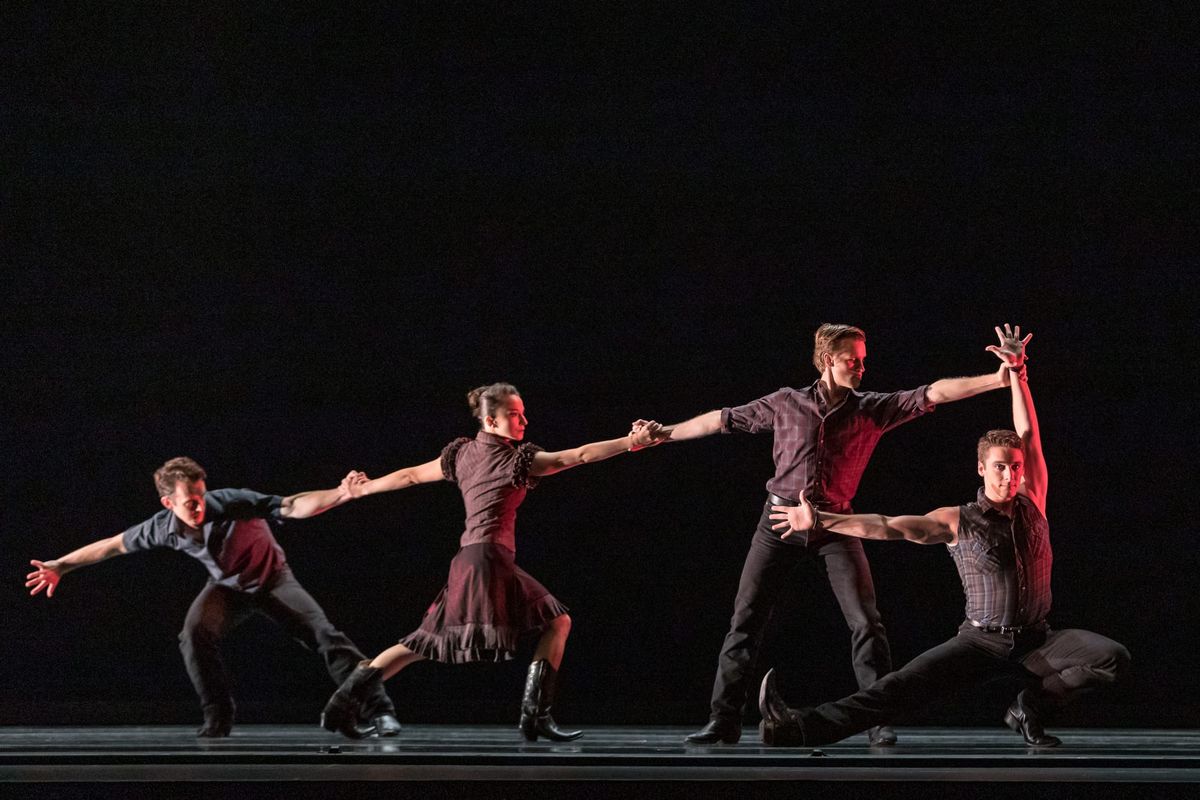
Bringing Kudelka’s “The Man in Black” into the company rep may have been one of Artistic Director Celia Fushille’s smartest choices yet. For one thing, as it was choreographed on four dancers, it allows for multiple castings. And then, how often do ballet dancers get an opportunity to don cowboy boots and engage in line dancing Country Western style? Set to tracks chosen and performed by Johnny Cash late in his life, this is music of a man looking back. Danced here by Buchanan, Kurta, Ben Needham Wood -- in his last season with Smuin -- and the petite powerhouse Terez Dean-Orr, the work reminisced about a life full of conflict, tenderness, failure and pain but also an odd sense of fulfillment.
I don’t do “Best of the Year” anymore but if I did, this Kudelka work would rate high because of how tightly he wove the movement motives together and for the resonance of their individual and every so human moments. These people pulled and yanked at each other, broke the unisons, climbed over each other, stamped on at least some of them but always came back together. With their blank looks they could have been the same person torn apart by life. The tapping heels and sliding feet became a kind of universal bass note, resonating beyond the theater.
I can never forget that Carl Orff composed “Carmina Burana’s” obsessive beats in the Germany of 1936. But, fortunately, the Smuin dancers put all of their beautiful humanity into what couldn’t be helped. Long-limbed Tessa Barbour, a high stalking Fortuna, became magnificent, both royally domineering and oozing sexual allure. Her unfolding from an egg-like position, supported by pumping legs from men on their backs, was a fine Smuin touch. In ‘Ecce Gratum,” Maggie Carey’s fine piqués and hops in arabesque perfumed the duet with Buchanan as her young lover. I thought it was both sad and hilarious the way Sampaio slowly reached up from the floor, exposing his bare chest into deep cambré in what quite literally was a swan song. The choreography for the company men who joined the male trio (Wall, Kurta and Dyer) for ‘Swaz hir got umbe’, thankfully avoided some of the male “debauchery” of other settings. At the end of the evening the Smuin dancers deserved every bit of the applause they received.
copyright © 2019 by Rita Felciano