Thanks for the Memories
"Brandenburgs", "Rewilding", "Cascade"
Paul Taylor Dance Company
Neidorff-Karpati Hall
Manhattan School of Music
New York, New York
June 23, 2019, matinee
The final performance of the Paul Taylor Company's part of the Orchestra of St. Luke's Bach Festival was a heartfelt farewell for many in the packed audience, as it was their last chance to see so many members of the company Taylor molded by the choreographer – six members are retiring soon and it will inevitably be a different company. The audience especially cheered Michael Trusnovec's 22-year career with flowers and tears, as a long-time partner Annamaria Mazzini, a dancer who matched his passionate generosity, presented him with a bouquet and a hug.
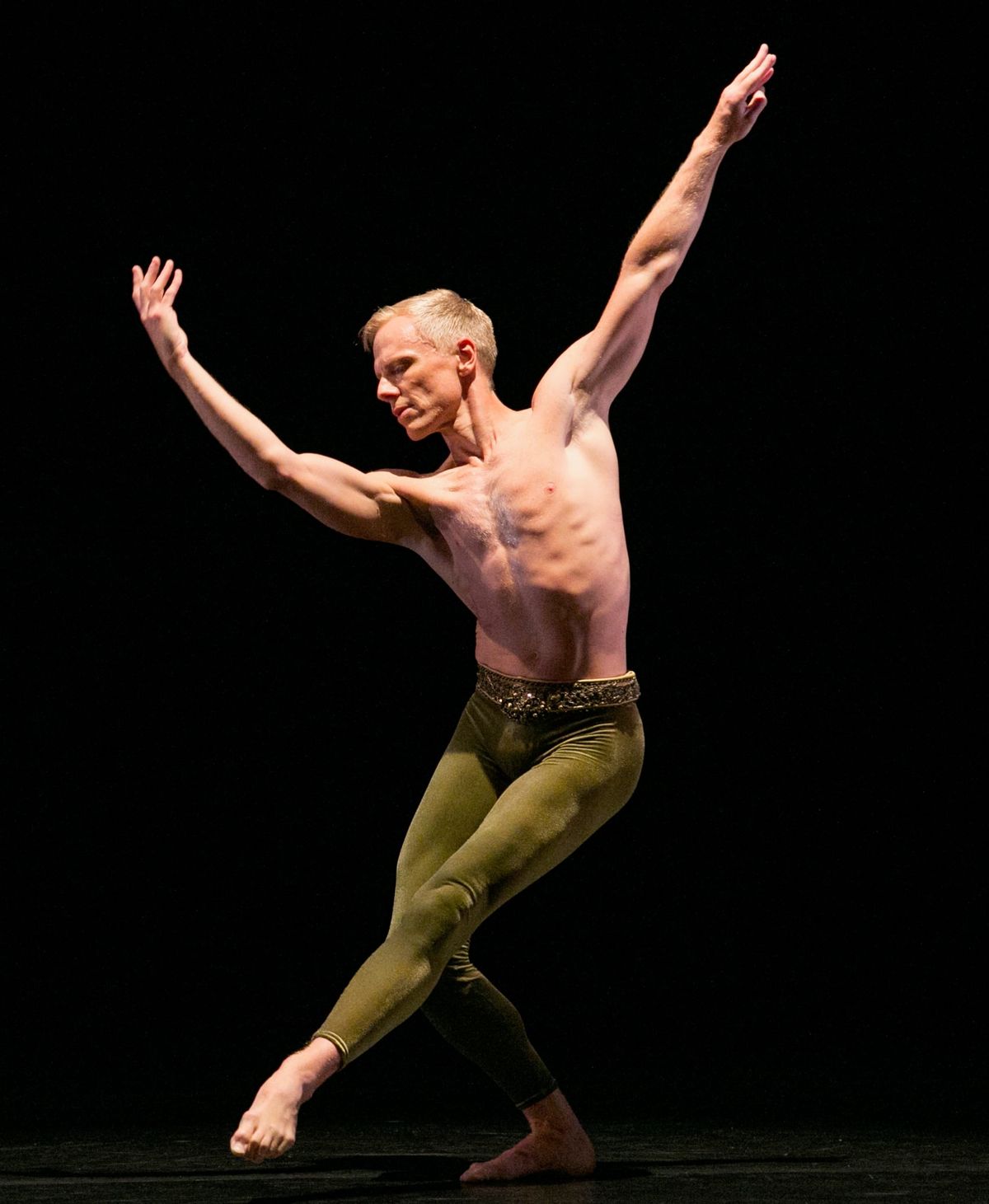
Though Taylor choreographed "Brandenburgs" in 1988, long before Trusnovec joined the company, the rich, joyful harmony of the work exemplifies many of the dancer's outstanding qualities. Underneath Trusnovec's classical form, a form of rare, sculpted beauty, there is a wiry intensity. His solo, performed stage left in a circle of light (rebalancing the classical harmonies of the opening and closing symmetries of the work) was liquid marble as he moved effortlessly from one balance to another, solitary yet hopeful, as he reached upwards with a slow deliberate gesture, encapsulating, it seemed, human aspirations.
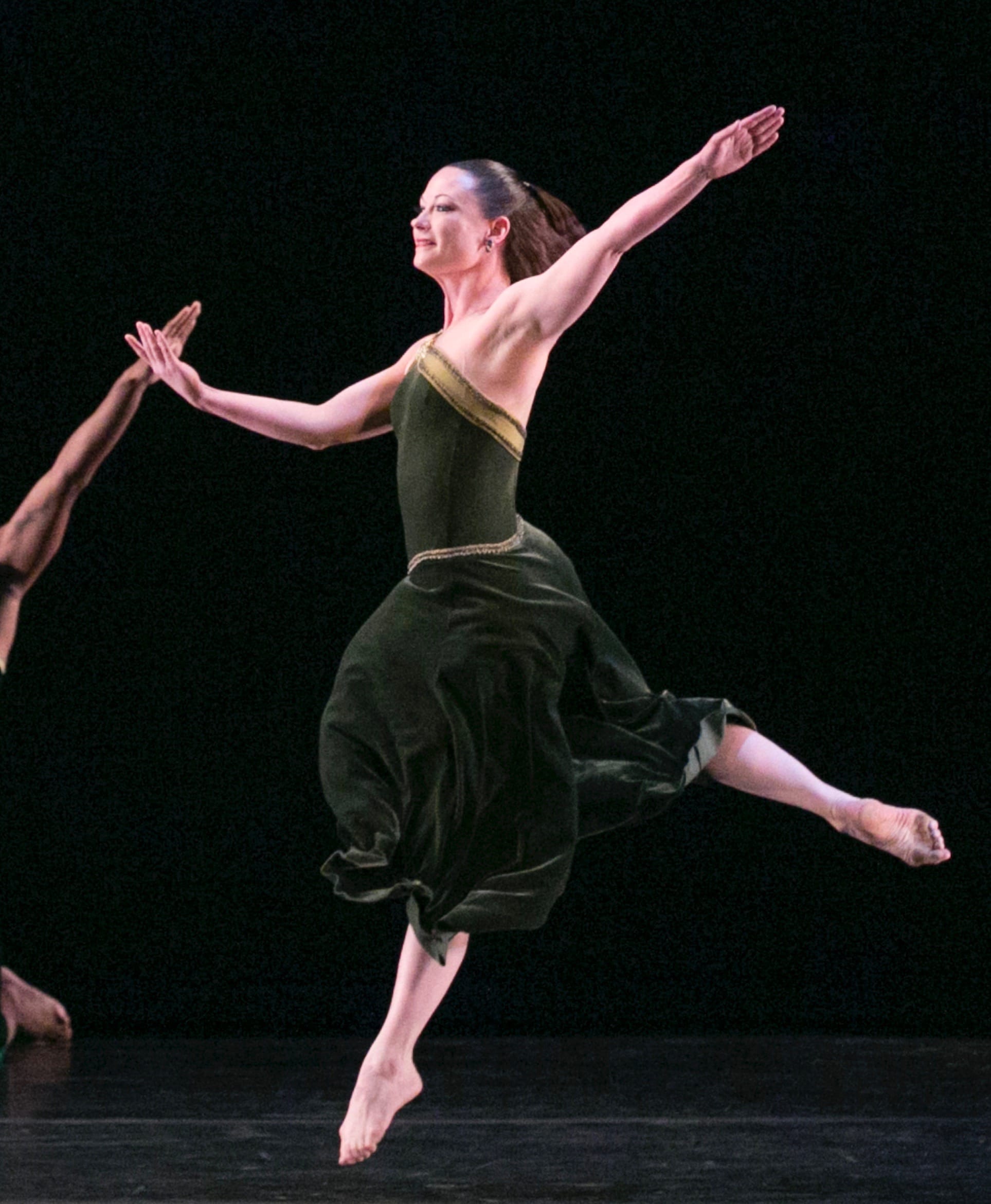
His three companions (Erin Bugge, Christina Lynch Markham, and Laura Halzack; this gracious, statuesque dancer was also saying goodbye to New York) revolved around him, dancing with solos with a special juice, Halzack showing immaculate balances, Bugge twisting her torso with a ravishing seductiveness, and Markham skipping through Taylor's petite allegro with a charming abandon. For all its thrilling choreography, so full of Taylor's bounding leaps, Trusnovec's simple, powerful gesture – his contemplative, weighted walk and his generosity as he slowly offered his hand to his partners, turning them as if showing off a jewel –is what glows in my memory.
Taylor's 1999 "Cascade" is a more reticent work than "Brandenburgs", with Trusnovec leading Michelle Fleet (who is leaving in November) in a formal, stately measure. The work's atmosphere is obliquely Elizabethan, with burnished copper lighting glowing like firelight, men in stylized jerkins, and women in modified farthingales, and the choreography nods to court dances.
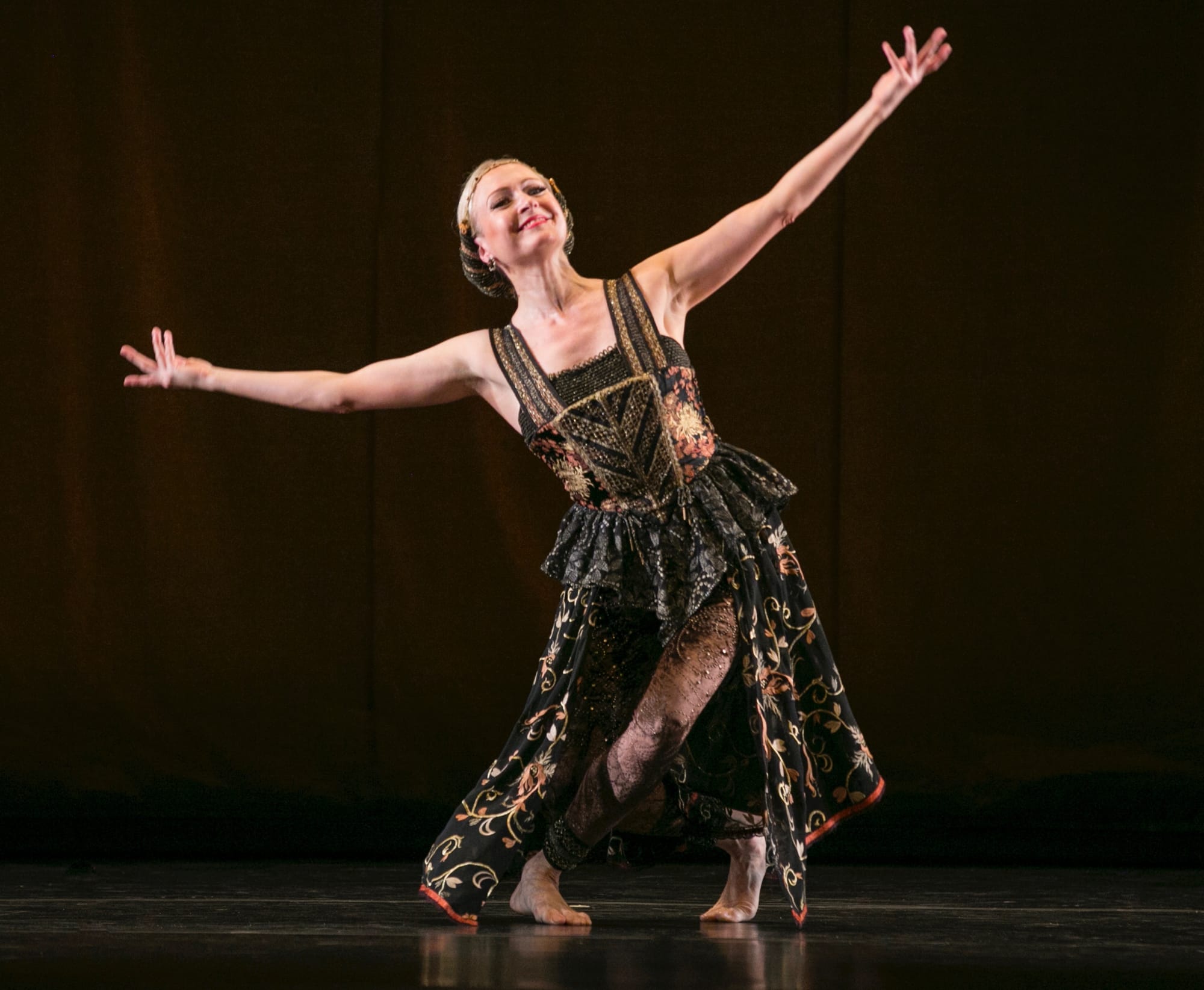
Jamie Rae Walker (leaving in November) had a delicately mournful solo, full of curtseys to an invisible partner. Trusnovec's dance with Fleet had a rare coolness, with little physical contact until the final, gentle pose with Fleet resting her head on Trusnovec's shoulder. It looked as if they were a couple approaching an arranged marriage, wary yet hopeful, with powerful but controlled emotions; Taylor, for all his bounding joy, did choreograph for grownups.
The audience's reaction was powerful and quite uncontrolled, saluting Trusnovec for all those years of powerful performances. As he stood among the flowers, so many memories returned – of his golden god roles of course, but also of the grim, conscience-stricken soldier in "Last Look", the vicious predator in "Banquet of Vultures", the comic roles like the prissy naval officer in "Offenbach Overtures", and perhaps most of all the heroic decency of his Everymen; the doomed soldier in "Sunset", the young farmer in "Eventide" fading into the mists of time, and the unemployed Depression-era worker of "Black Tuesday's" Brother Can You Spare a Dime, who survived World War I but was doomed by a power he could not fight. Time is a power no one can fight either, but the audience was profoundly grateful for those 22 years.
Copyright © 2019 by Mary Cargill



