Sublime and Ridiculous
"Divertimento No. 15", "Tschaikovsky Pas de Deux", "Carnival of the Animals"
New York City Ballet
David H. Koch Theater
Lincoln Center
New York, New York
February 14, 2025
This evening’s performance began with two of Balanchine’s gloriously classical works, the celestial “Divertimento No. 15” to Mozart and the whipped cream “Tschaikovsky Pas de Deux” and ended with anthropomorphic animals of Christopher Wheeldon’s “Carnival of the Animals”; both the opening and closing ballets were stuffed with some of NYCB’s most intriguing dancers. The audience seemed very happy, though some did seem to be confused by the pause between the first two works, and their rushed returns did disturb the opening of the pas de deux.
There was no confusion during “Divertimento No. 15”, and its limpid stream of dances flowed with an elegant precision. All sixteen dancers (eight soloists—three men and five women and eight female corps) danced with a warm yet slightly remote aura, acknowledging each other—there were many courtly révérences but no fixed grins directed at the audience. It seemed watching an elegant, comfortable, and exalted conversation between the most magnificent people in the world.
There were two debuts, Mira Nadon in the first variation and Jules Mabie, who danced the Theme with Aarón Sanz. Mabie and Sanz looked very well together, and both were noble (Sanz’s upper body was especially gracious) and generous. Their brief solos had a hint of competition, just to make things lively, but there was nothing flashy or ostentatious about their dancing. Nadon’s height made getting around the quick little steps of her solo a bit of a challenge, but her extensive line and gentle flow gave it a lovely glow. The other solos were also very well danced; I love the way Balanchine had them come on just as their predecessors were ending, so there were no breaks in that beautiful chain.
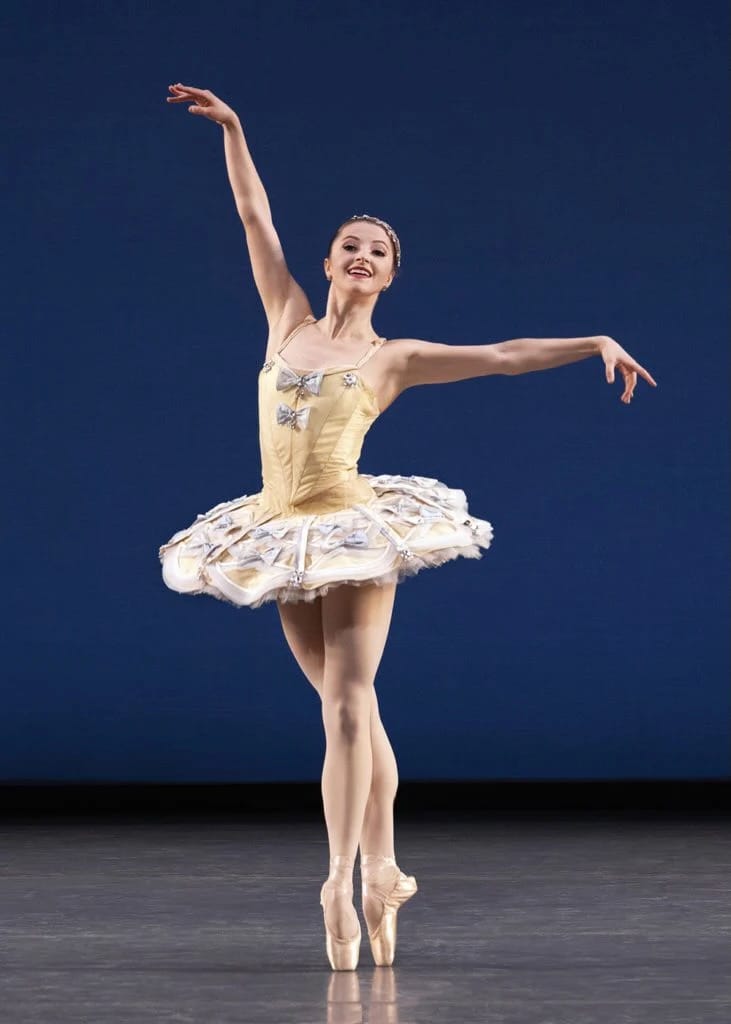
Ashley Hod, in the second solo, gracefully accented the little syncopated moves, and her long arms were especially eloquent. Ashley Laracey’s leggy twisting moves and airy lightness in the third solo were confidently expansive, as were Emily Kikta’s swinging turns on point in the fourth solo. Indiana Woodward’s fast, accurate point work made it look like she was playing hopscotch on a cloud and she used her upper body so beautifully, hovering her arms just slightly before letting them move, the music rippling through her body.
Peter Walker danced the male solo with an elegant clarity, his cabrioles floated and his repeated jumps into plié were soft and pliant; it was a fine performance. So to was the dancing of the eight corps women, who got to shine in the Minuet section, with its celestial mathematical format. Two divisions of four entered, couples emerged from the group to dance, then rejoined the mass; it was as if their bodies were singing Mozart’s music, with the duets blending into the chorus in gracious harmony. Meaghan Dutton-O’Hara and Claire Von Enck were especially vibrant though the whole corps looked as if they were so happy to be dancing with each other in that ballet for this audience.
There were more mathematical calculations in the Andante, where the three men partnered the five women seamlessly; the final pas de deux for Woodward and Walker stood out for its gentle flow, as she leaned back so trustfully. But the number three was especially luminous, as the finale had Laracey, Nadon, and Walker linking arms and floating through that soaring melody as if they had just skipped in from one of Petipa’s frolicking trios.
The “Tschaikovsky Pas de Deux” can certainly frolic, though this performance by Megan Fairchild and Jovani Furlan was a bit muted and was not helped by some sour sounds from the orchestra; the brass section was having a hard night. Furlan is coming back from a serious injury and while his sissonnes floated, his jumps were a bit heavy and his landings sometimes fudged. He was, though, a compelling performer, and it was a joy to see his face light up when he first saw his ballerina. Fairchild, too, seemed a bit muted, and her rather lackadaisical arms made her upper body look flat, though her footwork sparkled and her jumps into Furlan’s arms were daring.
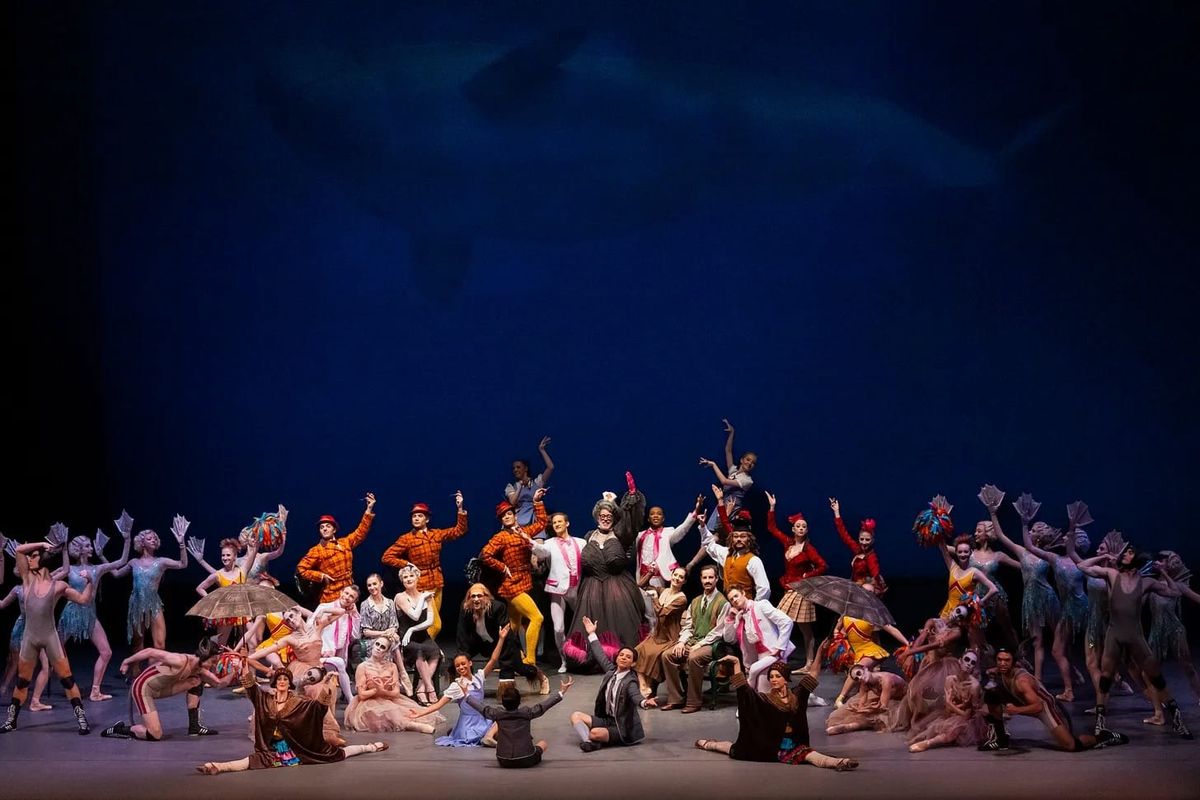
There is nothing muted about Christopher Wheeldon’s 2003 “Carnival of the Animals”, with its elaborate costumes and frequent scene changes (sets and costumes by Jon Morrell), its rhymed couplet narration written and delivered by the actor John Lithgow, and its often jokey choreography. The ballet narrates the adventures of the young boy Oliver, danced with admirable panache by SAB student Hannon Hatchett, who spends the night in the American Museum of Natural History and sees animals from Camille Saint-Saëns famous score come to life as people he knows.
It is a charming idea ingeniously produced, but unfortunately the result was light on actual choreography. Wheeldon tends to take one idea and repeat it. The Librarian/Kangaroo/Mermaid (Indiana Woodward, who switched seamlessly between dowdy and glamorous) spent her brief mermaid solo bourréing back and forth. The Teacher/Lion (Chun Wai Chan, whose face was completely hidden by his mask) spent the finale doing endless perfect turns a la seconde, showing off when he should have been Bert Lahr. For me, the most disappointing section was the Fossils, a supposed sendup of Romantic ballet. Certainly ballets can make fun of their conventions, as Balanchine’s mock “Swan Lake” from “Western Symphony” shows, but Balanchine’s choreography in that section was musical, inventive, and witty, where Wheeldon just had the six girls in Romantic tutus wear grim face masks and do a stiff-legged walk; it was like he stuck his tongue out at the Mona Lisa and claimed to be an art critic.
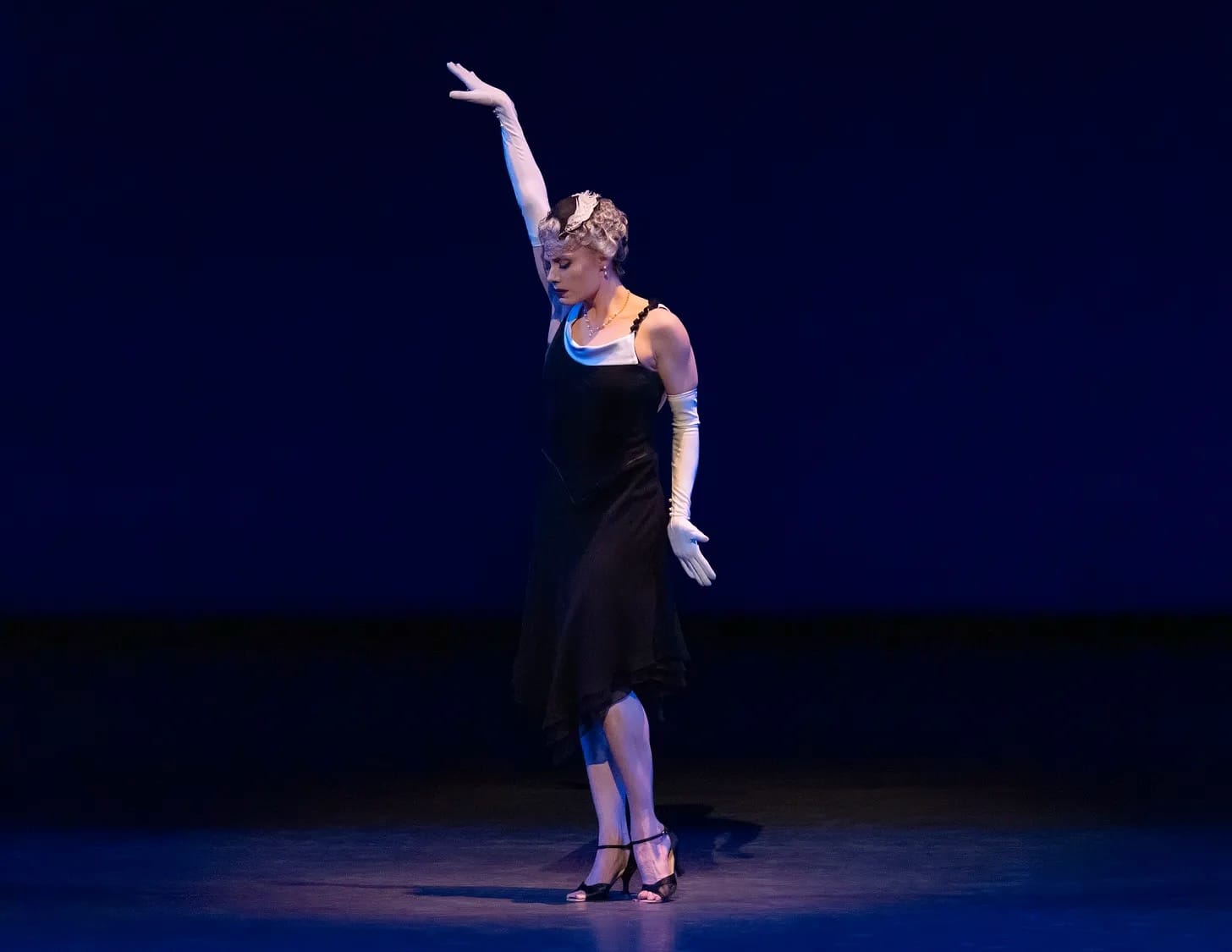
Sara Mearns was extradorinaiy moving in the famous “Swan” section, as she portrayed a retired dancer remembering her glory days, the music echoing through her arms and back as she stood watching the stage. There were a couple of arabesques but no real steps, and the effect was profound. The audience enjoyed the effects and the ballet is impressively theatrical, but “Divertimento”, I expect, is the work which will endure.
© 2025 Mary Cargill



