Stalwart in Step or Stance
“A Tribute to Marian Anderson”
Dana Tai Soon Burgess Dance Company
McEvoy Auditorium
National Portrait Gallery
Washington, DC
February 3, 2020
She was one of the world’s greatest singers. Marian Anderson (1897-1993) specialized in German lieder and African American spirituals. Opera she had the chance to try only late in her career because prejudice against her African ancestry had, earlier, kept her off stages such as New York’s Met. Currently, Marian Anderson is the subject of a Portrait Gallery exhibition as well as the inspiration for Burgess’s choreography. Almost all the music Burgess chose is by Johannes Brahms, half a dozen of his lieder (songs) - from Opus 43 to Opus 121. Burgess placed the singer (soprano Millicent Scarlett) prominently on stage, either left (between pianist Jeffery Watson and the dancers) or center (surrounded by the dancers). He uses the seven dancers in two ways, as dancers and as watchers, perhaps as wardens. This piece displays the most austere dance images Burgess has made, repeatedly from song to song, over and over again. Yet no two of the danced “songs” are actually alike. Remarkable is the effect of subtle differences.
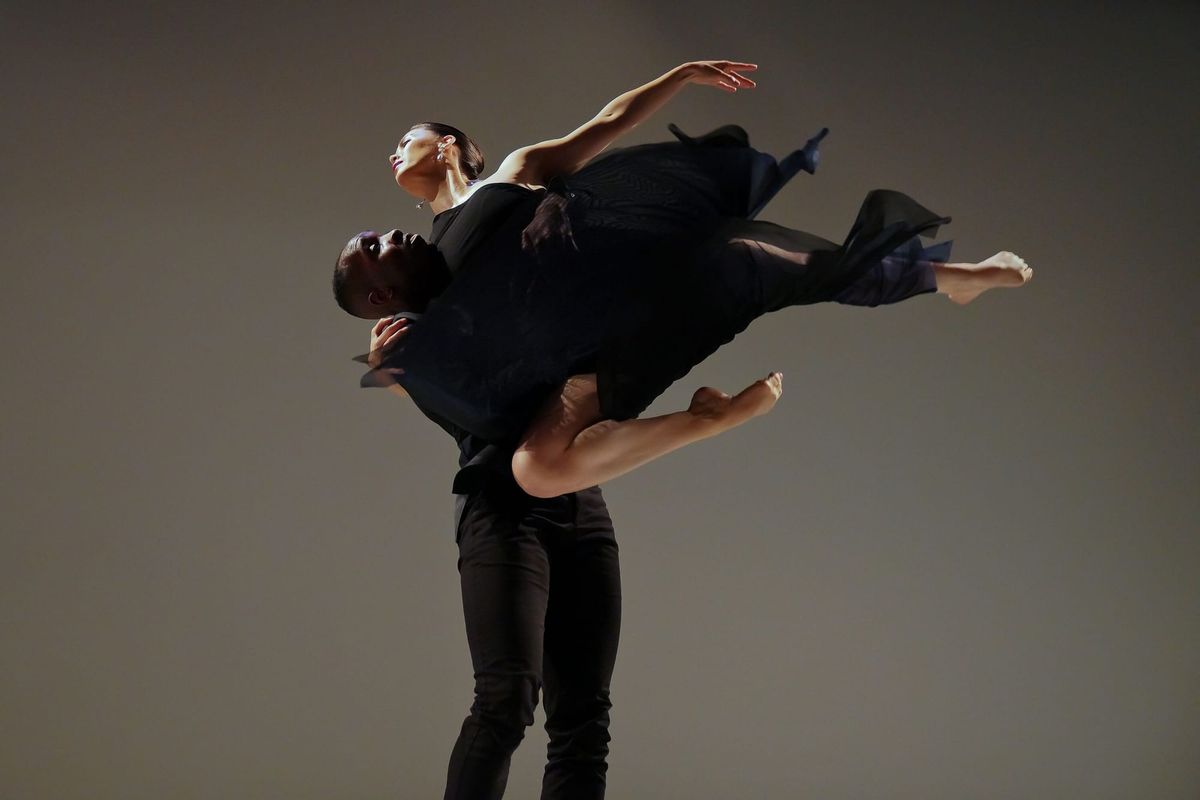
For the first Brahms song, “Immer leiser ...” (“Ever more silently ...”) to a verse by Hermann Lingg, the singer has moved from stage center to stand beside the pianist. The focus is on a dancer couple, woman and man, but there is an additional female dancer who seems to be watching the couple intently. She stands statuesquely while the pair engages in balletic holds, lifts and lowerings. Intensity is also apparent in the actions of the couple. The watcher stands still at first and then walks slowly past the pair. Everyone is dressed in black. Fatality is manifest on stage.
For the second song, “Of Eternal Love” to a poem by A.H. Hoffmann von Fallersleben, the dancing of three women is witnessed by a man and by another woman. The trio’s motions are as balletic as those of the first song’s couple. When in motion, the watching male is swift. Yet this is not a dance of joy but rather of thought. There follows “Sunday”, to an Uhland text and featuring two couples without witnesses. Then the Brahms setting of Klaus Groth’s “Your blue eye ... ” prompts Burgess to set two women and two men into motion. The women dance separately, the men sometimes together.
Next, a biblical text - from the Ecclesiastes - becomes the starting point for Brahms’ “serious” song “Then it happens for humans ...”. Burgess makes this a dance for three couples. The central pair is the most active. Those to the sides are semi-watchers. The concluding song by Brahms, to Klaus Groth’s “Like melodies pulling ...” has three women and three men dancing plus another man as sometimes watcher. According to the printed program there is a finale to music not by Brahms. It is composer Samuel Francis Smith’s “America” (“My country ‘tis of thee ...”). Again, as at the program’s start, the singer stands in the center of the stage. She is surrounded by three dancer couples. A photo of Marian Anderson appears on the backdrop screen.
The dance company numbered seven: Christin Arthur, Joan Ayap, Jaya Bond, Ian Ceccarelli, Sidney Hampton, Felipe Oyarzun Moltedo and Aleny Serna. They reminded me of performers enacting the ancient Greek tragedies. Burgess hasn’t before, as far as I know, been so serious, so modern balletic, so richly monotone.
copyright 2020 by George Jackson



