Spring Gala, Take Two
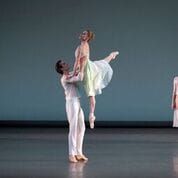
“Bright,” “Bartók Ballet,” “Tschaikovsky Suite No. 3”
New York City Ballet
Spring Gala
David H. Koch Theater
New York, New York
May 2, 2019
Congratulatory speeches from the stage; women in fancy dresses passing up and down the aisles; a rather late start to the evening; men of a certain age in formal wear shaking hands across the rows of the orchestra of the David H. Koch Theater: it's another gala at New York City Ballet. All three of the works on the program have their origins elsewhere, and the two world premieres, Justin Peck's "Bright" and “Bartók Ballet” were, at best, disappointing.
"Bright" has its roots in a duet, "The Bright Motion", set to the piano score by Mark Dancigers, made for Sara Mearns and Russell Janzen at Fall for Dance in 2013. They reappeared here, to an orchestrated version of the score, surrounded by Emilie Gerrity, Sara Adams, Andrew Scordato and Gilbert Bolden III. According to its choreographer, the ballet is about people crossing paths but never connecting. Sara Mearns, on Instagram, referred to the dancers as atoms. What you get is a speedy (less than ten minutes), frothy, ballerina vehicle. Mearns looked contented and comfortable opposite Janzen, but it was Sara Adams, in a quick allegro solo, who stole the show. The costumes, by Harriet Jung and Reid Bartelme, are fluid, flowing, white with patches of sorbet colors, accentuating the sense of the dancers gamboling through dewy grass on a summer morning (they're pastoral atoms). And "Bright" evaporated just as quickly as dew in the warming sun.
To be fair, “Bartók Ballet” (set to the composer's String Quartet No. 5) was not supposed to be Pam Tanowitz' first work for New York City Ballet; that was to take place this coming fall. But she graciously agreed to step in for the originally commissioned choreographer, unavailable for medical reasons, revisiting material from an unrealized project with ABT II. Some choreographers who cross over, in whichever direction, superficially appropriate a step here or a gesture there with all the reasoned consideration of a toddler rifling through a toy chest. Tanowitz approached this collaboration with rigor and historical understanding.
Borrowing from the modern side of the equation, she used, and thereby opened up, the entire stage space, scattering incidents around it. From ballet, she had a dancer take a tight fifth position but had her face stage right, the side view toward the audience. What does it say about ballet, its vocabulary and accepted presentation, that this is almost a visceral shock? That's a crossover moment that gets you thinking and seeing differently. The relationship between music and dance was muddier. Tanowitz is a dance descendant of Merce Cunningham, who divorced music from dance. One of the basic tenets of the New York City Ballet is that music is the floor for dancing. “Bartók Ballet” has its own pulse around which the music swirls. Its various folk rhythms are certainly acknowledged throughout. So music and dance are not completely independent of each other yet neither do they illuminate each other, not necessarily in Balanchine's way, but in Tanowitz' own.
This was also a piece in which the men, Daniel Applebaum, Jonathan Fahoury, Kennard Henson and, particularly Devin Alberda, took pride of place. Alberda danced his solo, which included balances on one leg which hovered between resisting gravity and acceding to it, as though he had been waiting for it his entire career. The women were all but anonymous, not usually the case at New York City Ballet. For the record, they were Rachel Hutsell, Emily Kikta, Miriam MIller, Mira Nadon, Gretchen Smith, Sarah Villwock and Indiana Woodward. In the end, “Bartók Ballet” came across as too diffuse in both its intentions and its structure, and in consequence, at thirty-five minutes, far too long.
It was a relief to be back on familiar ground with “Tschaikovsky Suite No. 3”, even though the first three movements of the ballet, choreographed by Balanchine in 1970, all romantic yearning in silk shirts and bell bottoms, sit uneasily next to the rigorous diamond bright classicism of 'Theme and Variations' made twenty-two years previously. In the opening 'Élégie' , Adrian Danchig-Waring, in a debut, was a totally invested poet, using particularly the turn of his head and the direction of his gaze to convey this poet's wonder, yearning, desire and resignation. Teresa Reichlin, known for her cool presence, chose not to be the icily distant muse, but to share her partner's emotions; she too had something to lose as they separated. Reichlin is at her best when she upends expectations, as here, dancing barefoot, or years ago, ebullient, her hair loose, dancing Bournonville.
The evening ended with Megan Fairchild, newly returned from maternity leave, and Gonzalo Garcia, out for months last year due to injury, in one of Balanchine's most taxing but also most wonderful ballets. There were bobbles and wobbles, but Garcia makes classical ballet look like a natural language, particularly in his upper body and the ease of his port de bras. And this performance announced that Fairchild is back to reclaim her place in the company and her repertory. But the highlight was how happy both dancers were to be back on stage – together – and the audience was full-throated in its pleasure to see them there.
copyright © 2019 by Carol Pardo



