Spice Girls
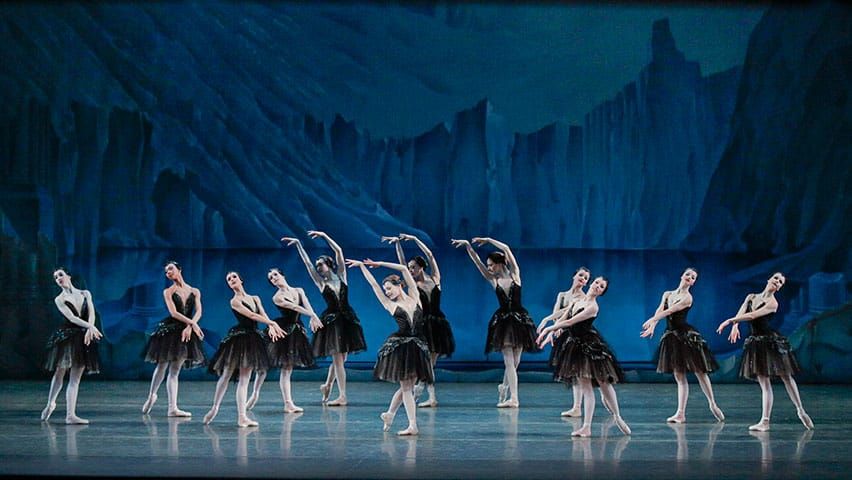
"Allegro Brillante", "Swan Lake", "The Four Temperaments"
New York City Ballet
David H. Koch Theater
New York, NY
January 18, 2017
The current programming scheme of performing three similar ballets together took a welcome break on Wednesday, as New York City Ballet presented a varied triple bill, proving that variety is really spicy. The all Balanchine program had three varied works: the exhilarating opening, a drama, and a black and white masterpiece. The newest of these works, "Allegro Brillante", was choreographed in 1956, but there was nothing old-fashioned or fusty about the program or the dancing.
"Allegro Brillante" is a bracing opening ballet, dropping the audience in the middle of a sparkling merry-go-round with no preliminaries as the corps seems to toss steps back and forth. Tiler Peck and Andrew Vedette led the dance. Peck's musicality, control, and confidence suit the choreography and every position was photo-op clear. As Balanchine famously said, the work "is everything I know about classical ballet in thirteen minutes" and Peck made it a technical tour-de-force. But classical ballet also has an emotional underpinning, which Peck didn't convey. She was crisp, elegant, and isolated, dancing in a bubble. This made Veyette look a bit passive, though his dancing was polished; he has tremendous beats and is a gracious partner.
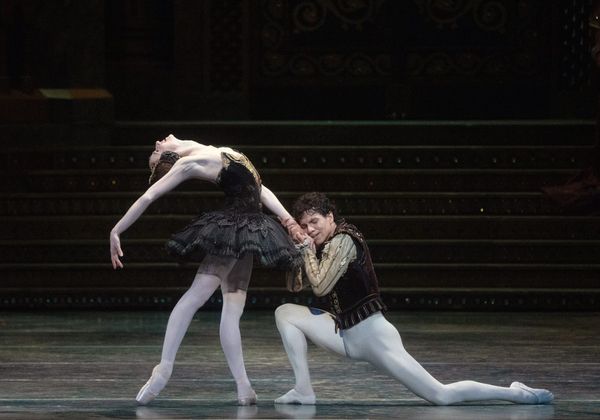
There is nothing passive about Sara Mearns' "Swan Lake". The choreography is by Balanchine "after Lev Ivanov", and there is more Ivanov in it than in many so-called traditional versions. (Hurray for the hunters posing with the swans.) For me though, there is not enough Ivanov, since without the story (so eloquently mimed by Odette in the original version), Von Rothbart is just an extraneous guy in black, the swans are merely decorative, and there is no reason for Siegfried to be concerned. Balanchine merges the traditional acts two and four, without the joint suicide, but since Siegfried never swore his oath to Odette, there is no feeling of the inevitable tragedy, except of course in that powerful music, which sweeps away a lot of choreographic holes.
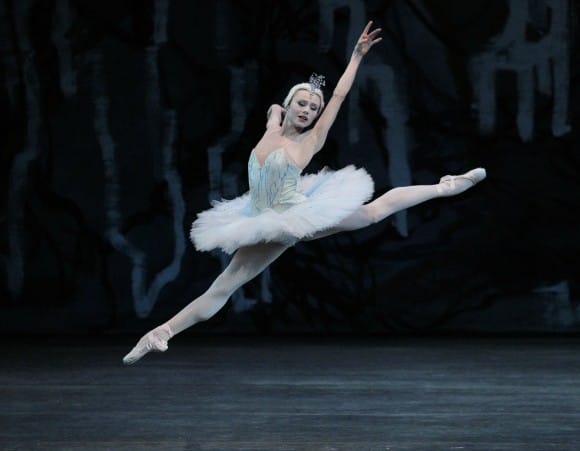
Mearns is a naturally dramatic dancer with extravagant extensions, and her performance was gripping. But she is neither vulnerable nor tragic (she gives the impression she could tear Von Rothbart's wings off with one hand), so is not a traditional Odette. This "I might just fly away" approach works well with the chirpy ending that Balanchine added to Ivanov's famous white swan pas de deux. Jared Angle was her dignified Prince and his solo (to the traditional big swans' waltz), though dramatically superfluous, was smooth and graceful. I also enjoyed Ashley Laracey's silvery, long-limbed elegance leading the Pas de Neuf.
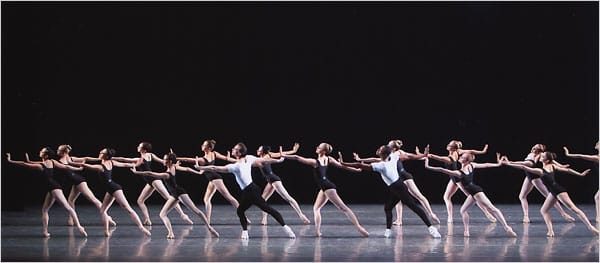
The spectacular icebergs designed by Alain Vaes helped set off the simple black and white of "The Four Temperaments"; the 70 year-old work remains blazingly modern. The three themes looked well-rehearsed; Brittany Pollack's second theme was especially vibrant with her staccato attack and dramatic backbend. The tall, elegant Aaron Sanz made a fluid debut in the third theme.
Anthony Huxley was affecting as Melancholic, using moments of stillness to seem to gather his momentum and almost (but never quite) flailing helplessly. He created a portrait of universal suffering without self-pity. Ashly Isaacs and Tyler Angle were the Sanguinic couple. She was a substitution for Abi Stafford and making her debut. She seemed a bit uneasy, tending to give each movement the same inflection and the quirky hip-thrusts were statements rather than accents. Her footwork though, sparkled and she looked much more comfortable in the more lyrical movements, especially when supported by Angle, whose dancing had weight and dignity.
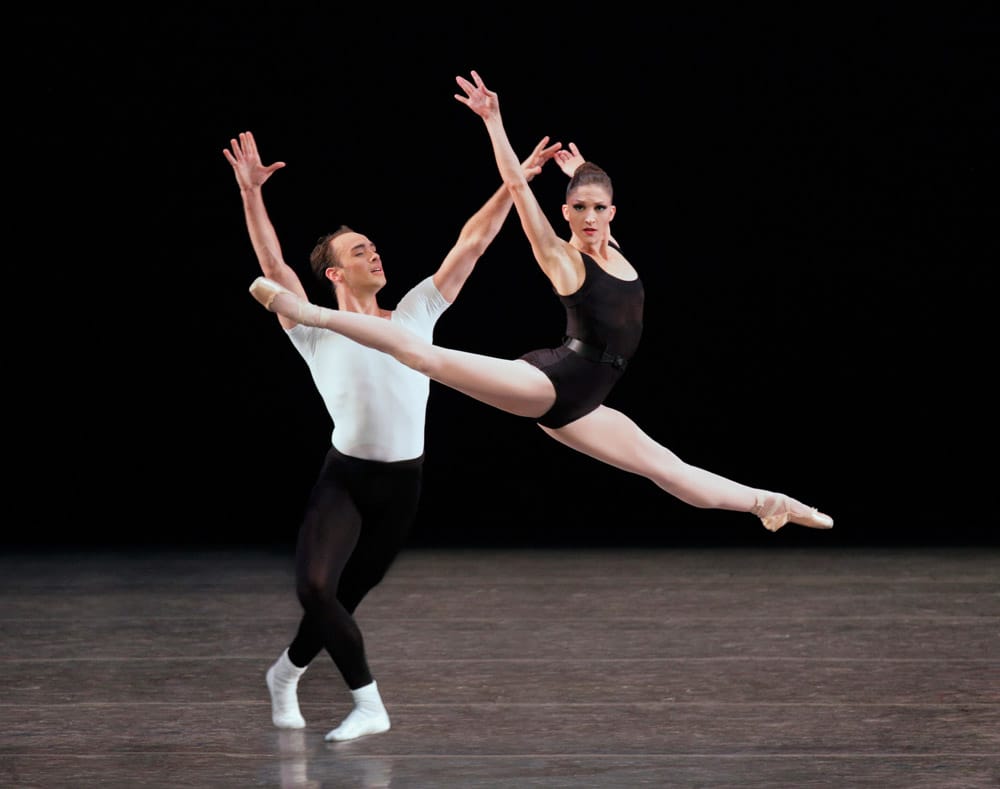
Ask la Cour's Phlegmatic also had weight, and an odd sort of dignity. He didn't dance it for laughs, and gave the limp, loose steps a tinge of Petrushka, an odd-man out seeking some unattainable goal. There were no laughs in Ashley Bouder's Choleric either, as she carved through the choreography. Her classical purity (her leg seems to hit a perfect 90° arabesque line automatically) combined with her power gave her dancing an explosive quality than resonated through the serene ending, as the dancers soared towards the light.
Copyright © 2017 by Mary Cargill