Some New Jewels
"Jewels"
New York City Ballet
David H. Koch Theater
Lincoln Center
New York, New York
September 21, 2023
New York City Ballet’s all-Balanchine fall season opened with a week of the ever-popular “Jewels”, Balanchine’s salute to mood and style. The lush romanticism of “Emeralds”, the American cockiness of “Rubies”, and the Russian grandeur of “Diamonds” call for much more than accurate steps, as the dancers need to convey an inner life; these works may be plotless but they are not pointless. The September 21st performance had a number of impressive and accomplished debuts, and one disappointment, when Aaron Sanz, who was to debut as the second male lead in “Emeralds”, was replaced by Adrian Danchig-Waring. Not that Danchig-Waring was in the least disappointing, but Sanz, which his romantic presence and dynamic imagination, would seem a natural for “Emeralds”.
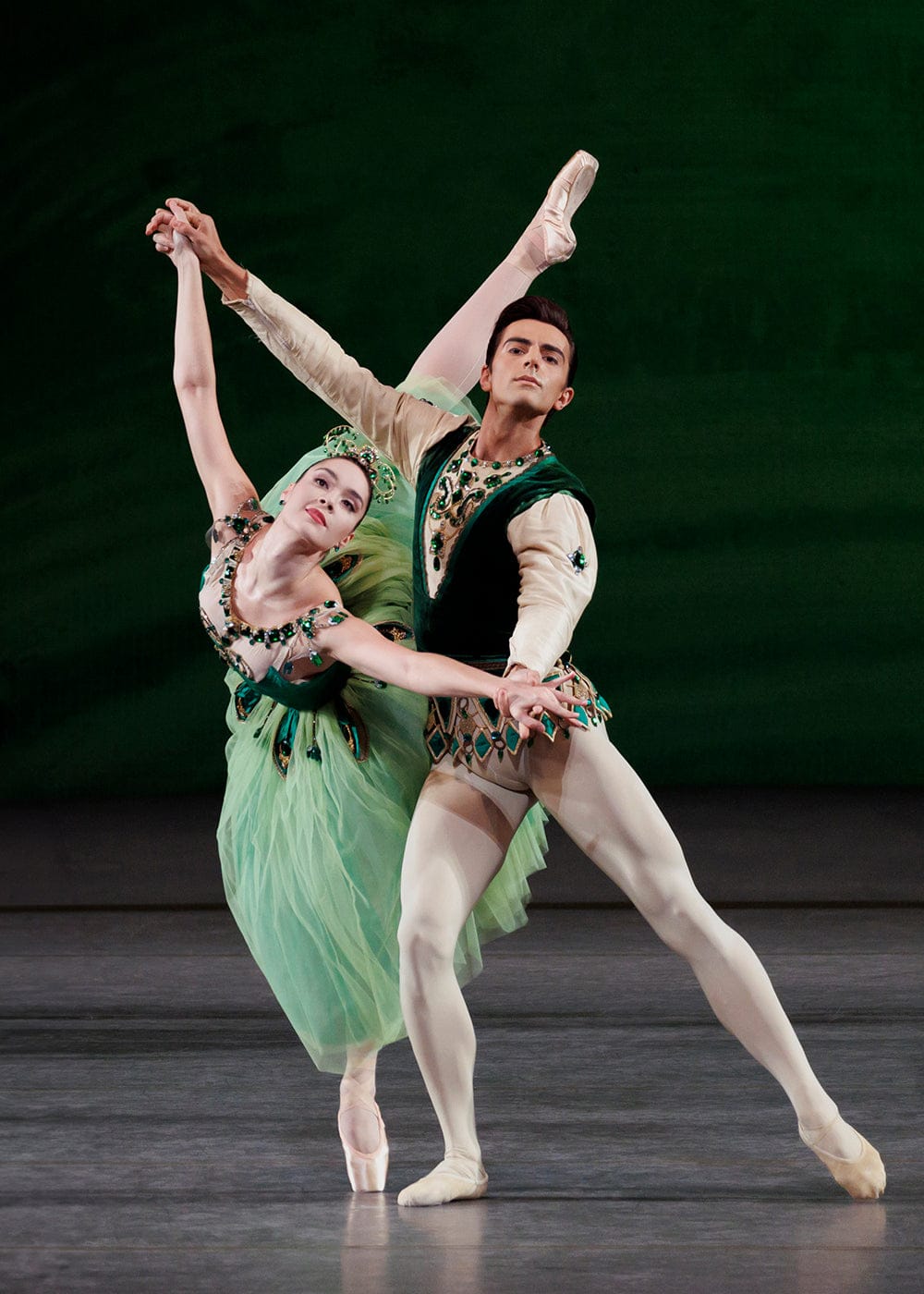
Mira Nadon, debuting in the Verdy role, danced with a lush expansiveness (such beautiful backbends!) and a haunting and mysterious quality that made her seem like an invisible presence, felt but not seen by her partner Davide Riccardo (also a debut). The mime scene, where her arms seem to be telling hidden secrets known only to herself, had a quiet, confident playfulness that oozed femininity. It was a breathtakingly beautiful performance. Riccardo, with his reticent dignity and devoted concentration, also had an impressive debut; it is hard to believe that he is still in the corps. His solo, with its soft landings and graceful power, did seem to be danced on moss. Their pas de deux had a hushed intimacy and an intense but subtle sorrow as they reached for each other, hinting of their final separation.
The second lead was danced by Megan LeCrone, with Danchig-Waring. Despite Danchig-Waring’s committed and unobtrusive support, her performance was disappointing. She is a straight-forward, rather staccato dancer who can be very effective in leotard roles, but seemed to lack any romantic breadth or imagination in the mysterious, inward solo and later in the walking pas de deux; she was clearly just walking on the stage, not in some imagined glade, and had no sense of mystery.
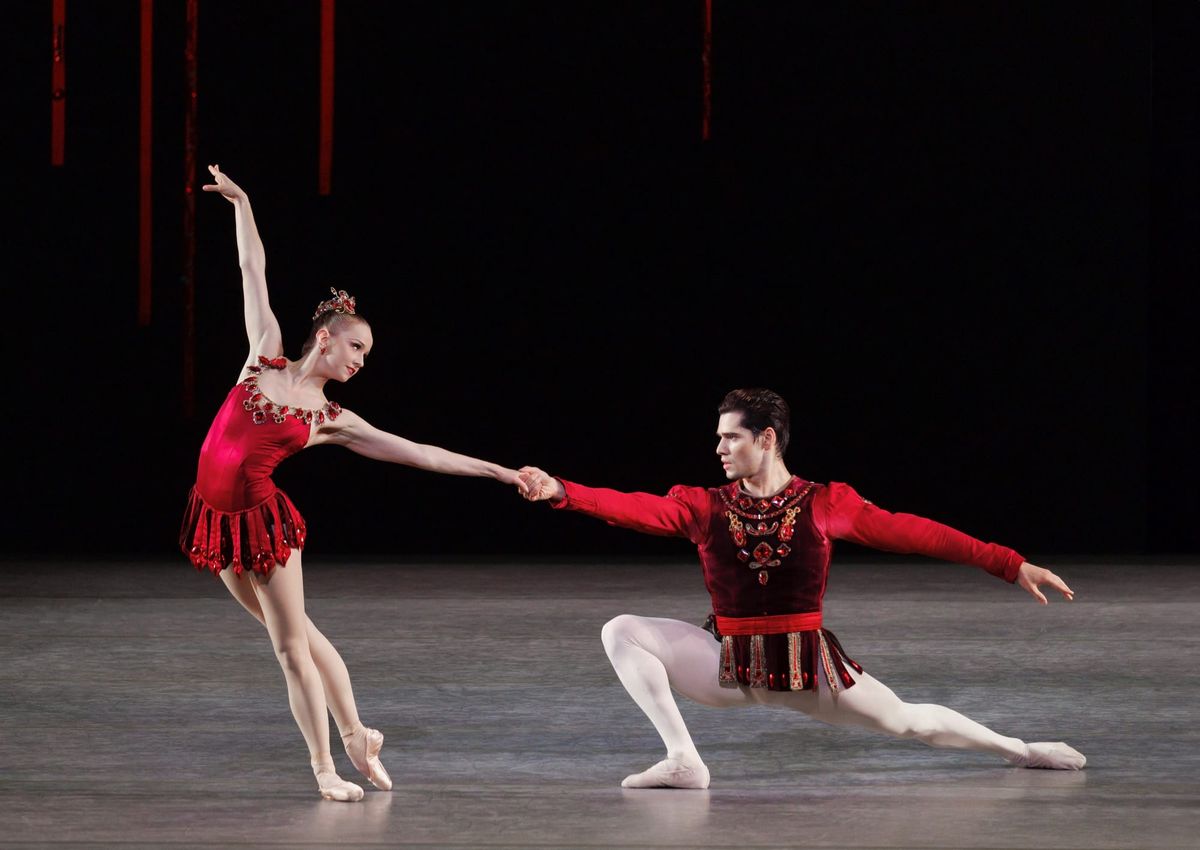
There is no glade in “Rubies”, as the frenetic energy suggest asphalt rather than Central Park. Emma von Enck and Jovani Furlan debuted as the lead couple, accompanied by Christina Clark’s debut as the Tall Girl. Clark was more subdued than many other Tall Girls, but she gave the role a confident playfulness, and it was intriguing to see the role danced without a tinge of brashness; she phrased the steps using commas, not exclamation points. She was teasing the men rather than commanding them, which in its own quiet way, was very effective.
There was nothing brash about van Enck’s debut, and nothing quiet either. Her dancing was clear, dynamic, and endearing as she flew around the stage looking like a pearl in a bowl of red hot embers. It was a lighthearted interpretation, a young girl having the time of her life, and she absolutely owned the stage. Furlan was a powerful and graceful partner, though he lacked some of the earthy swagger built into the role. He seemed almost too gracious, as if he were dancing in an unfamiliar language; his accent, though, was charming.
The most effective “Diamonds” I have ever seen was danced with a foreign accent, when the Mariinsky danced “Jewels” in 2002 as part of the now-defunct Lincoln Center Festival. Their corps dominated “Diamonds”, weaving in and out with a uniformity and commitment that was thrilling; I especially remember the four “Russian girls” digging into the folk-inflected rhythms, and the moment in the finale when everyone on stage swept their legs to the sky in one sweeping, powerful gesture. NYCB’s “Diamonds”, with the exception of the astounding pas de deux, tends to meander from one shape to another.
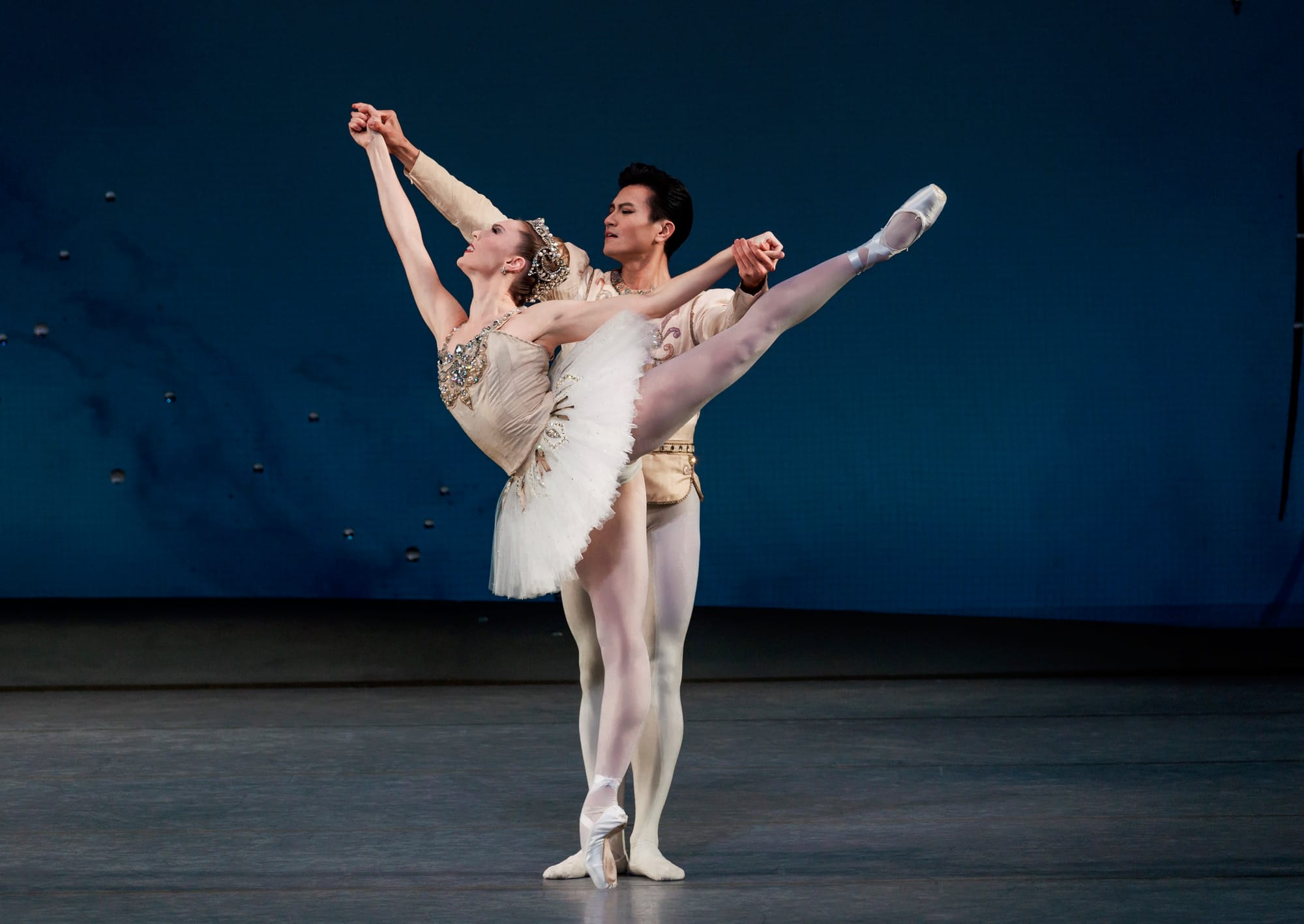
Isabella LaFreniere and Chun Wai Chan made their debuts as the leading couple. The choreography is simple, with a lot of walking and gestures. There are echos of “Swan Lake” in the backward falls and sense of mystery, but it is not a straight forward narrative and each couple has to tell their own oblique story. LaFreniere seemed to go in and out of the hints of narrative, separating the dancing, which was straightforward and dynamic, from the drama, which she seemed to demonstrate rather than experience, as if she were hesitant to expose too much emotion; I missed the sense of mystery and vulnerability that the music suggests. She seemed to explode in her solos during the many finales, and her dancing was powerful and secure, though it seemed that, rather than living a love story she was dancing in friendly competition with Chan.
Chan, though a bit short for LaFreniere (on point she is taller than he is which is not a very romantic image) had a more consistent dramatic presence, looking only at her and reaching for her with a sense of urgency, trying to comfort her. His dancing, especially the brilliantly controlled turns a la seconde, where he seemed to slow down and speed up at will had a scintillating elegance that was truly jewel like. His control, including immaculately silent landings, combined with generosity and a warm stage presence, lit up the stage.
copyright © 2025 by Mary Cargill



