Royal Danes at Jacob's Pillow
Royal Danish Ballet
Jacob’s Pillow Dance Festival
Beckett, MA
June 20, 2018
by Gay Morris
The Royal Danish Ballet, founded in 1748, calls itself the third oldest ballet company, but its August Bournonville repertory gives it something like eternal youth. Bournonville’s village girls and boys breathe a freshness that exists nowhere else. Fortunately for audiences, a good deal of Bournonville choreography was included in the program a group of dancers from the Danish company offered for the opening of the Jacob’s Pillow Dance Festival. There were excerpts from “Napoli,” “A Folk Tale,” “La Sylphide” and “The Kermesse in Bruges. The eleven dancers were nearly all principals, so this was very much a “stars of” program with numerous duets.
Bournonville (1805-1879) gave the Danish Ballet its national style, but national styles are difficult to maintain in a global world. Six of the dancers at Jacob’s Pillow are from outside Denmark and did not grow up in the company’s school, as did the majority of dancers until fairly recently. Yet for the most part the six have managed to absorb Bournonville’s virtuosic footwork and soaring leaps, as well as the modest demeanor that his works require. The most accomplished of the foreign dancers was Amy Watson, a graduate of New York City Ballet’s School of American Ballet. She was especially memorable in the duet from “La Sylphide,” which she danced with Marcin Kupiñski, who is from Poland. This is the dance where the Sylph introduces James to her world of woodland nature. Watson has a lovely open face, and she recorded the Sylph’s innocence and playfulness with no trace of exaggeration. She also has the lightness and speed the role calls for.
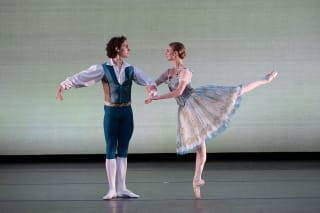
It must be said, though, that the Danish trained dancers were the most impressive in the Bournonville works. Andreas Kaas has the joyousness and flashing footwork that epitomizes Bournonville, while Jón Axel Fransson, still a soloist, has an extraordinary lightness in jumps. Both were outstanding in solos from the “Napoli” divertissement that constituted the second half of the program. Ida Praetorius, the sole Danish female principal dancer in the group, was notable for her restraint, another element of the Bournonville style. This calls for a supple but predominately upright posture while letting the speed of the footwork and lightness of jumps do the virtuosic labor. Praetorius and Kaas danced a duet from the first act of “The Kermesse in Bruges,” and one could hardly imagine better. Somehow these dancers can make the teasing and playfulness that could look affected in other dancers, appear utterly natural and charming.
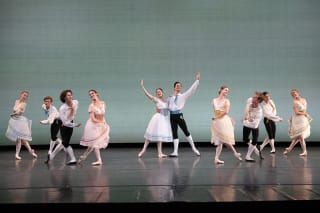
The program opened with a septet from “A Folk Tale,” which introduced three of the men, including Kaas and Fransson, plus Jonathan Chmelensky (from Cuba) and four women: Praetorius, Watson, Emma Riis-Kofoed (a Dane and corps member) and Kizzy Matiakis (from the UK), all dressed in fiery red. This was very much an ensemble piece and, with “Napoli,” bracketed the rest of the program.
“Napoli” was the main event of the evening, and this lively divertissement, which is a Royal Danish touring staple, was evidence that the company is not neglecting its Bournonville heritage. The dancers took turns skimming the stage in awe-inspiring combinations of lightning fast steps. The exciting rhythms of the tarantella encouraged them to ever greater feats, while all the while they seemed to be simply young people having fun. It was an exhilarating end to the evening.
In addition to the Bournonville works, the group also offered duets from “Swan Lake” and “Giselle,” as well as a “Dvorak Pas de Deux” by Harald Lander. It is understandable, to a degree, why the Lander was included, since he was an important Danish ballet master. Even the “Giselle” made some sense, since it is from the romantic period, as is Bournonville’s choreography. But why it was thought a good idea to dance excerpts from “Swan Lake” is incomprehensible. If it was to show the company’s range, why not include contemporary choreographers like Alexei Ratmansky or Christopher Wheeldon, whose works are in Danish repertory. The Lander duet is of little choreographic interest. It was made for television in 1966 and features pseudo Slavic flourishes loaded onto a stilted academic vocabulary in which the dance phrases stop and start as if woven together in a broken pattern. The costumes are odd, too, considering the Dvorak score and folk idiom: the male dancer wears black jeans and a T-shirt, the woman, black practice clothes, as if trying to make the dance read as contemporary. The only saving grace was Fransson and Riis-Kofoed’s committed dancing. Fransson, especially, was outstanding, falling to his knees only to leap up as if weightless. He has the ability to create crystalline dance images, something he shares with all important dancers. He was made a soloist in 2016 and seems destined for principal rank.
“Swan Lake” was represented by the second and third act duets, and they did neither the company nor the dancers much good. The Danish heritage does not lie with Petipa’s high classicism and it showed. The “white swan” pas de deux was danced by Matiakis and Kaas and it was notable only for Kaas’s attentive engagement. He, not she, was the one who seemed enchanted. This duet is danced by the world’s greatest ballerinas and comparisons are inevitable. Matiakis’s dancing was honest enough but consistently blurred and lacking in any sort of musical vision. The recorded sound didn’t help, either. The third act “black swan” pas de deux, danced by Holly Jean Dolger and Jonathan Chmelensky, was worse. Unlike the Act Two duet, it is often used as a stand-alone bravura number. Dolger was allowed to indulge in a display of technique in which, during lifts, she executed more than 180 degree side splits and generally carried on as if she were in a circus. Chmelensky was far more refined, but it was, finally, her show.
The duet from the second act of “Giselle” was better, but taken out of context, seemed bereft. Again, this is a ballet danced by the greatest ballerinas and J’aime Crandall, although a good dancer, is not a great one. She was accompanied by Meirambek Nazargozhayev, who is from Kazakhstan and still in the corps de ballet, He made a convincing Albrecht and was technically strong, as well. But it is a shame that these dancers could not have been given repertory that would have shown them to better advantage. It is particularly surprising since the company’s artistic director, Nikolaz Hübbe, was not only a star of the Danish ballet but of New York City Ballet, where contemporary choreography is the mainstay. However, it was a welcome gift to see at least a little of the Bournonville repertory danced as it should be. And it is to be hoped that one day soon the entire Royal Danish Ballet will once again find it’s way to the U.S. to show us entire Bournonville works. The Danish group will be at the Pillow through the weekend.
copyright© 2018 by Gay Morris



