Romantic into Classicism
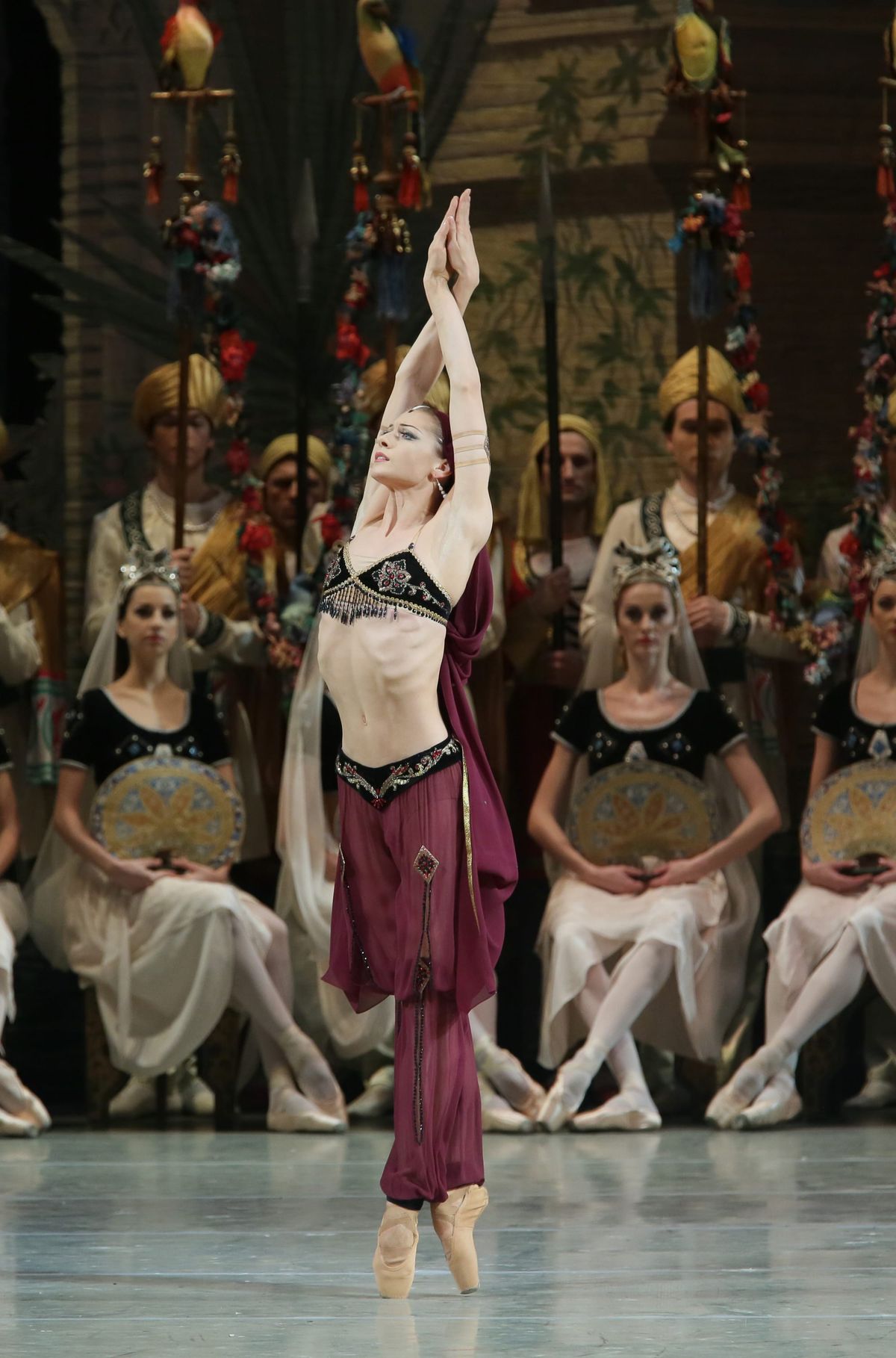
"La Baydère"
Marinsky Ballet
Cal Performances
Zellerback Hall
Berkeley, California
October 30, 2019
What a magnificent, somewhat cumbersome fantasy “La Bayadère” is. In the recent Mariinsky Ballet performance at Cal Performances with a cast of, apparently, two hundred, and an orchestra that just about spilled out of the pit, the dancing was superb, the story telling clear and beautifully spaced, the mime large and much welcome. So there were few a missteps, a couple of errant balances; that is and was expected in a live performance. Yet it was so much fun to see the transition from the Romantic story ballet to the pure Classicism of the Ballet Blanc in the same evening. The story ballet just about dissolved in what is here the last act. We entered the realm of pure beauty.
But for all its fantasy, just like in its model “Giselle,” ”Bayadère” also embodies a dose of hard-nosed reality. It’s only in fairy tales that the poor boy gets the princess. In life the peasant girl on the assembly line doesn’t marry the factory owner’s son. Maybe in 1877 the implicit critique of corruption in religious and secular powers – the High Brahmin and the Rajah — also could be downplayed as “it’s just a story.” But we live in a more skeptical age.
Maybe the most impressive aspect of this ballet are the unisons, not just the magnificent ones by the Shades in the last act but from the beginning with the temple dancers entering and Vladimir Shklyarov Solor’s cohorts marching off to where ever they went. The divertissements are full of unisons, splitting into smaller ones only to re-coalesce. Unisons have a mesmerizing power on the viewer because, I think, there is something “unnatural” about them. We are not “meant” to do exactly the same thing as the person next to us. While we admire the discipline and willingness to submit to something bigger than our individuality, we also fear them or are made uncomfortable. Dictators have long used the power of military parades not for our delectation on stage but as a way to control life.
I also found myself less irritated by Minkus’ blustery oompah-oompah score, perhaps because it so often supported the story telling closely and the mime that arose from it. The waltzes and polkas in the divertissements have a ridiculously heavy beat to them but the plaintive violin for Nikia’s solo for the bridal couple is one of this composer’s most inspired moments.
Zellerbach Hall, apparently lacked the requisite space for the ramp, so the Shades emerged one by one out of the dark upstage, depriving us of those diagonals, but becoming a large outpouring that finally filled the stage. These Shades performed magnificently in unison yet didn’t look academic. They breathed through their paces. Curiously, planted on the sidelines, they leaned slightly backwards looking into the audience. Their billowing framing of the soloists was varied and beautiful — very good choreography.
Maria Khoreva’s Nikia, with a back as flexible as a billowing reed, initially, looked as though she might be blown away, almost too delicate to be earthbound. Her fifth position on pointe was so tight that the second leg just about disappeared. Her arms, and those of her fellow bayadères, recalled flocks of birds. If you didn’t know the story, her confrontation with Gamzatti (Anastasia Nikina) would not have been as inevitable because Nikia could be fiercer than Myrtha. But much as she couldn’t step out of her social constraints, neither could Gamzatti, excellent in this complex role and a strong partner to Shklyarov's Solor. He is long-limbed, shows strong elevations and decent descents, but every once in awhile he didn’t seem to quite remember in which ballet was. The fact that Andrei Yakovlev’s Rajah was a good head shorter than Kulaev gave the power struggle between the two rulers a special spice.
The D’Jampe with the scarves, the Parrot Dance with the birds and the Manu with the water jug made good use of props. The latter’s touch of comedy must be rather rare in 19th century ballets. Small parts added details: the Fakirs and the Indians came in for a spot of derision; Philippe Stepin’s Golden Idol traveled the air while Roman Belayakov's slave crawled in the dirt. Lira Khuslamova slave girl Aya, however, had figured out exactly how and how much she had to be subservient to her masters.
copyright 2019 by Rita Felciano



