Remembering Before and Looking Beyond
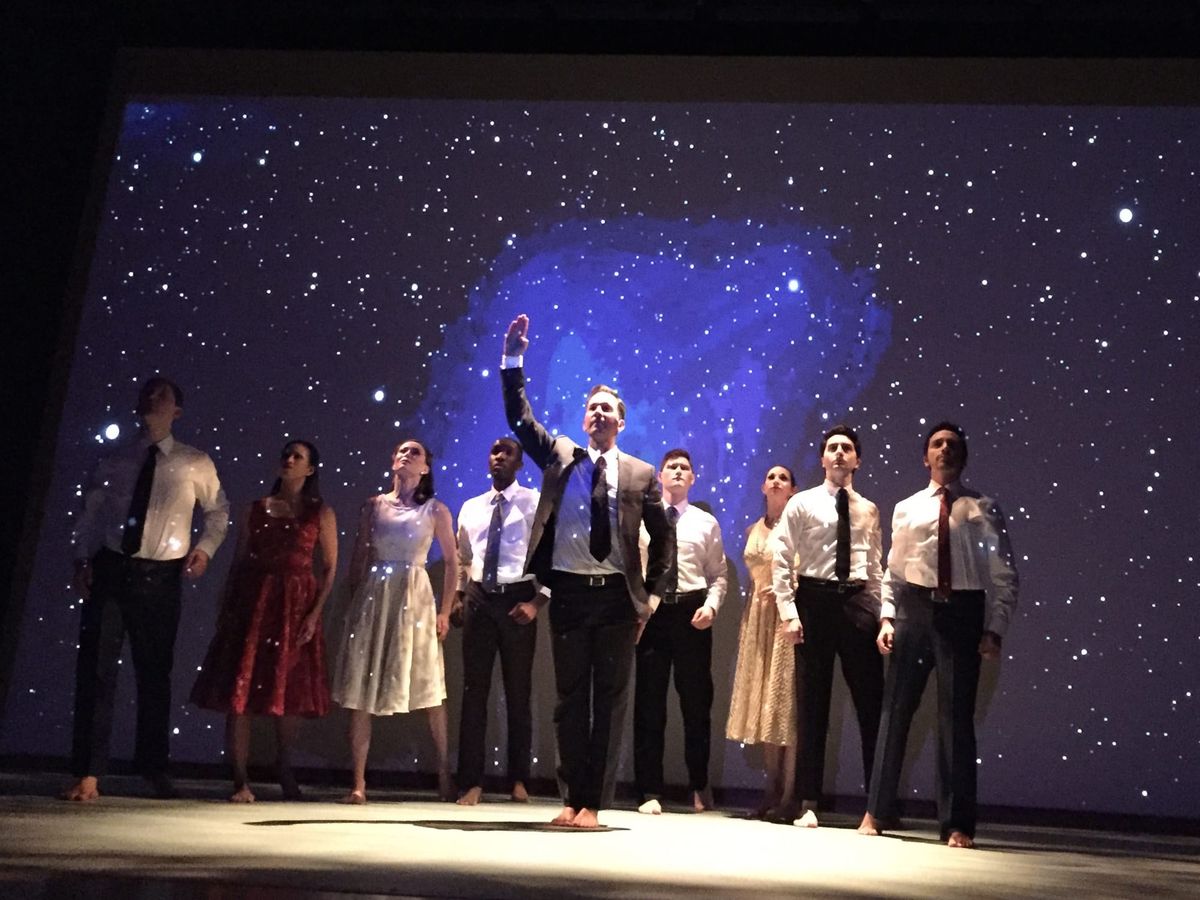
“We Choose to Go to the Moon”
Dana Tai Soon Burgess Dance Company
Nan Tucker McEvoy Auditorium
National Portrait Gallery
Washington, DC
December 12, 2018
For thousands of years, people have stared up at the night sky in wonder — naming constellations and tracking stars as the cosmic landscape changed with the seasons. The advancements made in science and engineering during the space race in the 1960’s only elevated humanity’s fascination with the uncharted territories of the ever-expanding universe. With the piece “We Choose to Go to the Moon,” Dana Tai Soon Burgess took on quite a lofty goal by investigating the connections between humanity and space, science and artistry, presenting a dance that couples the nostalgic idealism characteristic of the 60’s time period with the hesitance that has emerged over the years in response to the greater unknown uncovered by new discoveries.
“We Choose to Go to the Moon,” which first premiered in the fall of 2015, was developed in collaboration with NASA and inspired by a myriad of Burgess’s own personal experiences. Burgess conducted interviews with multiple scientists who have dedicated their lives to the exploration of space, and through these interactions Burgess discovered a camaraderie linking his own identity as an artist and their inquisitive, scientific minds. He said that there is an inherent connection joining the outside-the-box thinking required by scientists to make new breakthroughs in their fields and the creative process necessary for a choreographer to make successful work. Burgess was additionally grieving the death of his father while creating this piece, leading to the introduction of the concept of heaven and what still lies beyond humanity’s comprehension. This spiritual aspect concerning space was fully realized through an interview with Mary Motah Weahkee, a medicine woman who recounted a spiritual understanding of the cosmos informed by oral history and tradition.
Excerpts from these interviews, including a former Apollo Mission astronaut, an astrophysicist, an experimental physicist, a geologist, and Weahkee, were layered into the musical score for “We Choose to Go to the Moon” along with ambient noises hinting at space and classic songs like Frank Sinatra’s “Fly Me to the Moon” and Cliff Edward’s “When You Wish Upon a Star.” The soundscape played a significant role in enhancing the atmosphere of the performance along with the lighting and projections designed by Joao Beira and Quince Imaging.
The dancers themselves were smartly dressed in white shirts with black ties and elegant, sparkling dresses. Their quality was primarily romantic and statuesque, with stilted gestures backed by spoken word and aesthetically pleasing modern lines executed through bold lifts and suspended turns. Contrasting elements were built into Burgess’s choreography with bouncy, airy partner sections sporting fast footwork. These moments inserted joyful segments among the reverence and deep speculation that prevailed over the majority of the piece, alluding to the visionary tone of the 60’s that Burgess worked to recreate.
Burgess fashioned an atmosphere ripe with the proper romanticism to generate an easy chemistry among his performers, particularly evident in a flowing, seamless duet performed by Christin Arthur and Sidney Hampton. The two dancers orbited around one another sharing shy smiles and indulging in impressive extensions eclipsed by moments of sudden stillness, each choreographed moment building and dissipating with effortless precision. This theme of intimacy was again employed later on in a portion danced by Joan Ayap and Felipe Oyarzun Moltedo. They pranced about the stage to Perry Como’s “Catch a Falling Star.” Timed perfectly with the projection lighting the backdrop, Ayap and Moltedo simulated catching projected stars as they sunk in time with the tune, volleying them back up into the air and fostering an idyllic, almost hypnotic scene.
“We Choose to Go to the Moon” is the last of the National Portrait Gallery’s scheduled performances as part of the museum’s 50th anniversary celebration, with two more chances to see the dance on December 15 and 18, both at 6:30 p.m. The performance was presented in conjunction with the museum’s 50th exhibition now on display titled “One Year: 1968, An American Odyssey,” running until May 2019.
Copyright © 2018 by Arielle Ostry



