Queering Ballet
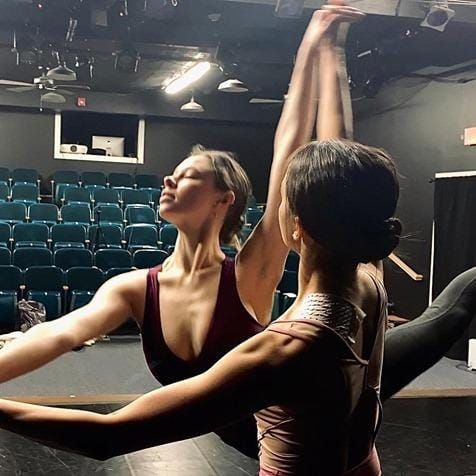
#QueertheBallet
Adriana Pierce, choreographer
Bridge Street Theatre, Catskill, New York
February 25, 2021
Streaming on Youtube, February 25-March 11
The art form of ballet is overdue for a queering – i.e. expanding its repertoire of meaning beyond the traditional binary codes of gender and sex. Adriana Pierce, an alumna of George Balanchine’s School of American Ballet and Miami City Ballet, went into a recent residency with a clear goal in mind: “to create a duet for two women which honors their movement styles, physique, emotionality, and connection in a way that is not harnessed by ballet’s traditional technical ideals. I also feel it’s imperative that audiences get to see genuine and thoughtful queer stories and relationships.” By the end of the residency she was well begun, maybe halfway done. But next comes the hard part.
Pierce created a lovely opening duet for two young ABT women, in a style that owes much to Balanchine’s neo-classical coolness. Remy Young and Sierra Armstrong dance on pointe, in unison and counterpoint, to an ensemble of stringed instruments – taking turns partnering each other, using traditional supporting techniques but without lifts. They stay on the same level, in every way. Concerto Barocco comes to mind – a counterpoint to twin violins --- as well as Balanchine’s many “daisy chain” figures with women intertwined.
The movement is beguiling, but tells us little about these two. The relationship they communicate is like that of new roommates who decide they like each other and want to stay together. It’s an idyllic orientation week, in which they stay close and often feel like one person.
This may be due to the anxiety they feel in a new situation – hesitant to “come out” as their individual selves. As anyone who has lived with a roommate knows, it doesn’t take long for the differences to emerge, and the problems to follow. That’s a good thing. If Pierce is to turn her six-minute pas de deux into a ballet, she needs a story.
Balanchine was often accused of lacking a story, to which he would say something like: -- You put a man and a woman on the stage, already you have a story. How much story you want?
To create any sort of theater, these two characters don’t need a man, nor a formal plot. But for a “genuine and thoughtful queer relationship or story,” they need to develop some contrast or conflict, either within themselves, between each other, or with the world outside. In a recent podcast, Pierce spoke emotionally about how isolated she has felt as a queer woman in the ballet world. There's a story. She also said she had tried to control how other people thought about her sexuality. She would confront herself in the mirror, trying to make sense of it for herself.
How much story you want?
Of course, there may be other directions to go. But let’s get queerer, quick.
copyright 2021 by Tom Phillips



