Poetry in Motion
“Four Quartets”
Pam Tanowitz
The Fisher Center at Bard College
Annandale-on-Hudson, NY
July 7, 2018
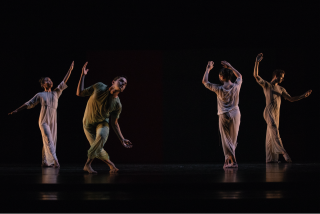
What comes first, the words or the movement? In a powerful tribute to the skills of choreographer Pam Tanowitz and her troupe, their dance to T.S.Eliot’s masterwork “Four Quartets” feels like a true partnership. In its world premiere at Bard College’s Fisher Center, her dancers interpreted “Four Quartets” Eliot’s elegiac meditation on time, to the poem series read in the commanding, husky voice of actress Kathleen Chalfont. The poems were woven into threads of a beautiful commissioned score by Finnish composer Kaija Saariaho, as the dancers wove themselves between panels of color and scrims, in a design by Modernist artist Brice Marden. This was a quartet of artistry in which every element was masterful.
With so much to listen to and look at, the primary job of the audience was to stop trying, and let the work reveal itself. The first dancer to appear, Lindsey Jones, gently moved onto the stage behind a scrim, slightly obscured, as her floating pajama costume (by Reid Barthelme and Harriet Jung) wafted around her legs in leaning arabesques and balances, her gentle twirls the first of many that would echo over and over through this dance. As Chalfont intoned the opening of the first of Eliot’s “Quartets”, Jones was softly shaded from view by that layer of scrim fabric, it was as if we watched “footfalls echo(ing) in the memory, down the passage we did not take, towards the door we never opened, into the rose garden.”
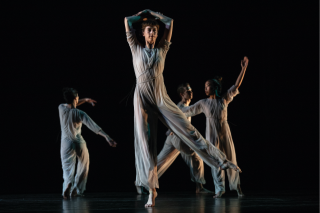
Solos wove throughout the piece, and the nine beautiful dancers each had moments of sublime primacy, like Dylan Crossman whose wide elegant twirls cut the stage in diagonal, and Melissa Toogood, shifting between elegiac stretched movement, and the twist of quick hops and skips. The solos were way stations to groupings of every size – duets, trios, quartets. In one of the few scenes for all nine, Tanowitz herself joined the dance as a tenth, not to be the star (in fact, just the opposite,) but as if this were too magnetic to just create and watch from the sidelines. Her own delicious inhabiting of the movement she creates for others was calm, connected, but brief, as they moved through a circle dance of ten, whole and round.
Tanowitz is a choreographer who incorporates multiple vocabularies into her movement – like the past, present, and future weaving through Eliot’s “Quartets.”
Her dancers are both athletic and lyrical, and the choreography incorporates pure balletic movement as well as the most quotidian of post-modern shrugs and steps. Her phrasing incorporates beautiful feet and expressive hands, like fingers lightly twizzling in the air as the dancers’ limbs extended in perfect parallels and angles to the floor or with partnered dancers.
In countless variations, what was most evident were the complex shifts in the dance, but there were also beautiful anchors of familiar moves – the opening twirls and leaning balances that wove throughout, and moments of pairings, like a particularly tender repeated moment by Crossman and his duet partner Christine Flores. Early in the work, Flores ran toward Crossman at a hard angle and sprang onto his shoulder, like a child or a small animal, holding him from above, as her knees tucked in a tight curl under his protective arm. They repeated that nesting several times in the work – each time in a new context, but always evoking a kind of gentle protection. “Home is where one starts from,” Chalfont murmured; the dancers circled far, but often came home for a familiar move, a familiar moment.
It was the words that wove scenes in relentless procession, often with familiar lines that echoed in our own memories. Eliot’s reverence for the dance, a motif that ran episodically through the verses, was like an extra spotlight – pay attention, he seemed to remind us – it is this movement that tells the story, that embodies the flow of “time present and time past.”
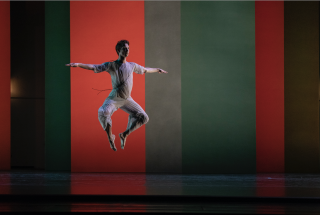
The poetry was framed in a stage set dominated by Marden’s glorious backdrop, with vertical and angled lines of primary wide red columns and “T” shapes, bounded by blacks, greys, green. As the lighting shifted, the set shifted from bright to dim and back; it was larger than life, but never overpowered the always central dancers, who appeared and disappeared through the openings that were the black columns of the backdrop.
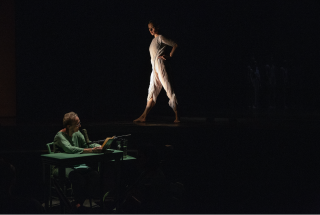
In later scenes where scrims appeared, Marden-designed panels were rolled onto the stage, and the dancers moved behind the screens, soft-edged, faded like memory, and in front – sometimes like mirrors, or perhaps doppelgangers. Each image – both verbal and visual – offered questions and evocations; each interpretation was both universal and personal for the audience. Figure and ground gently shifted throughout – the movement stayed forefront, but ceded attention to words, then to the insistent soft echo of the musical score, or the lights, or the colors.
The final partner in the quartet of artistry woven together in this work was Saariaho’s haunting, fluid score. Gently entering somewhere in the middle of the first quartet, the tinkling of bells alerted us of the music’s approach. Like the dancers, each instrument had its moment of solo power before folding into the whole. The gentle but urgent cello was the most evocative. The music was offered in service of the words and the dance, but made itself indispensable to the whole (perhaps an example, too, of Eliot’s appreciation for “the wisdom of humility.”)
“Every attempt” Eliot’s narrator muses, as he considers his middle age and his many attempts (and failures) is “a wholly new start.” Tanowitz, like Eliot himself, may have had some failed attempts over years of exploring, but this piece seems wholly new. Like Eliot, she can claim, “in my end is my beginning.”
copyright © 2018 by Martha Sherman



