Persistence
“RedWhiteBlueBlack&Orange -
the Art and Dance of Resistance”
Maida Withers Dance Construction Company
Center for Contemporary Political Art
Washington, DC
January 20, 2019
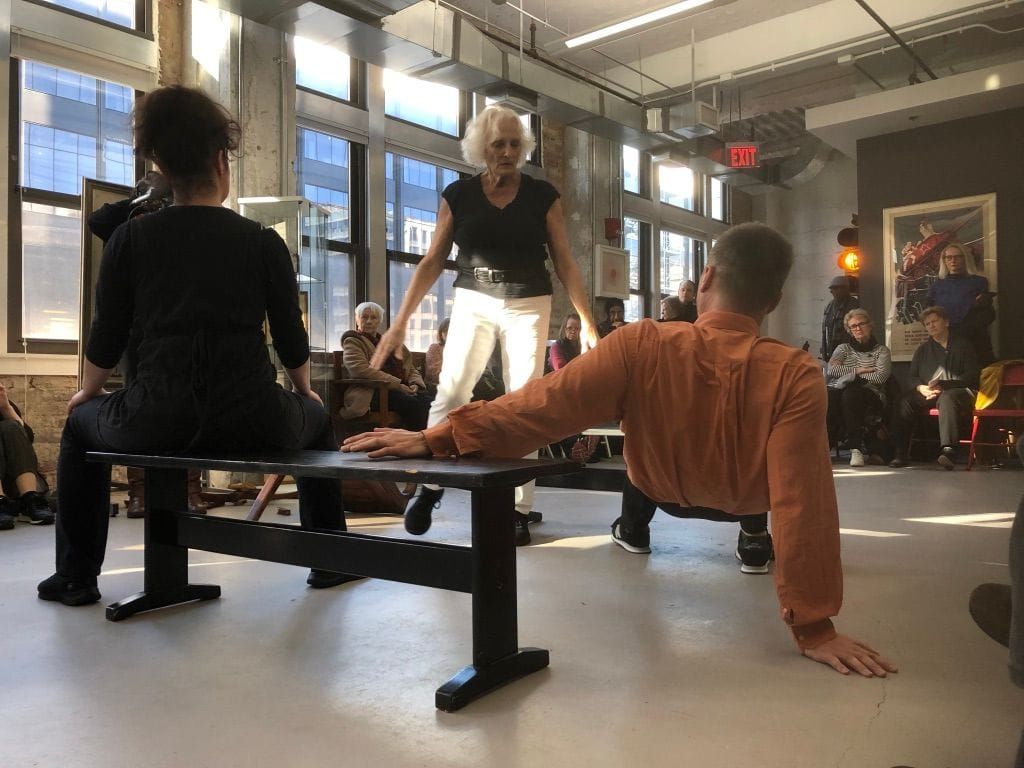
The performance took place in the main room of a downtown art gallery, a space with windows on one long side and art work hung on the inside walls. Through the windows came the sunlight of a clear winter afternoon, illuminating the space and its pictures. All the art was of actual, recognizable things but not in a single style or from a single period or place. It certainly was not a display of Soviet social realism. An audience of perhaps half a hundred people sat along the walls on folding chairs or on the floor while a few stood. Three red metal folding chairs, as if thrown down, lay on the floor near the center of the room as the performance began. Three dancers entered the space surrounding the downed chairs; a “sound artist” with an electric keyboard, microphone and other gear, sat on the floor against the long inside wall. The dancers, two women and one man, all wore velvet jackets but looked distinct. Maida Withers was a white-red-white motile. She had a mop of white hair, a red jacket and tight white trousers. Erica Rebollar surged like midnight. Her black hair was carefully coiffed, her jacket was black and so were her tights. Gold was the color of Anton Ovchinnikov’s velvet jacket. He wore it over a muted orange shirt. The dancers snapped their limbs, snapped at the waist and at the neck as Yoko K. Sen, wearing a bowler hat, sat producing her sound score. The dancers’ vigor made them look like puppets. Relaxing or pausing, they seemed more human.
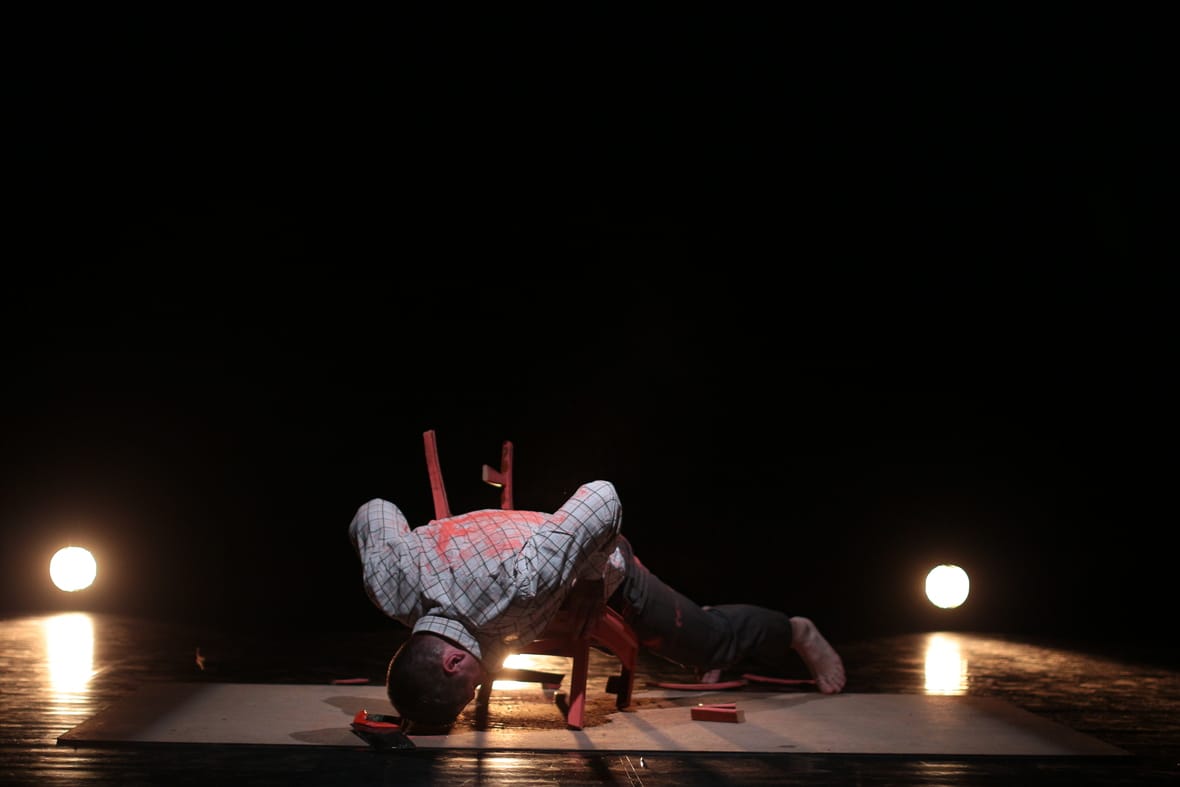
Withers is feisty. She challenges the others or urges them on. Remarkably strong, she does nothing to hide her age or her stance’s slight bend. Rebollar is resolute and dances with a retard. Is she thinking of other things she might have done or simply sorry to let the moment go? Her quiet sensuality is something to behold. Ovchinnikov gave the audience the longest chance to observe him by including his chair solo “Duel”. In it he first explores a substantial wooden chair by sitting in it in various postures and in different states of consciousness (alert, thoughtful, asleep, etc.). He does acrobatic balancing with it and even tries to stretch out beyond the chair’s small seat as if it were a bed. Then he attacks it with a saw and begins an act of demolition. Is he destroying the chair to save himself or is the attack on the chair (while at times still sitting in it) his own act of suicide? It is very hard to know what Ovchinnikov is thinking, but this duel with the stoic chair exhausts him.
For about 90 minutes, the three dancers conflicted with themselves and with each other, they also collaborated and, too, ignored each other. They wore their velvet jackets only at the start and had roused the downed folding chairs and sat on them. Later they had picnic-table benches to sit on and possess. A male figure wearing a Trump mask marched across their dance floor. Was it this presence that set the dancers parading like soldiers? Finally, the threesome gathered a good part of the audience into a circle of comrades: hands were clasped. Withers urged all to raise their joined hands high.
That the two women, Withers and Rebollar, are DC-based modern dancers whereas Ovchinnikov is a performer-choreographer from Kiev in the Ukraine, is biographically factual but doesn’t distinguish them in action. Moving and pausing, they were individuals, each with a core that remained independent of context. Being unable now to hear fully, I no longer review musical dance. Sen’s score, however, was a sound and noise composition that filled a void. It gave the dancers’ actions a backdrop of rhythm and dynamic that I was able to sense.
copyright 2019 by George Jackson



