Parable of the Plant Kingdom
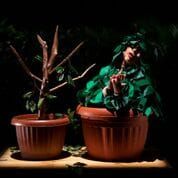
"Estado Vegetal"
Manuela Infante
Baryshnikov Arts Center, New York
May 3, 2019
In medical Spanish, "Estado Vegetal" means a vegetative state, where basic life functions go on but consciousness and thought are absent. Politically, a "Vegetative State" could mean rule by the plant kingdom. This intense theatrical piece, starring a young Chilean woman and an array of potted plants, suggests such a state is exactly where humanity is headed.
The plot is a parable – an inquiry into a tragic accident. A large tree was growing in a city park, slowly as trees do, imperceptibly to humans. Nonetheless it grew closer and closer to an overhead power line, and efforts to trim it were stymied by a tree-hugging woman camped in its branches.
One night the tree hits the power line and the city blacks out. A fireman speeds to the scene on his motorcycle, but crashes into the tree in the dark. Gravely wounded, he descends into a vegetative state. The inquiry is aimed at assigning blame, but in the end all the humans are cleared. The blame falls on the tree.
The plot thickens -- an old lady who talks to her houseplants hears them grumbling together about the house that's been stolen from them. She tears up her floor and re-buries them in the earth, but it's too late to head off the conflagration. The stage goes dark to the sound and smell of burning leaves, burning branches, a general firestorm. The lights then come up on a blackened forest, and the fireman re-appears, wailing a confession.
In this parable, it seems, original sin is not the knowledge of good and evil, but the very act of movement. It is not humankind that spoils Eden, it is the whole animal kingdom, creatures who advance and evade instead of just growing, kill and die instead of just living. The fireman is the last of the animals -- he repents of moving, accepts his vegetative state.
The intellectual content above is drawn from the thought of Michael Marder, a radical Spanish philosopher who sees plant life as embodying all the virtues humanity has lost, e.g. authenticity, selflessness, community. What saves this piece from being tedious philosophizing, though, is the way it celebrates the very modes of expression it condemns. The script laments the reduction of life into language, as it plays with puns on roots and leaves, pots and beds. The firefighter traces evil back to movement, then comes back for a mini-ballet in a leafy costume that evokes a Midsummer Night's Dream.
All the parts -- male and female, animal and vegetable -- are played by one virtuoso performer, Marcela Salinas, who grew this work with writer-director Manuela Infante. Salinas is at her most affecting when she plays the mother of the vegetating victim, wistfully remembering her hyperactive boy, who seems to represent all that's unintentionally destructive in the male psyche. Maybe on a more practical level the work is an argument for feminist rule, with women paving -- or rather, un-paving -- the way for plants to seize the day.
In the end, it suggests, the earth will revert to a green ball. All this contradicts the natural history I learned, which had life starting with little creatures moving in the ocean, as well as the current wisdom that has us headed for a watery grave. But this isn't science, or even philosophy. It is theater, food for the imagination. And it is good.
copyright 2019 by Tom Phillips



