Not His First Rodeo
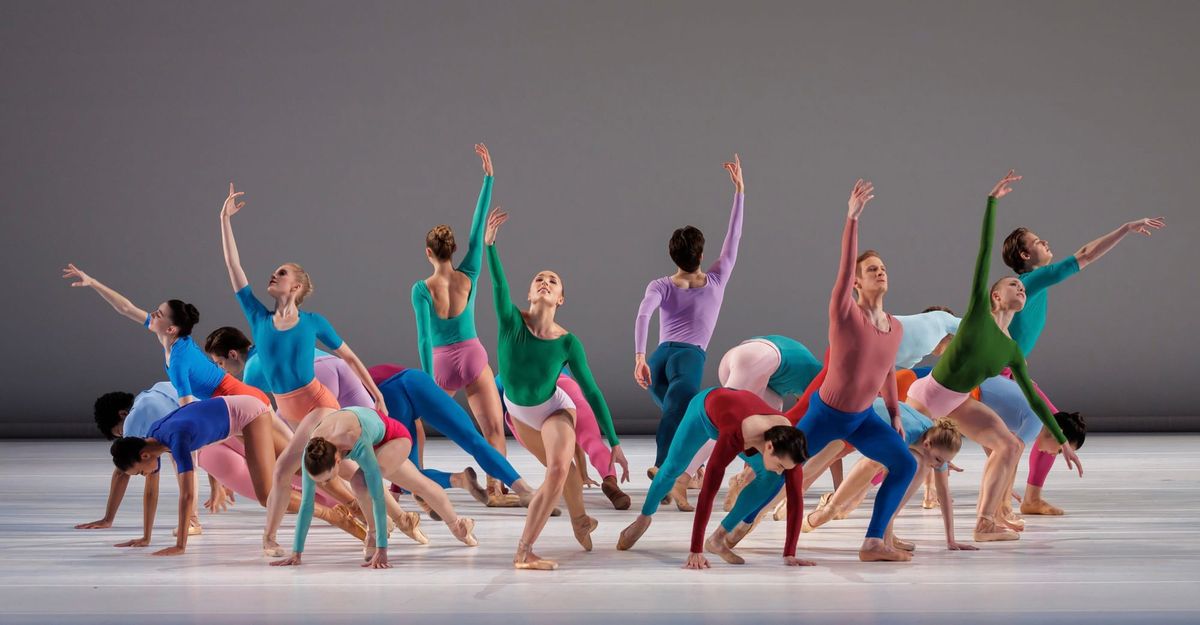
"Copland Dance Episodes"
New York City Ballet
David H. Koch Theater
Lincoln Center
New York, New York
January 28, 2023 evening
Justin Peck first used Copland's music for his 2015 ballet "Rodeo: Four Dance Episodes", an abstract piece set to Copland's symphonic arrangement of the ballet score that launched Agnes de Mille. For his new full-length ballet (as advertised and sold by the company, though it is a 70+ minute intermission-less piece) he has incorporated most of his earlier "Rodeo" and added two other Copland dance scores, "Appalachian Spring", composed for Martha Graham, and "Billy the Kid", from a now rarely seen ballet commissioned by Lincoln Kirstein and choreographed by Eugene Loring, with Copland's "Fanfare for the Common Man" as the overture. All of these works have a spacious grandeur and a Western twang (Copland interspersed cowboy and folk songs into his ballets) and his music evokes sunsets, campfires, boundless horizons, and determined optimism, which the orchestra, conducted by Andrew Litton, brought to life, beginning with the blazingly confident trumpets of the overture.
Peck used little of this glorious spaciousness and the ballet might have been called "Fanfare for the Uncommon Dancer", as his staggeringly talented cast leapt, hopped, and slouched through some extremely repetitive choreography. Peck moves his groups well and his corps formations, often undulating blocks with dancers forming and reforming shapes, were the most interesting aspect of his ballet. His choreography for smaller groups and pas de deux, though, tended to be composed in small bursts of energy, with extended arabesques melting into odd forms, then a pause and then a repeat. Overall, the ballet feels like watching a long rehearsal with a group of friends supporting each other (including a group hug); cosy but airless, with little relation to the expansive music.
The men in Peck's original "Rodeo" wore grey and blue with stripes hinting at athletic gear, suggesting comrades in arms. These have been replaced by gumdrop bright two-toned body suits for the men and colorful swim trunks (no tights) and leotards for the women (costumes by Ellen Warren). These are eye-catching but somewhat juvenile, as if his dancers had popped out of a box of M & Ms. The dancing itself was committed, energetic, and lively. Mira Nadon and Taylor Stanley danced the lead couple in the reworked 2015 "Rodeo", originally danced by Sara Mearns and Amar Ramasar. Nadon showed off her glorious arabesques and Stanley his boneless, elegant intensity, though there was little emotional connection beyond a few impassioned faces. They wafted in and out of the rest of the ballet at random intervals until, near the end of the ballet, they had a knotty pas de deux with interlocked arms and some frowns; a hint of a story but without any real emotion.
Tiler Peck and Chun Wai Chan here also featured. Chan led the most impressive section of the original "Rodeo", the adagio for five men, a lyrical salute to friendship, originally danced by Taylor Stanley. Chan, with his forthright, warmhearted presence, gave a dignified, generous performance. Later, he and Tiler Peck had a three-part pas de deux, which even her quicksilver feet and his generosity could not make much of. Each section was separated by various group dances, possibly to give the couple time to rest, but even with the breaks, each of their sections, slow or fast, had little variety.
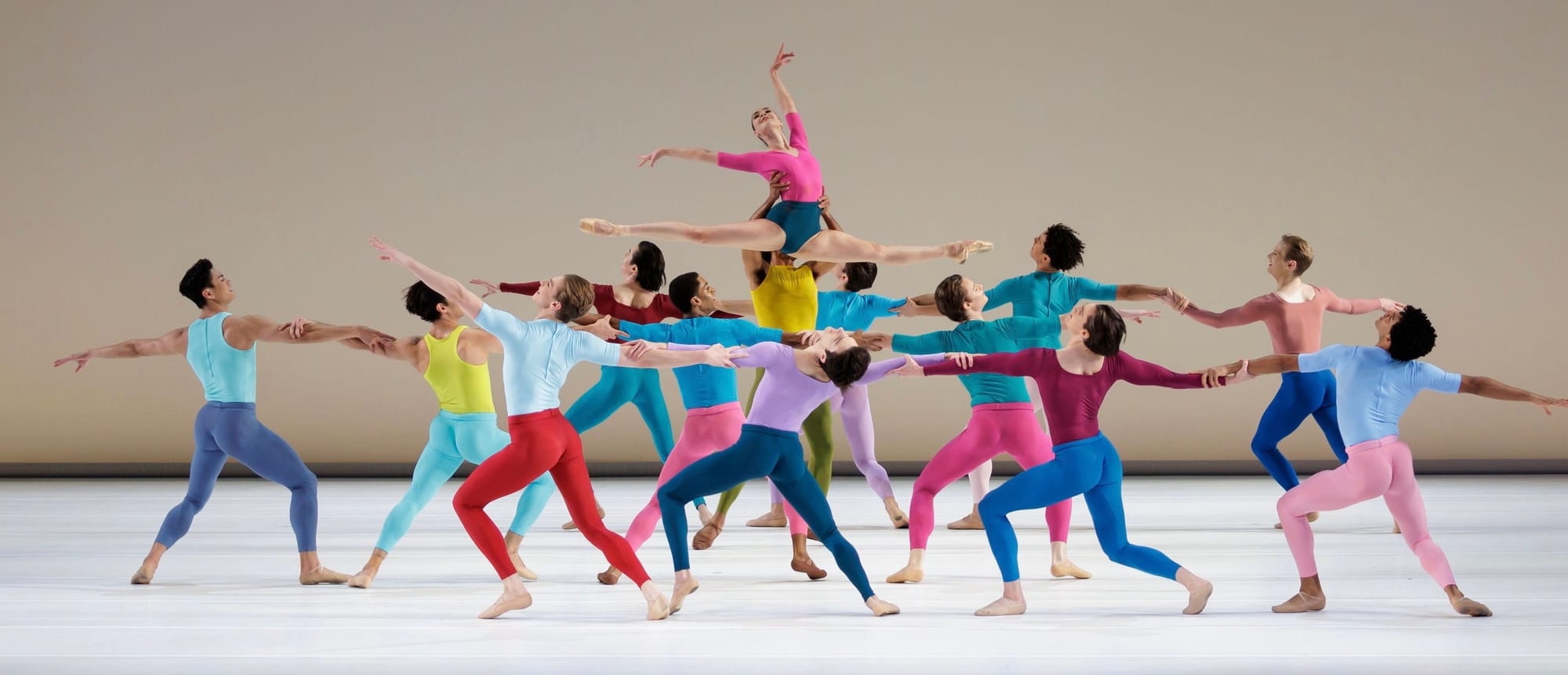
Peck seems more comfortable choreographing for men than for women. His women, who included many of the company's outstanding and individual dancers, tended to look alike, separated only by height. There was a tall cohort and a short cohort, but basically they were only legs and smiles; somewhere Florence Ziegfeld is nodding. Roman Mejia danced Daniel Ulbricht's role from the original "Rodeo" with his infectious dynamism, leading his two cohorts (Harrison Coll and Anthony Huxley) through a series of energetic jumps. Mejia's control, like Ulbricht's, is almost inhuman, and he slowed down his turns à la seconde with an insouciant grin, but he looked like a dancer trying out steps. Later, much later, Coll got to show off his control in some of his own turns. But, exciting as some of the individual dancing was, the ballet as a whole was disappointing, an unconnected set of dances floating on top of a stupendous score.
© 2023 Mary Cargill



