New York City Ballet at Lincoln Center

“Amaria,” “Opus 19/The Dreamer,” “Russian Seasons”
David Koch Theater, Lincoln Center
New York, New York
September 25, 2021
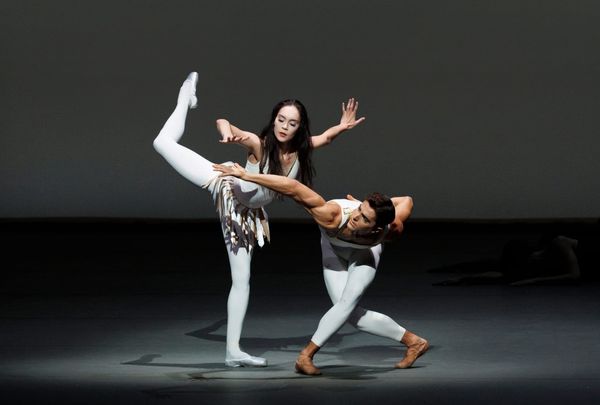
New York City Ballet is at last back at Lincoln Center, and a cause for celebration it is, after eighteen months of virus induced absence. The fall season, which began September 21, continues through October 17. Yet, it seems no gain can come without loss these days, and so we learn that by the end of May six senior principal dancers will have left the company. Among them is ballerina Maria Kowroski, who will retire in October after twenty-six years with the company. On Saturday evening she was featured in the premiere of a pas de deux by Mauro Bigonzetti entitled “Amaria,” dedicated to her in both title and dance. Her partner was Amar Ramasar, another of the principals who will leave in the coming year. The costumes, also by Bigonzetti, consisted of a dress for Kowroski in a rich green, and subdued grey t-shirt and pants for Ramasar, as if to stress the fact that this dance was hers.
Before “Amaria,” Bigonzetti had choreographed three works for New York City Ballet, with Kowroski featured in all of them. He may have been attracted to the ballerina’s tall stature and flexible body. Certainly he emphasized her flexibility in this duet where, in a number of instances, she grasped her leg in a vertical split while Ramazar supported her. It’s not the most subtle use of Kowroski’s attributes, but it is typical of Bigonzetti’s approach to choreography. The score consisted of two Scarlatti sonatas, which Craig Baldwin played onstage, highlighting their delicate refinement. Bigonzetti seemed not to refer to the music in any way, essentially using it as an orderly means of keeping time. The dance, which was purely abstract and performed by Kowroski in soft ballet slippers rather than point shoes, consisted of many twisted gestures and poses that challenged ballet classicism without offering a convincing alternative. Kowroski deserved better.
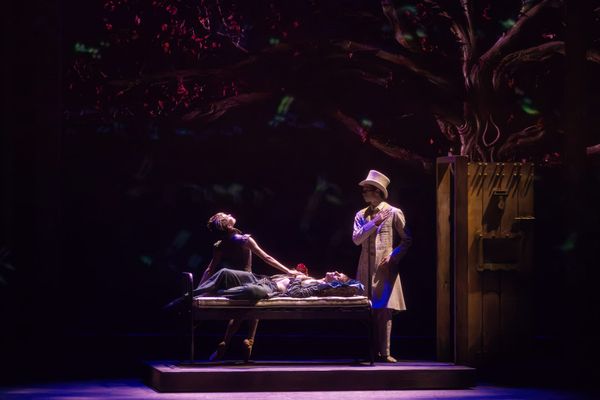
The evening opened with Jerome Robbins’ “Opus 19/The Dreamer,” set to Prokofiev’s Violin Concerto No. 1 in D Major. There are those who consider the work to be minor Robbins, but whatever one’s view, the ballet does have its fascinations. Made in 1979 for Mikhail Baryshnikov and Patricia McBride, on Saturday it featured Gonzalo Garcia and Tiler Peck. Garcia, who will be leaving the company in February, is an understated dancer who can look bland. However, here his reserve served him well, rendering movement meditative, which in another dancer might look histrionic. The dreamer, himself, appears to be on a quest or journey, although for what exactly, we don’t know. The core of the mystery is the woman who appears to him. She doesn’t easily fit the character of muse or feminine ideal, so common in ballet narratives. In fact, this conjured vision is frequently nightmarish and on the attack, with claw-like gestures and stabbing movements. Only gradually does she transform into a more positive figure, until in the end, dreamer and dreamed are at peace. Tiler Peck, whose temperament is more girl-next-door than idee fixe, nonetheless found her way into the role and was compelling.
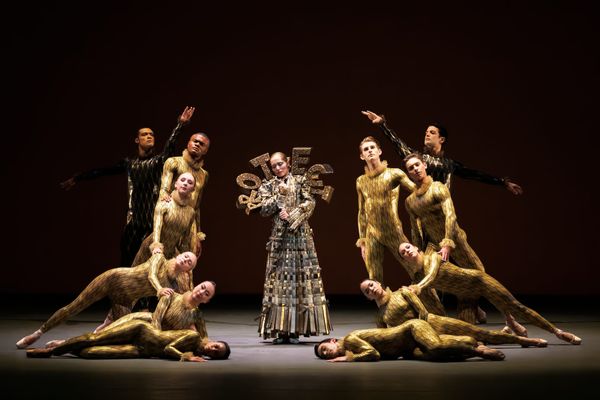
The final work of the evening was Alexei Ratmansky’s “Russian Seasons,” made for New York City Ballet in 1979 and set to a score by Leonid Desyatnikov. It is a big ballet with twelve sections and a cast to match, and it was received rapturously by an audience starved for an ambitious work, grand in theme and scale. Although the program notes spoke of the ballet exploring love, loss and death within the context of traditional Russian rural life, the overriding sense the work communicates is one of an indefatigable life force centered in community. Its energy picks up those who fall, who feel pain or anger, and folds them back into the group. If there is individual frustration and sadness, there is, in equal measure, playfulness, flirtation, and romantic advances. And though death is everyone’s end, and the ballet acquiesces to that inevitability, life is the unquenchable element that drives humans onward.
Galina Soloveyeva’s costumes for the ballet are brightly colored and folk-like, echoing Ratmansky’s Russian folk references. Sara Mearns danced the role of a woman in red, fierce in her anger. Taylor Stanley was a central figure in orange, and then in white, when he becomes the bridegroom in a wedding that links human rituals to the eternal round of seasons and of life and death.
copyright © 2021 by Gay Morris