Movements That Are Drawn
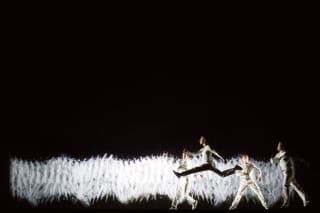
"Frame by Frame"
The National Ballet of Canada
Four Seasons Centre for the Performing Arts
Toronto, Canada
June 1, 2018
When the National Ballet of Canada announced a full length commission from Guillaume Côté, some may have had their doubts. Côté is a brilliant performer, but his work as a choreographer has been uneven. His 2016 adaptation of "Le Petit Prince" did not instill much confidence in his ability to craft a coherent narrative work. Furthermore, this new commission is an homage to the life and work of Scottish Canadian filmmaker and animator Norman McLaren (1914-1987), not exactly straightforward ballet material. Yet through collaborating with renowned Quebecois filmmaker, playwright, director and actor Robert Lepage, "Frame by Frame" is an innovative landmark work for the company. The artistic team included Ex Machina, Lepage's multidisciplinary production company, as well as the National Film Board of Canada. "Frame by Frame" successfully combines a varied dance vocabulary with innovative digital media techniques to create a ballet that is distinctive to the company and true to the ethos of McLaren's oeuvre. Devoted balletomanes, first time balletgoers, and cinemaphiles alike will find something meaningful and memorable in this work.
"Frame by Frame" unfolds like a collection of short films, two hours with no intermission. A loose chronologic outline of McLaren's life is interspersed with tributes to some of his most iconic films. A selection of his more abstract or experimental works are shown in their original form projected on a screen, including the whimsical and geometric "Le Merle (The Blackbird)" set to a Quebecois folk song. His live action films, such as his most famous work "Neighbours" lend themselves to being recreated by dancers (Dylan Tedaldi and Skylar Campbell) on stage. As "Frame by Frame" progresses, the common threads between McLaren's films and dance become evident. The vast majority of his works are without dialogue. The musicality is paramount. Abstract works like "Synchromy" are kinetic, matching gestures to sound. Where actors are used, mime and physical comedy abound. George Balanchine is famously quoted saying "see the music, hear the dance." He could just as easily be describing the ingenious synesthesia of McLaren's work. Côté's choreography draws on a wide range of influences from slapstick to vaudeville to jazz to popping.
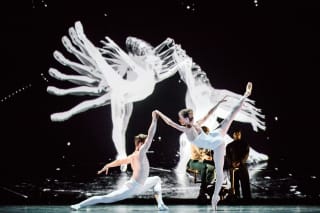
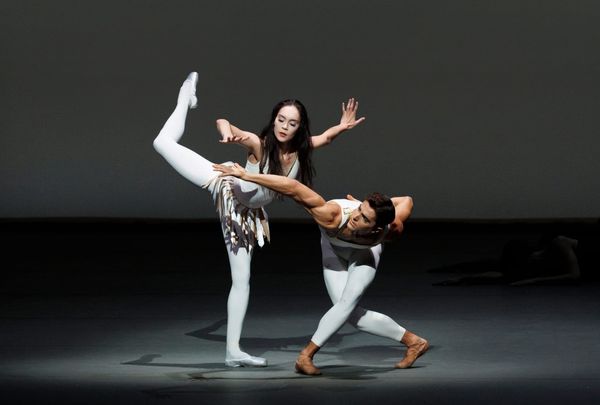
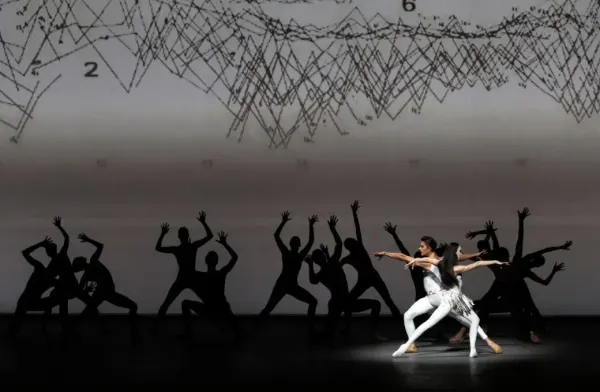
"Frame by Frame" is truly a 21st century ballet in its use of mixed media and technology to create novel effects. While often in new works such effects can be piled on or used simply for their own sake, here there is judicious restraint. The effects are not embellishments. They are integral to the work and are only used to express an idea that cannot be conveyed otherwise. For example, dancers dart across the stage in front of a projection of dancers on film while a strobe light flashes. The flashing light fragments the live dancers' fluid movements in choppy starts and stops such that they initially blend in with the video. In another segment, the audience gets a behind the scenes look at McLaren's most overt dance work, "Pas de Deux", a dream-like short film featuring dancers Margaret Mercier and Vincent Warren, choreographed by Ludmilla Chiriaeff (founder of Les Grands Ballets Canadiens). The piece is exquisitely recreated with Heather Ogden and Harrison James, except in addition to their dancing downstage, McLaren (Jack Bertinshaw) is shown upstage, filming them. His real time recording is simultaneously projected on the backdrop. The audience sees two perspectives at once, their own and McLaren's, and the choreography can be appreciated from different angles.
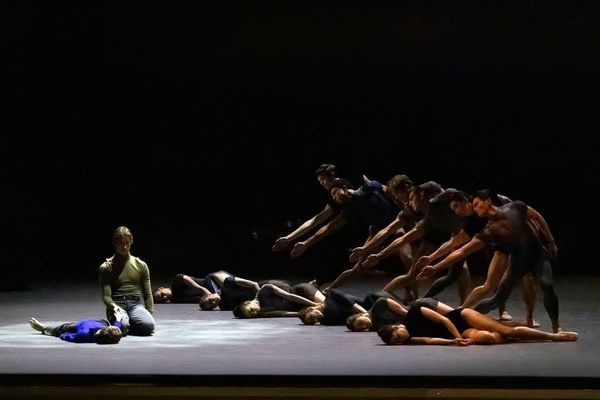
McLaren was a great admirer of the ballet. One of the most touching and humorous segments of "Frame by Frame" is the scene where he meets actor and director Guy Glover (Félix Paquet), who becomes his lifelong companion. They meet at a performance of "Swan Lake". The perspective is flipped and the audience is watching from upstage, facing the "audience". Familiar choreography from Act II is interspersed by the two aloof men pursuing one another. It is love at first sight, but instead of time slowing down, the music speeds up as they shuffle around between the swans with quirky, whimsical improvised steps. Later, the tone changes. Another pas de deux hints at the struggles of a closeted gay couple. The dancers are shown as silhouettes, the lighting creating a rainbow behind them before they retreat back to a state of darkness. There is also a tender and complex pas de deux for McLaren's frequent collaborator, animator Evelyn Lambart (Greta Hodgkinson), and her female lover. It is a powerful statement as one of the only, if not the only, representations of a lesbian relationship in the NBoC repertoire.
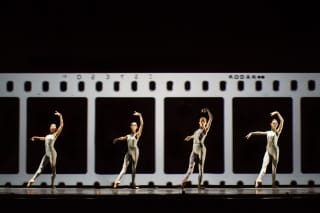
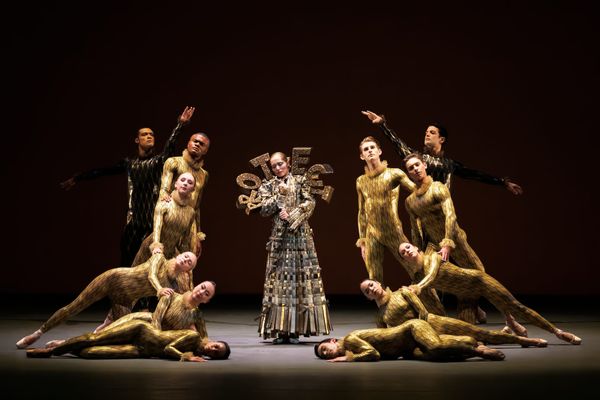
Other memorable vignettes include a business meeting at a cafe. Using an overhead camera, the birds eye view of the round table is projected, showcasing a dance between hand gestures and movements of napkins, teacups and saucers. The movements are small and intricate, requiring precision and perfect timing. There are cameos by some of McLaren's most well-known collaborators, including jazz pianist and composer Oscar Peterson (guest artist Wellesley Robertson). There are also nods to time McLaren spent teaching film in India and China, although the awkward inclusion of dancing red guards (with a dancer in yellowface) should be omitted.
Each of the dancers showed impressive range as movers and actors. There was only one cast for the entire run of 11 performances. It will be interesting to see how their interpretations develop from having the chance to reprise their roles. The NBoC will bring "Frame by Frame" on tour to London's Sadler's Wells, who co-produced this work. Touring has been a priority for the company under Karen Kain, so it is very fortunate for the NBoC to have created a work that is distinctly and proudly Canadian to show to the rest of the world.
copyright © 2018 by Denise Sum