Moonlighting
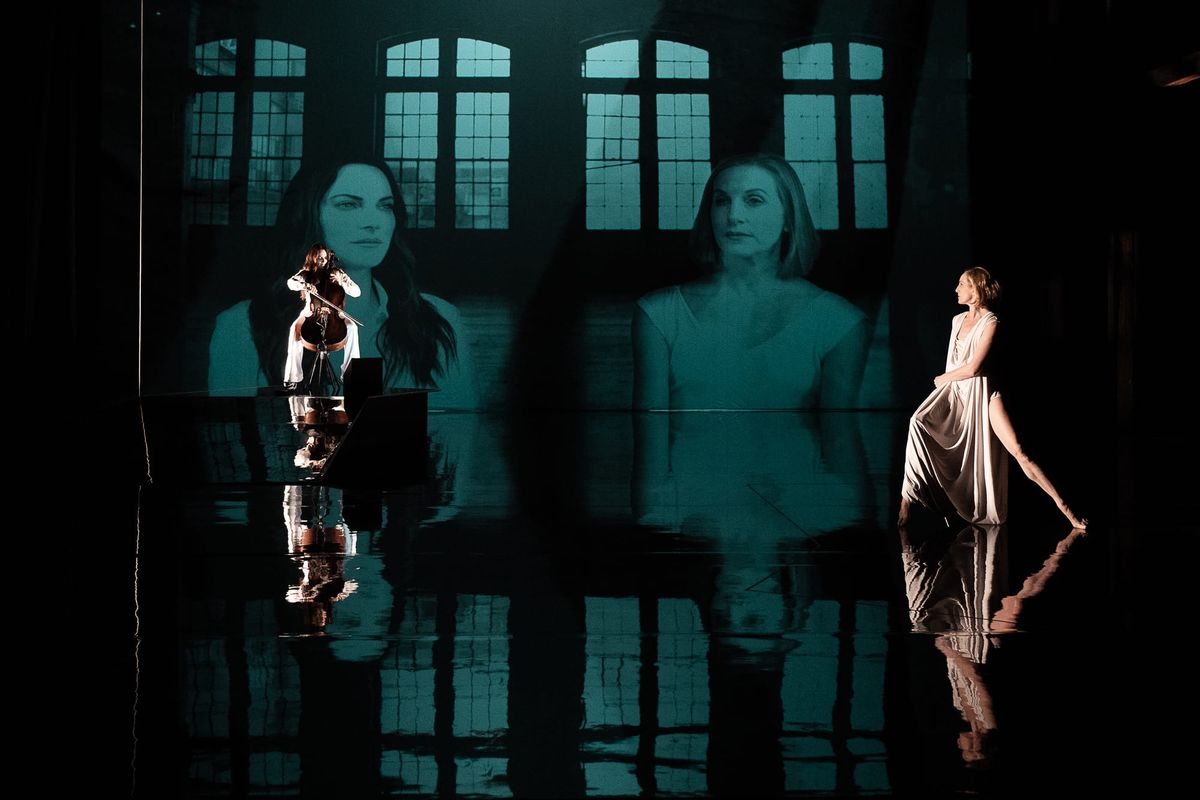
“The Day”
Wendy Whelan and Maya Beiser in
choreography by Lucinda Childs to
music and poetry by David Lang,
Eisenhower Theater,
The John F. Kennedy Center for the Performing Arts,
Washington, DC
December 6, 2019
At the start of the 20th Century, Diaghilev’s ballet dancers such as Pavlova, Nijinsky, Karsavina, Bolm et al. did “moderne” numbers on their comcert programs. Nijinsky, of course, has been considered an innovative modern dance choreographer as well as a classic-romantic performer. If ballet and modern dance are analogized to poetry and prose, then the reverse examples - modern dancers doing ballet - aren’t as frequent. They haven’t the requisite bodies nor techniques. Yet there is the instance of Merce Cunningham’s partner, Carolyn Brown, daring to dance in Fokine’s “Les Sylphides” and doing so quite credibly.
Lately, some maturing ballet dancers such as Robert Fairchild and Sara Mearns have have been venturing into modern dance. Currently, at the Kennedy Center, the former New York City Ballet ballerina Wendy Whelan (now that company’s associate artistic director) is performing choreography by post-modernist Lucinda Childs. There are just two women on stage in “the Day”, Whelan and cellist Maya Beiser. The musician is seated somewhat upstage left, playing her instrument. Whelan moves about, dressed in flowing white like a Roman image of Minerva. The space they inhabit is transected by four metallic poles and a partly horizontal, partly raked floor. Projected behind them is a daytime panorama of sky and perhaps cliffs. Whelan holds herself tensely compared to Beiser. Moreover, Whelan’s movements seem intentionally limited and repetitious. This is not a generous goddess.
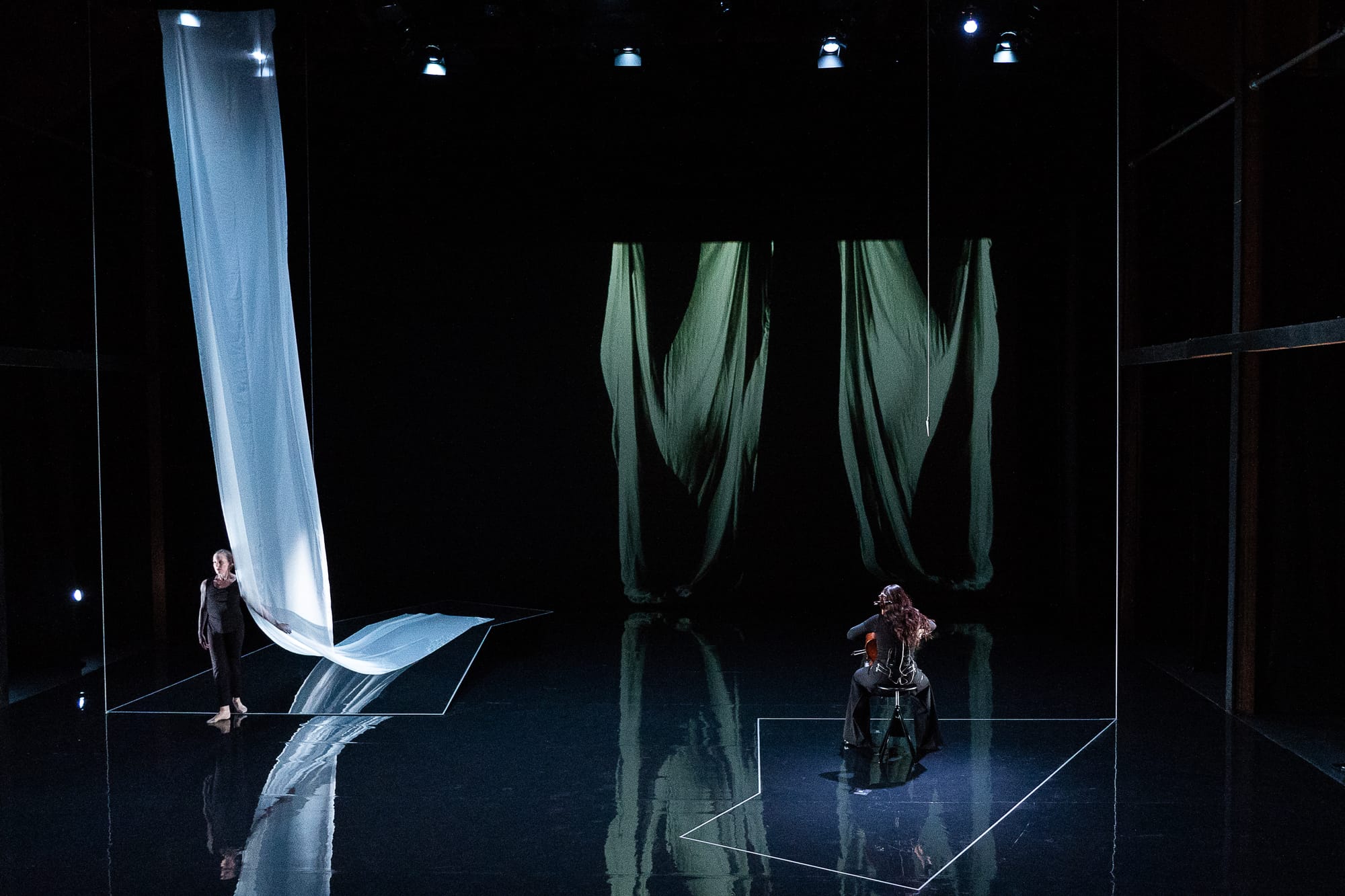
Whelan stands, stalks, runs, turns forcefully and deliberately, plus she handles props. She does these things repeatedly. Her favorite instrument is a metallic tape measure which she shapes into geometric forms. I was reminded of Ruth Page’s 1932 “Variations on Euclid” (also known as “Expanding Universe”) but was Childs aware of this predecessor? During the first part of “The Day” , Whelan removes her toga and moves about in simple underwear. Later she has on black, overall tights. The backdrop changes, bringing us indoors from the rocky landscape into a huge hall filled with people at its far end. Throughout this dance’s first part, a recorded voice (Reisen’s, I think) recites David Lang’s poem “The Day” (it is over 300 lines long in the printed program). All the while, Reisen remains seated, playing Lang’s often grainy music.
Part 2 is subtitled “world to come”. There is no poetry but Lang’s music starts with bangs on the cello that becomes more melodic, more mournful than the score for Part 1. Whelan remains dressed in the overall black tights. She repeats poses and motions from the dance’s first part but performs them with greater flow and also adds some new motions. There is more taking of poses while lying down. This final, tomorrow section of “The Day” ends with another reminder of preceding work. Veils of white cloth unfurl from on high. One of them covers Whelan. When the long cloth has hit the floor, Whelan wraps herself in it and rolls forward, down the raked portion of the stage floor. This recalled an image from Balanchine’s neo-classical “Orpheus”. Apparently, according to Childs and her collaborators, our future is a mummy.
Post-modern dance at Judson Church in the 1960s, where Lucinda Childs first called attention to herself, was often simplistic and repetitious yet daring and new emotionally. “The Day” hasn’t that risky, innocent edge of feeling. Whelan, Reiser, Lang and Childs try hard to recapture a memory of the future.
copyright 2019 by George Jackson



