MMM
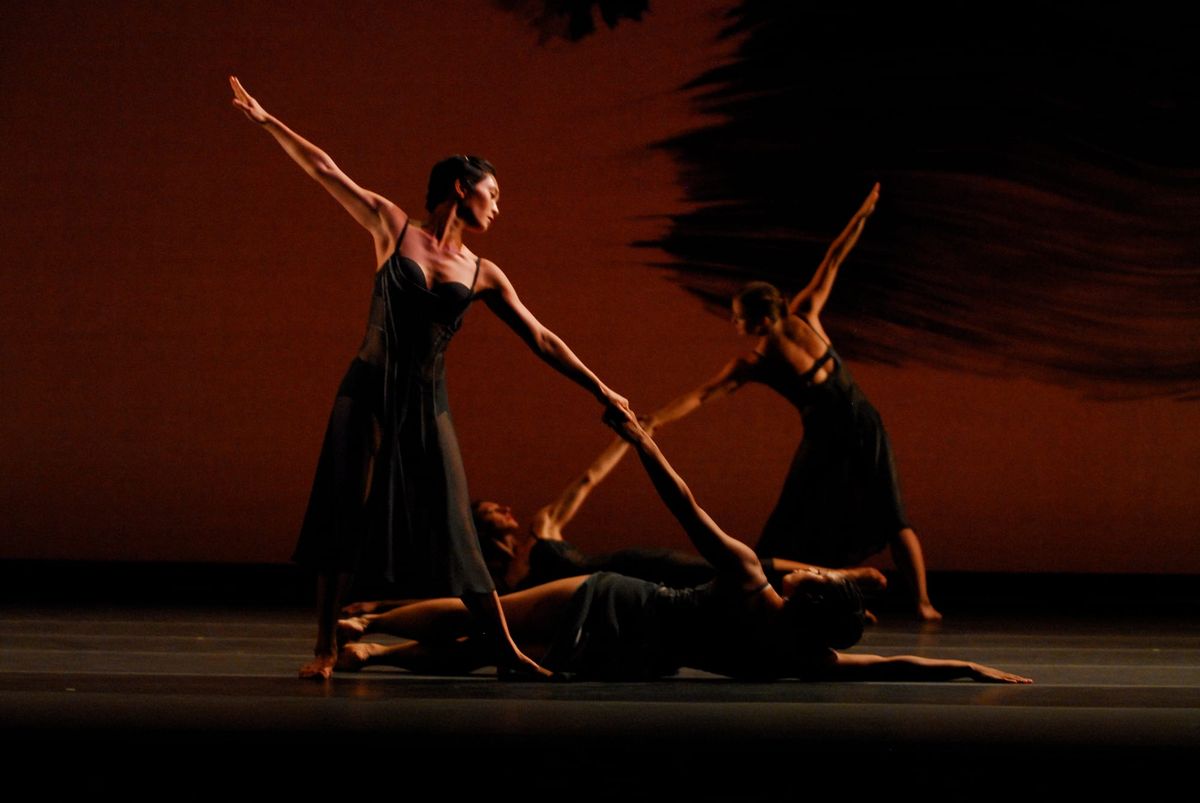
“Mozart Dances”
Mark Morris Dance Group
Zellerbach Auditorium
CalPerformances
Berkeley, CA
September 20, 2019
Mark Morris gets justifiably praised for the depth of his musicality but he most certainly also keeps our attention with the breadth of his imagination. The three parts of “Mozart Dances”, set in 2006 to the Piano Concertos No. 11 and 27 and the Sonata for Two Pianos, offer an extraordinary insight into Mozart, above all as a genius of crystalline clarity of music as abstraction. The music is all about structure, and to some extent Morris’ work here is as well.
“Mozart Dances” is about structure. (Of course, all good dance is.) But here, with all its elegance and beauty, ultimately the music keeps us at a distance. And so do the dances. What we notice is the richness of Morris’ sources, the arms thrown up and open as in Russian folk dance, the mincing steps and lacy wrists of Baroque dance, at one point frozen as in a porcelain figurine. I do not recall having seen as many perfectly thrown grand jetés and surely the most exquisite descent into a deep arabesque in a Morris choreography – all of it in service to the music.
Lauren Grant, the company’s tiny, powerful senior dancer, set the tone. After the men leave, she steps in from the sidelines at the first note of the piano. There is a splendid matter-of-factness about her super-clear dancing that gets picked up by the women with the orchestra. In their black costumes, which slyly reveal undergarments, they look like silhouettes. Arms are straight in front, opened up or angled behind their heads; glances go upwards, they run, they fall, they get up. Finally, Grant leads them off stage in a charming line formation.
“Double,” to the sonata for two pianos, was the work’s intimate middle section. It would have been fun to actually see the two performers (also conductor Colin Fowler and pianist Inon Barnatan) interacting with the dancers. Set on the company men — with some of the women in white tutus almost as in a cameo role at the end, echoing the men’s opening of the first concerto —“Double” highlighted male dancing as elegantly as you might have seen in Mozart’s time.
A fluid circle dance seemed wind-blown, changing its shape from round to oval into many directions. Yet it held beautifully even while opening into smaller units and coalescing again into a garland dance. These dancers, so different from each other, breathed the same air. There is a trace of love story embedded in “Double”, with Aaron Loux in fluttering waistcoat turning his steps into half circles as if looking for something. Noah Vinson, so experienced and a powerful dancer and still looking naïve, appears in the circle. With fists to his chest, he unhappily twirls as the centrifuge of the ensemble. Unless my memory fails, Vinson and Loux do get an embrace until they are separated again. In the central section, I confess, music and dance were so perfectly in tune with each other that, quite literally, they took my breath away.
The third section, the Piano Concerto No. 27, re-introduced some of the movement motives to remind us of the richness already seen. It was almost too much to simply keep up with. The ensemble also divides into two groups that approach and recede playfully. Several dancers had short solos — Leslie Garrison and Billy Smith are two I particularly noted. At one point the men lifted the women in all kinds of manners only to have them return again and again as if wanting more. Couples travel across the stage pushed by the music; the mood is festive and almost a little chaotic. And then the piece just ends. One can only hope that it was for this evening only.
copyright © Rita Felciano 2019



