Miracles of Dance at LaMama
LaMama Moves/Online
Tamar Rogoff with Merri Milwe
"Wonder About Merri"
Kevin Augustine/Lone Wolf Tribe
"Body Concert"
Tamar Rogoff with Mei Yamanaka
"The Yamanakas at Home"
January 27, 2021
It's not that often that three disparate dance pieces fit together so well that they seem to be subtly referring and commenting on each other – but last night's trio of experiments from LaMama seemed to have been made with each other in mind. The bookends were two short pieces by Tamar Rogoff – one set in downtown Manhattan, the other in a residential neighborhood of Tokyo – with entirely different characters and themes, but a single groove – a Motown beat that gets you on your feet, and won't let you do anything but dance.
"Wonder About Merri" is a six-minute film by Rogoff starring Merri Milwe, an elderly New York dance aficionado diagnosed with Dystonia – a neurological disorder that causes involuntary muscle spasms. We see her at home, struggling to control her movements as she gets out of bed, slowly dresses and puts on makeup, then leaves the building in a wheelchair. Then, with a sudden breathless jump-cut, she is on her feet in the street, in gold lame tights, grooving to a disco beat. The wonder of Merri is the miracle of dance – the human body's instinctive response to music. It can heal the sick, raise the dead, make the lame to boogie.
The centerpiece of the program is Kevin Augustine's "Body Concert," in which he sets out to raise the dead -- to animate the inorganic. He takes discarded foam-rubber couch cushions and fashions them into human body parts -- muscles, bone and sinew, devoid of skin. Channeling the Japanese puppet art of Bunraku, he puts on a black body-suit, fades into the shadows and brings these disembodied limbs to life. A leg crawls along the floor, an arm comes down to caress it. He peels away the muscle and reveals the bones, which then seem to speak to each other. The sound score by Mark Bruckner evokes thunder, then rain. At the end a full human body appears, a transparent form of a baby, crawling toward a skull on the floor. The sound score weeps as the child looks for the living among the dead.
If that sounds apocalyptic, that how it looked. Augustine's art also draws on Butoh, the Japanese "Dance of Utter Darkness" that emerged in the ghastly rubble of World War Two -- after the firebombing of Tokyo, and the immolation of Hiroshima and Nagasaki by the atom bomb. The disembodied limbs -- shorn of their skin -- evoke the victims of that American rain of terror, and the trauma that lives to this day.
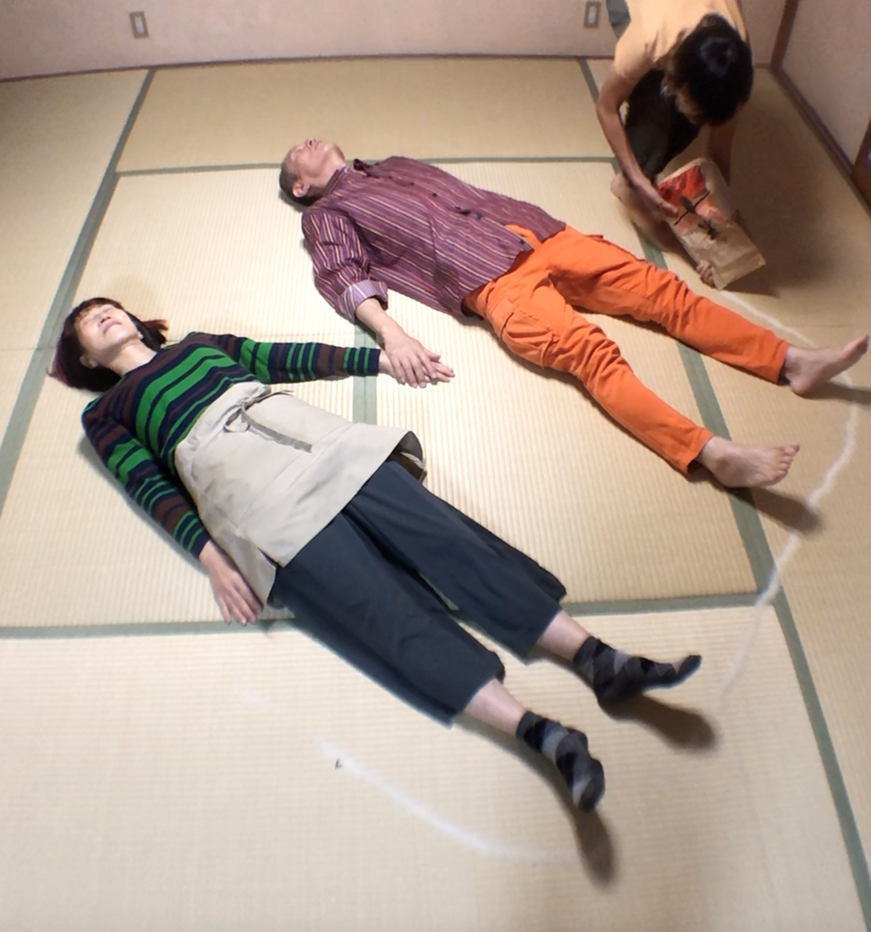
What can heal such woe? The last piece on the program is a collaboration between choreographer Tamar Rogoff, whose father fought the Japanese in World War Two, and Mei Yamanaka, one of her dancers, whose grandfather fought the Americans. The pandemic separated them as they were working on a piece for LaMama last year, and Mei had to return to Tokyo. So they collaborated on a piece from opposite sides of the world, a film that brings together their ancestors. A portrait of Tamar's father is propped up on the family's Yamaha piano, a symbol of the US-aided Japanese economic miracle after the war. But it's the miracle of dance -- American-style -- that sets Mei's middle-aged parents boogieing all over the living room, to one of the innumerable American raves that tell us to dance dance dance, "let the groove take over."
The shadow of the war and the bomb remains, personified by a silent guest (Mei) in military camouflage, writhing on the staircase, mysteriously spreading circles of rice around the house, which are neatly cleaned up by the parents ... until the end, when a cascade of rice falls and falls, as the Yamaha plunks out "Sakura," the wistful Japanese tune about cherry blossoms. Life is short and fragile, wars ruin and pandemics rage, but the dance goes on and on.
copyright 2021 by Tom Phillips



