Memories
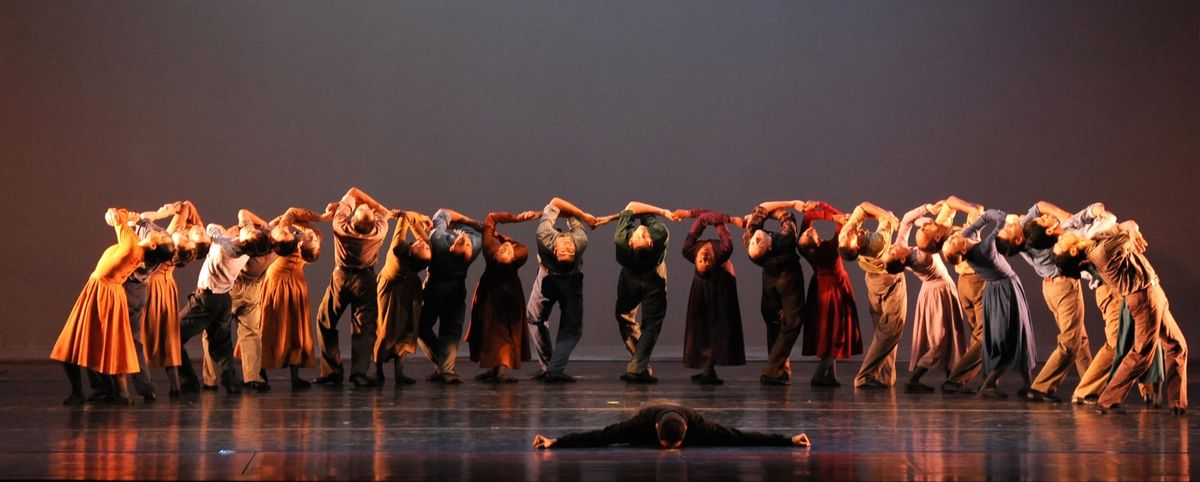
"The Unsung", "The Body is a House Without Walls", "Querida Herida", "Missa Brevis"
Limón Dance Company
Joyce Theater
New York, New York
May 10, 2018
The Limón Dance Company opened its New York season with a program bookended by two powerful works by José Limón supporting two newer works, both of which sported interesting designs, committed dancers, and somewhat meandering choreography, which put Limón's focused, structured works into sharp relief.
Limón's "The Unsung" from 1970 is a memorial to Native Americans; the only sounds were rhythmic stomping and the sharp intake of breath by the seven male dancers (Tanner Myles Huseman, Malik Williams, Jesse Obremski, Alex McBride, Terrence D. M. Diable, David Glista, and Mark Willis). The program gave the dancers names of Native American chiefs, though there was nothing literal about the choreography, which evoked rather than imitated Native American styles. The outstretched fingers framing their heads could represent feathers or the horns of the animals they hunted, but they also seemed to indicate power and grace.
The group dances were lit with a soft golden glow and the shifting patterns as they circled each other with their bodies rising and falling, accompanied by those stomping feet, had an elegiac power; the dance had an undercurrent of loss without any squishy sentimentality.
The dancers left their protective circle for their various solos, bringing to life moments of victory, defeat, and survival. Mark Willis (as Geronimo) gave the final solo an all-encompassing generosity, as he spread his long, powerful arms, seeming to signify both resignation and triumph.
The women then got their moment as Colin Conner, the Limón Company's current artistic director, set "The Body is a House Without Walls" (to a recording by Glenn Gould of Beethoven's "Piano Sonata #32") on an all-female cast. According to the program notes, the work is "about the regenerative power of memory" and the annotation refers to elephants holding "the bones of one who has died the year before". The choreographer did not set this literally, other than a few nudges which might have signified trunks waving about. The dead body (Brenna Monroe-Cook) wore a red dress which her fellow dancers removed to reveal white underwear; at the end the group carried her back to the red dress.
The work was atmospheric and at times lyrical, as the dancers lifted the body and slowly let it down to merge with the group. The dancers, especially Monroe-Cook, gave committee performances, but without reference to the program notes, the piece was decorative rather than profound; memory is a concept that is difficult to translate into dance.
Rosie Herrera set "Querida Herida" (which translates to the quaintly opaque "Dear Wound") to four bouncy Spanish songs. This too had an all female cast (Jacqueline Bulnes, Brenna Monroe-Cook, and Angela Falk). It did not, unfortunately, have a recognizable theme, though the color red and working zippers played prominent parts. It opened with two women (Bulnes and Monroe-Cook) cuddled together swathed in black cocoon-like outfits decorated with red zippers. There was some huddled fiddling with the zippers as red sequins showed through until one dress completely unzipped, which left suggestive bits of skin (or rather a flesh-colored body stocking) showing.
The scene then shifted to another girl (Falk) in a bright red sequined leotard running backwards and forwards between two red strips; she may have been the teeth of a zipper but she seemed to morph into a strutting, cartwheeling gymnast. Then the first two girls returned in shiny gold dresses and had a stylized fight. The work had a slight prurient charm but the dancers deserved something much more substantial.
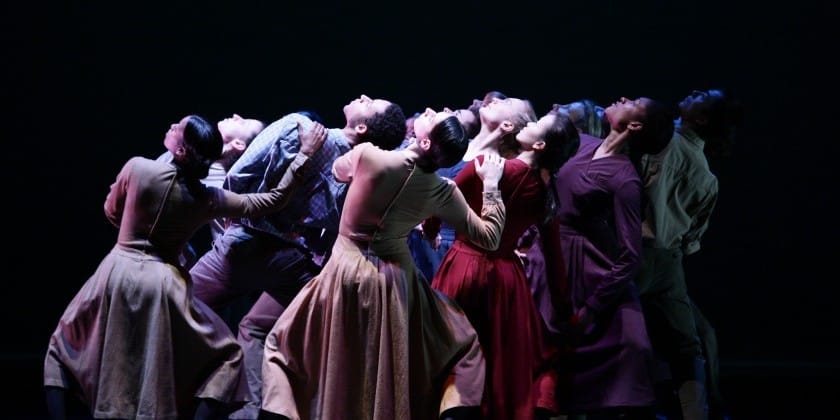
They got it with Limón's 1958 "Missa Brevis", set to Zoltán Kodály's "Missa Brevis in Tempore Belli". The Limón Company had toured Eastern Europe in 1957 under the auspices of the State Department and Limón's memory of the people he saw struggling to rebuild their cities and their lives after World War II inspired the work. This background certainly enriches the dance but it is not essential because the choreography, with its simple, solemn, and extraordinarily musical sensitivity, speaks directly to the audience; the work is both specific and universal.
The formations have an almost architectural solidity, as the dancers, moving with a steady, methodical weight, grouped and regrouped, rising and falling. There was a sense of struggle, but also of hope, as they raised their eyes to the light; their faces were vivid but impassive, and even in the most dramatic moments there was no false emotion. In the "Crucifixus" Monroe-Cook repeatedly pointed to her palm (for a fleeting moment I seemed to see the stigmata) as she moved with a calm and steady power. It is a magnificent work, and thanks to the Limón dancers, is unforgettable.
Copyright © 2018 by Mary Cargill



