Mark Morris New and Old
“Sport,” “Prelude and Prelude,” “Words (excerpts),” “Grand Duo”
Mark Morris Dance Group
Jacob’s Pillow
Becket, MA
July 21, 2019
In recent remarks about his working process, Mark Morris said he almost always starts with a piece of music that interests him, then creates choreography for it. That is not surprising, considering Morris’s longstanding dedication to music, from his insistence on live music at his concerts to his forays into orchestral conducting. In last week’s performances at Jacob’s Pillow, Morris stressed twentieth century composers: Henry Cowell, Erik Satie, and Lew Harrison, with Felix Mendelssohn being the nineteenth century exception.
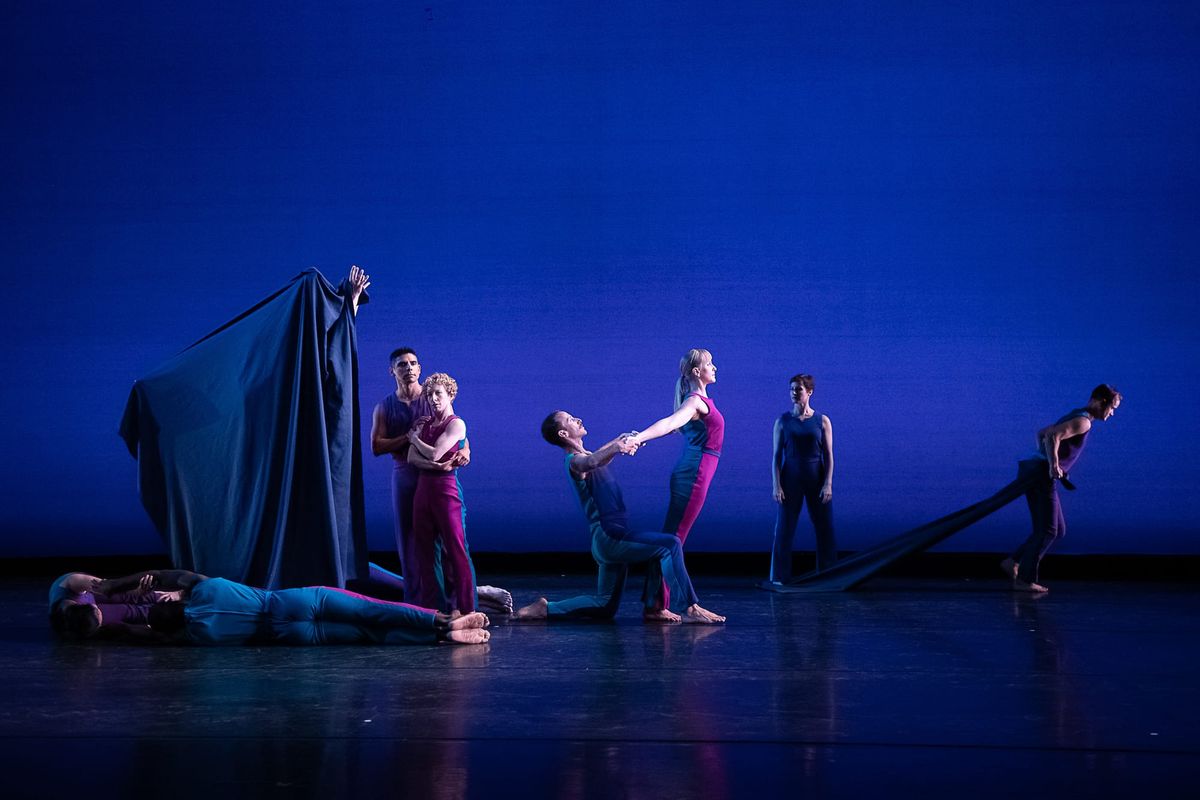
In the case of the oldest and newest works on the program, music inspired intriguing dances. “Sport,” which was premiered on July 10 for New York’s Mostly Mozart Festival, is set to Satie’s “Sports et Divertissements” of 1914. The dance, like the music, consists of a series of short vignettes centering on various kinds of diversions. Morris separates these with sections of silence, which he treats not simply as times of transitions from one scene to another, but as spaces for dances in their own right. These are often abstract, in the manner of divertissements in nineteenth century story ballets, and arabesques, attitudes, and other balletic steps are in evidence.
The scenes themselves are often amusing and lighthearted, in keeping with the idea of pastimes. Included are sports such as golf, fishing and canoeing as well as games and other forms of entertainment. At one point couples tango, at another, groups play blind man’s buff and tag. There is a moment in the swimming section in which the dancers, lined up from the front to back of the stage, peel off, one after the other, in a way reminiscent of the fountain-like moves of a movie aquacade. Another section has two dancers’ bodies providing a swing for a third who is pushed forward and back by yet another dancer. And in a bow to the more wicked side of Morris’s humor, the hunting section has dancers letting off volleys at “deer” who tumble to the ground while rotating like the objects in a shooting gallery.
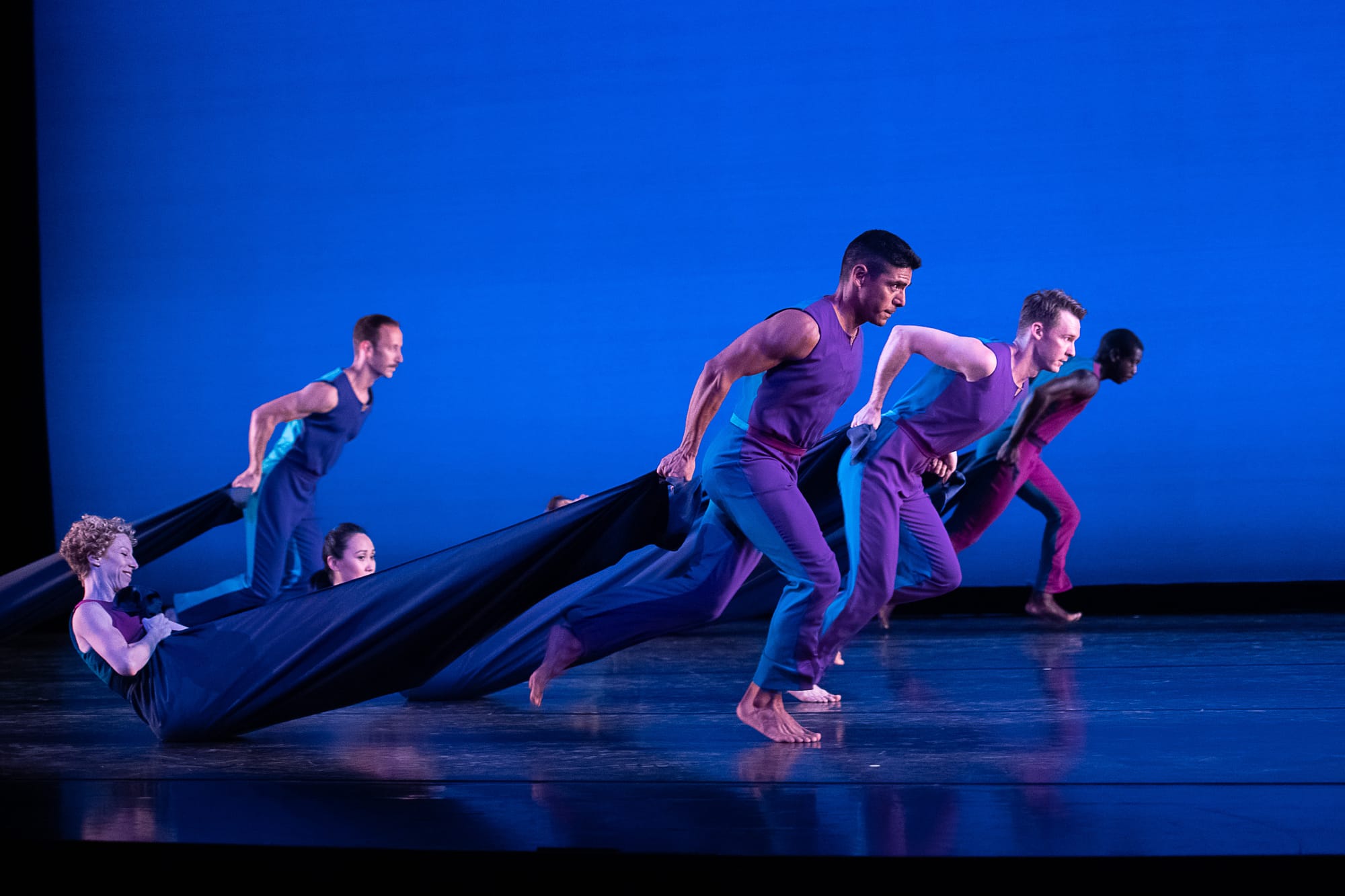
There is also a beautiful yachting scene in which a large piece of fabric is used for a sail while the ship’s occupants sway with the gentle roll of the waves. Again, dancers’ bodies make up the ship, including an elegant bowsprit. Pieces of blanket-like fabric also are used to represent toboggans and canoes, pulled along by one dancer while another acts as passenger. The movement of the piece, as a whole, moves forcefully in a horizontal band across the stage, like a film strip of the various activities.
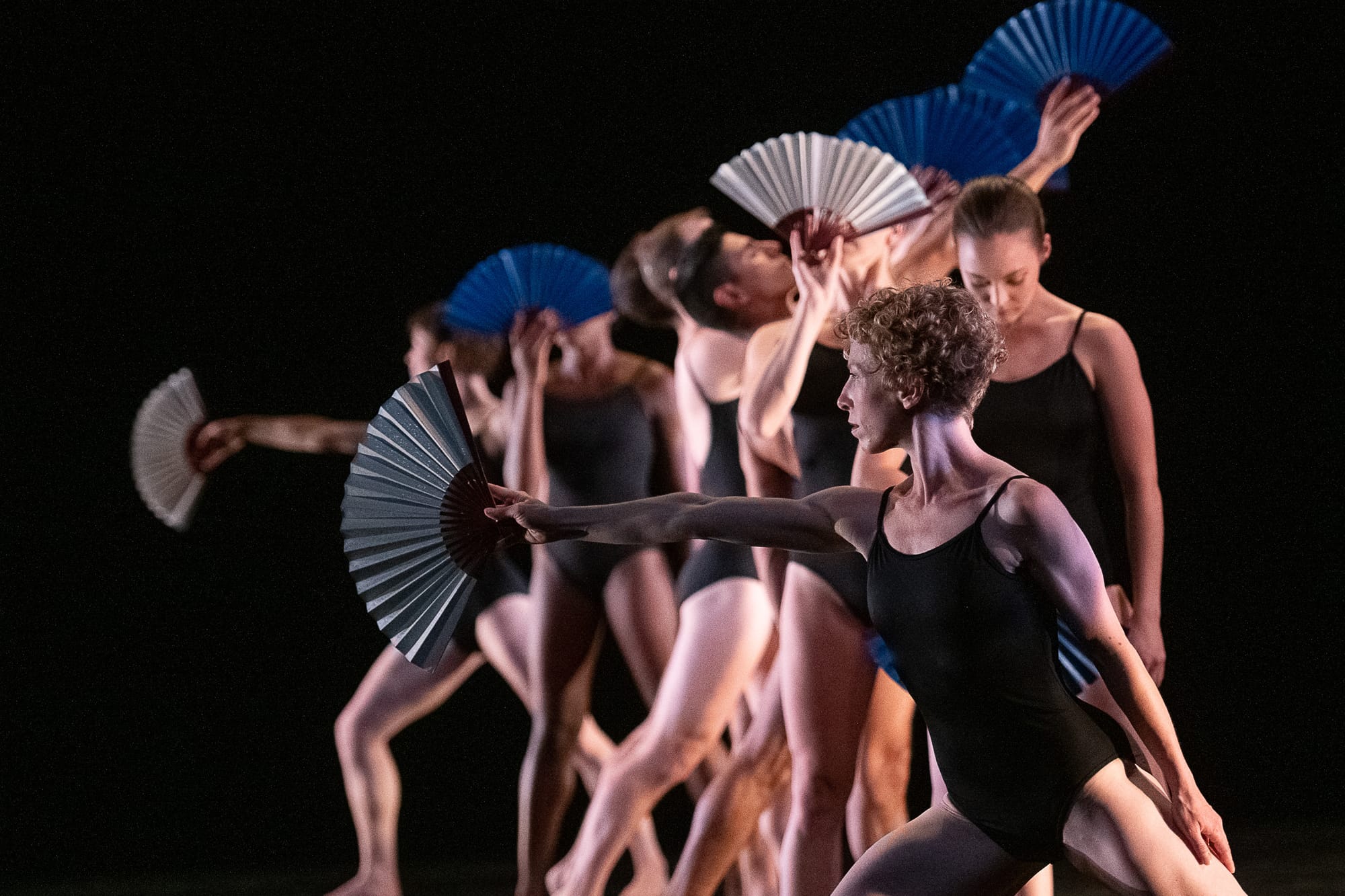
“Sport” reveals Morris’s strengths, which tend to be most apparent when he has a solid theme to trigger his imagination. This was also the case with “Prelude and Prelude” from 1984, the earliest dance on the program. It is set to Henry Cowell’s “Set of Two for Violin and Harpsichord”of 1955. The composition is played twice. The first time a soloist (in this performance Laurel Lynch) performs a dance in which she moves about the stage, while eight other dancers, holding fans, stand in a line and move in place in canon. The fans are blue on one side, white on the other, and the dancers manipulate them in a way that emphasizes and at the same time enlarges their gestures. When the music is repeated, the group performs the soloist’s dance in canon while the soloist stands in place, repeating the group’s gestures of the first dance. It is an interesting conceit, made even more interesting by the fact that Morris chooses the soloist from among the nine dancers just before the curtain rises.
The solo reminds us how much Morris liked to push against dance conventions early in his career. He stressed awkward movement that challenged dance comportment and dignity on the stage — splayed legs, half somersaults that exposed bare midriffs and underpants, flailing arms and blunt kicks. When the group takes over this dance, they are often forced to hold their fans in their teeth in order to execute the movement, much of which takes place on the floor. And what is the purpose of the fans, anyway? They add an extra design element to the dance, as well as a performative challenge, but could they also refer to Cowell’s West Coast origins and interest in Asian musical forms? The answer is ours to ponder.
“Words (excerpts),” set to a handful of Mendelssohn’s “Songs Without Words,” was premiered in 2014 at the Fall for Dance Festival in New York’s City Center. As Seth Williams, the Pillow’s scholar in residence, mentioned in a pre-performance talk, titles matter to Morris, and here the Morris and Mendelssohn titles play off each other in the context of dance. At the Pillow we were also apparently seeing excerpts from the entire “Words,” which in total lasts nearly half an hour. What we saw was considerably shorter.
As in “Sport,” “Words” incorporates large pieces of fabric as props, this time as screens to hide or expose the dancers. In this work, too, Morris uses the kind of illustrative gesture he often employs in dances to make musical themes visible. These can be suggestive or in some cases literal (hitting an invisible tennis ball, clutching the head in melancholy agony). He also uses another device, called mickey-mousing, in which there is a step for each musical beat. Morris has been criticized for both these devices; my feeling is that although they can be an effective way to make a point, if they go on too long they dull the impact of the choreography, which was sometimes the case in “Words.”
The program ended with “Grand Duo,” set to Harrison’s Grand Duo for Violin and Piano. The work has been a staple in the company’s repertory since 1993. Made up of four sections — Prelude, Stampede, a Round, and Polka — it slowly builds to a crescendo of atavistic ecstasy, a sort of rite of spring without the sacrifice. It is pretty much guaranteed to have an audience on its feet by the end, and Sunday’s performance was no exception.
A word must be said about the company’s sixteen dancers, who are superb both in terms of technique and expression. Morris emphasizes group as opposed to solo performance and the dancers are keyed to each other with almost uncanny sensitivity. They were accompanied by two equally superb and versatile musicians, Colin Fowler, piano and harpsichord, and Georgy Valtchev, violin, who make up the Mark Morris Dance Group Music Ensemble.
copyright © 2019 by Gay Morris



