Learning a Lot From Lydia
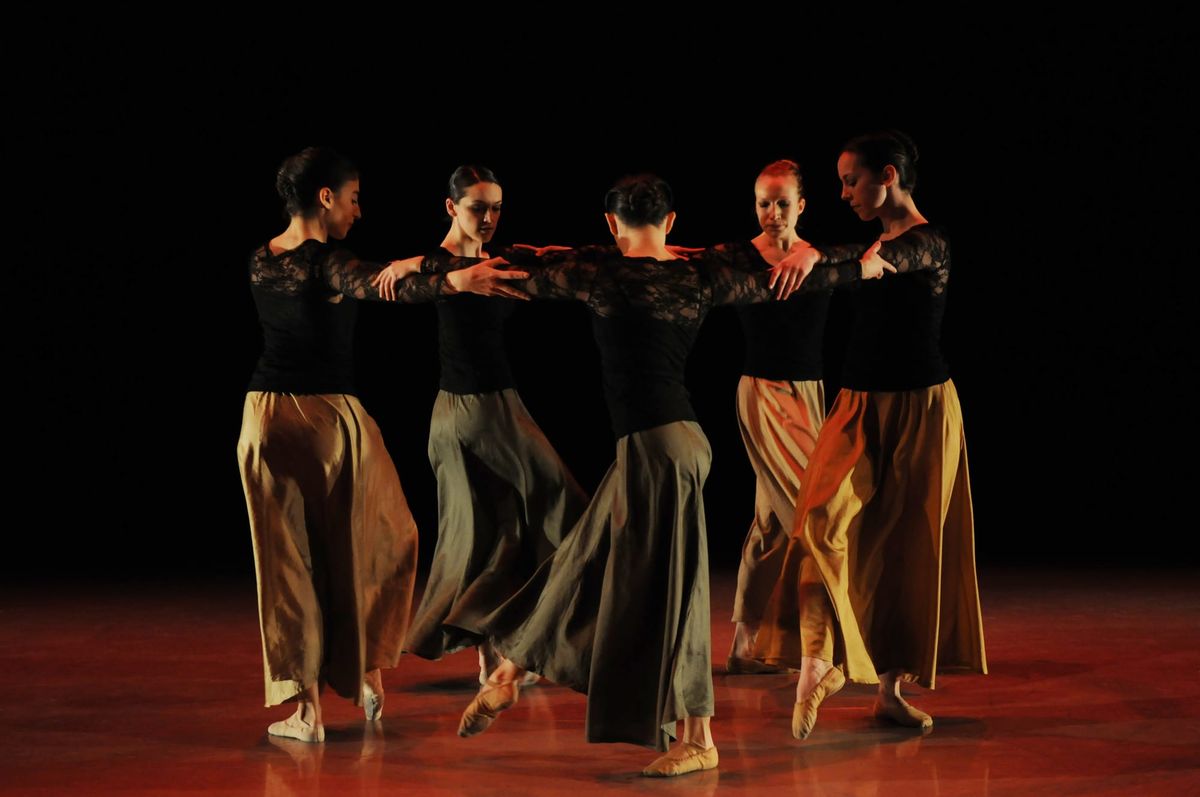
"New Untitled Work", "Falling Out"
Lydia Johnson Dance
Peridance's Salvatore Capezio Theater
New York, New York
February 26, 2012
There were no tattoos to be seen at Lydia Johnson's matinee at the intimate Capezio Theater, but there was a lot to enjoy. The small, female company (with the addition of former NYCB dancer Max van der Sterre as a guest artist) is ballet based, with a weightlessness and controlled upper bodies, which they combine with everyday, non-balletic gestures. Johnson uses these everyday gestures--walking, waving, swinging the arms--abstractly and formally, almost obliquely, to create a mood rather than a specific feeling, and the dancers all moved with an easy formality. There was no sense of a work-in-progress in the new, as yet untitled piece. Set to selections from the Argentinian composer Osvaldo Golijov, it uses the plaintive, rhythmic music to create a feeling of ritual mourning. The five dancers are rather formally costumed, in black lace tops and long fullish skirts of gold and green, and the shifting shapes evoke both the Spanish baroque and archaic Greece.
Johnson used form to create mood, and the three main dancers (in gold skirts) crossed and uncrossed their arms, raising and lowering them in unison, three bodies working together. They had a certain serenity of demeanor, creating a formal distance between the audience and the slightly mysterious sense of mourning, which helped avoid any sentimental mawkishness, as they gently cradled each other, suggesting either death or sacrifice. She is not afraid of simplicity, as the gestures repeated and wove into subtly divergent patterns, and the piece had a golden glow.
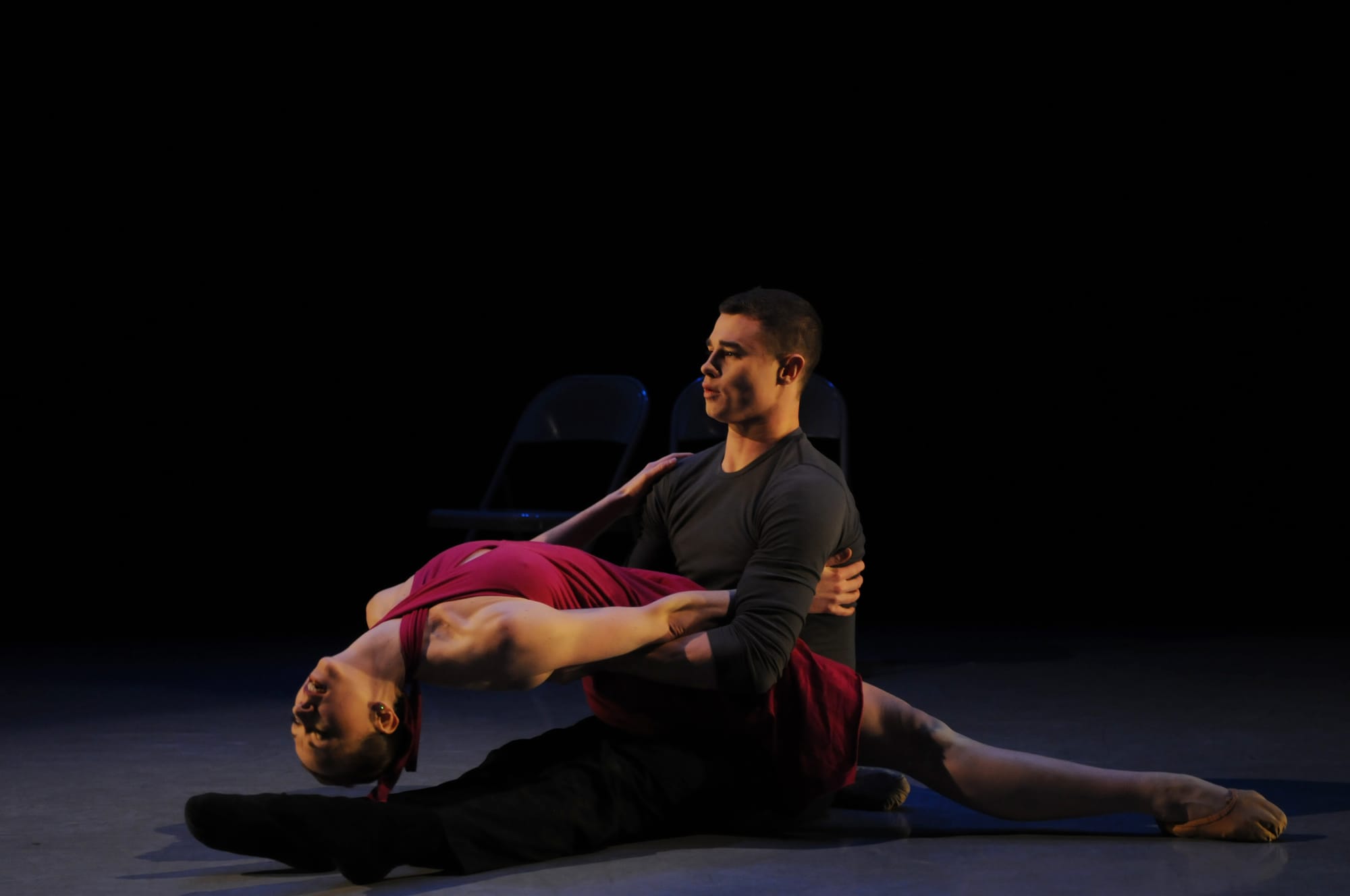
"Falling Out", her 2006 work to Philip Glass's 3rd Symphony, had a more concrete scenario, but it too, relied on structure to convey meaning. The stage was set with folding chairs in irregular groups; one for a woman alone (Jessica Sand, in a simple green dress), a couple (Kerry Shea, in hot pink, with Max van der Sterre), and four supporting dancers on the side, who commented on and emphasized the action. Sand began the piece, with an impassioned but somehow impersonal solo. She was joined by a fierce Shea, who seemed to be competing with her. The following pas de deux for Shea and van der Sterre hinted at a reason; the stylized Apache-style dance alternated with moments of tenderness as she seemed to both drive him away and try to hold him. Shea had an underlying anger and desperation, as if she needed him, knew that he wanted to leave her for Sand, and resented both his leaving and her love. These complex emotions were never explicitly spelled out, but the power of simple gestures hinted at deep emotions, and the work was both universal and personal. The dancing was clear and concise; there was something both sensual and sad as van der Sterre gently reached for Shea's hand, a caress and a farewell. The relationship between van der Sterre and Sand, the new or idealized love, was created without ever having them dance together, and the final tableau, as van der Sterre stood in the back of the stage and just looked at Sand was far more powerful than a clichéd clinch would be. But cliché is apparently not in Johnson's vocabulary.
copyright © 2012 by Mary Cargill



