Junk Dances 2020
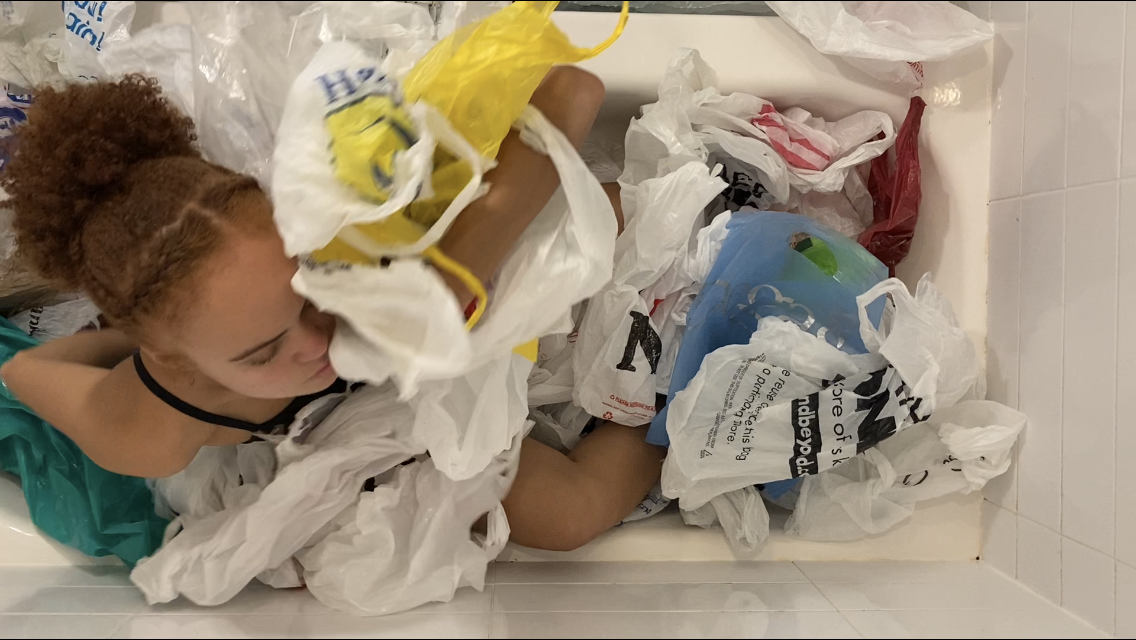
"Plastic Harvest"
Jody Sperling/Time Lapse Dance
The Center at West Park, New York
Streamed Live December 15, 2020
In the early 1960s, choreographer Murray Louis took a ride up the escalator at Macy’s, the world’s largest store.
''I looked at rooms and rooms … waves of coats and shirts,'' he told the New York Times. ''I thought, 'Who buys this?' And suddenly I had an image of excess as a theme.'' Shortly after, Louis attended a country auction where he bought a bundle of old umbrellas. He opened them up: ''They were all completely eaten away. It was wonderful.” He had one thought: “It all turns to junk.”
Out of this, in 1964 Louis and Phyllis Lamhut made a wonderful duet, set in an alleyway that steadily filled up with the detritus of a shopping spree – heaps and piles of paper bags, filled with goods destined to decay and disintegrate. They called it “Junk Dances.” Fast forward to 2020, and choreographer Jody Sperling is on the Down escalator, contemplating the end times of our national shopping spree. She calls it "Plastic Harvest."
Today a tsunami of accumulated junk is filling up the whole earth. And instead of paper bags full of ephemeral objects, we have mountains of plastic bags, filled with plastic products that will not decay. In 1964 our consumer products all turned to junk. Today they start out as junk, and turn to toxic waste.
“Plastic Harvest” is a Covid-era virtual work in progress, a video featuring four dancers in costumes fashioned from plastic bags. Anika Hunter opens in a tub, taking a bubble bath in a sea of crackling plastic. As she periodically disappeared under the surface, I thought of the warnings on some bags –- danger of suffocation. Hunter begins and ends her bath reading a book – “So You Want to Talk about Race.” It’s a crisis, for sure, but not the one that’s immediately surrounding her. Like the American consumer she appears unconcerned, even as she slips under the waves.
Maki Kitahara follows in a wide-sleeved kimono made of bags tied and hanging from her outstretched arms as if from a clothesline. This too is a disappearing act, through a trick of Sperling’s camera that shoots her in a split-screen mirror image. Turning toward the center she disappears, turning outward she splits into two. An identity crisis – is it a person, two persons, plastic, or nothing at all?
The grand finale is a whirling balletic folk dance in swirling tutus and puffed plastic sleeves, intercut between Frances Barker on a suburban street and Andrea Pugliese-Trager on a street in New York. Both wind up crossing an intersection – Pugliese-Trager through a construction zone, Barker past a Stop sign into a weed-strewn vacant lot.
Obviously, there are more questions than answers in this work-in-progress, but that’s as it should be. The camera work is sharp and the split-screens stunning. It’s all kept driving by Matthew Burtner’s repetitive score, an inscrutable loop like the engine of some infernal micro-mill.
Besides the dancers, the most effective visual was the unheeded sign that said STOP. Hey, it's not too late…
copyright 2020 by Tom Phillips



